
Bringing home a newborn is full of sleepless nights, joy, and a huge learning curve. Figuring out how you’ll feed your new baby is one of the first big decisions you’ll have to make. Breast milk has a lot of proven benefits, but formula feeding is completely safe and nutritious, feeding millions of happy, healthy babies all over the world. Whether you’re supplementing or formula-feeding entirely, a healthy mom and a healthy baby are your ultimate goals.
But when you walk down the baby food aisle, the options can be a little overwhelming: the countless brands, confusing terminology like “hydrolyzed protein,” and the scary threat of bacteria, to name a few. Formula Feeding 101 will walk you through every step of preparing formula safely, storing it, and best feeding practices so that you can feel confident with your baby feeding responsibilities.
Part 1: The Basics-Selecting the Correct formula for Child Health
Before we delve into preparation, we need to decide on the formula that’s right for your baby. While the choices are plentiful, any healthy, full-term baby is perfectly fine on a standard cow’s milk formula that is iron-fortified.
Types of Infant Formula:
1. Powdered formula- The most common and economical type; you’ll need to add water. Powdered infant formula is not sterile so its preparation instructions are extremely important.
2. Liquid concentrate- You mix this with an equal amount of water; it’s more expensive than powdered formula but cheaper than ready-to-feed.
3. Ready-to-feed (RTF)- This is a sterile formula and the safest option for premature infants or immunocompromised babies. It’s also the most expensive and bulky to store.
Specialty Formulas- Talk to your pediatrician about hydrolyzed and amino acid-based formula if your baby has reflux, colic, or a cow’s milk protein allergy.
Part 2: Safe Preparation – The “Clean Slate” Method
Safety is a non-negotiable rule when feeding your baby. Powdered infant formula is not sterile and may potentially carry Cronobacter Sakazakii or Salmonella, which can be dangerous for babies younger than two months old, premature, or immunoincompetent.
Step 1: The Gear (Sterilization)
Sterilize baby bottles, nipples and caps daily for infants two months or younger, premature, or immunoincompetent.
How to Sterilize: Boil items in water for 5 minutes, steam using a microwave steam bag or an electric sterilizer.
For healthy infants over two months old: use a hot water cycle in the dishwasher, or baby bottle wash using hot water, and a bottle brush designated for this purpose.
SEO Tip for Mother Health: Sterilizing formula can be time consuming, but it is a good way to decrease the risk of contamination; it can therefore contribute to a sense of preparedness that will positively affect mother health.
Step 2: The Water
Using the proper water is just as important as using the correct formula.
Well Water: Annual testing of water for bacteria and nitrates is recommended; you may need to boil water for 1 minute (and then cool before use).
City Tap Water: If you live in a city that uses older pipes and the risk of lead contamination exists, you can either use cold tap water, after letting it run for 30 seconds, or use filtered water.
Bottled water: Make sure to check if it is low in sodium and sulfates; distilled and purified bottled water are acceptable alternatives. Never use mineral water since its high mineral content is bad for baby’s kidneys.
Step 3: The Water Temperature- The “70C Rule”
It’s recommended by the World Health Organization (WHO) that you prepare powdered formula using 70C (158F) water; this is high enough to kill any potentially harmful bacteria but will not affect the formula’s nutrient profile.
How to Reach 70C- boil water and let it sit for no longer than 30 minutes. The water should feel hot to your touch without instantly burning your skin.
Procedure-
1. Pour 70C water into the bottle.
2. Add the powder (do not pack the scoop; level it with a clean knife or by wiping the excess off on the leveller).
3. Cap the bottle and shake vigorously until it’s combined.
4. Run the bottle under cold tap water or immerse it in an ice bath until it reaches body temperature (37C / 98.6F) and it’s ready to be served.
Note- Online communities advocate for the “hot shot” method but the CDC does not recommend it unless you’re using a formula that’s approved to be mixed with water at room temperature.
The “Standard” Method (For healthy infants over 2 months)
For healthy full-term babies over 2 months old, it’s acceptable to use cold tap water or cooled boiled water at room temperature. The 70C method is always safer, however.
Part 3: Formula Storage – Keeping it Safe from Fridge to Feeding
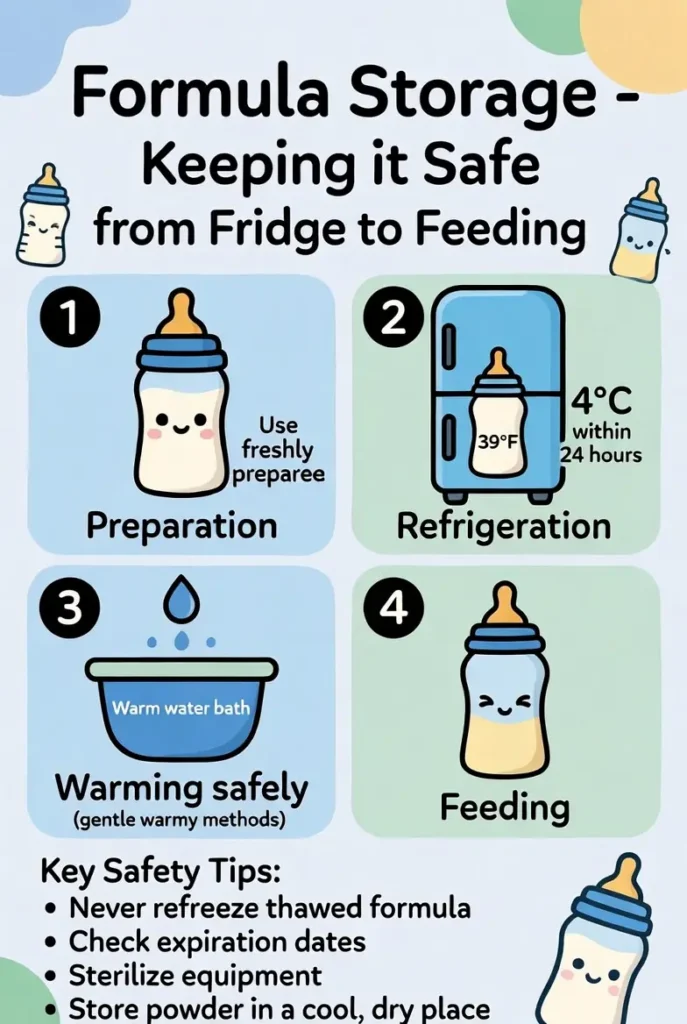
Proper storage practices are essential to prevent bacterial growth, which can quickly multiply once introduced to formula.
Unopened Formula-
Store in a cool, dry place away from heat, such as the oven or the garage.
Do not use dented, bulging or leaking cans of formula.
Opened Powdered Formula-
Seal container immediately after each use.
Use the opened can within one month. You can either use a marker to write the date on the container or attach a sticker.
Avoid storing powder in the refrigerator; the humidity will cause it to clump.
Prepared Formula in the Refrigerator-
Put any formula prepared using the 70C method into the refrigerator within one hour of making it.
Make sure your refrigerator is set at 4C (40F) or colder.
Store formula at the back of the refrigerator, not on the door, as the temperature will be less volatile.
Consume refrigerated formula within 6 6-8 hours.
Part 4: Feeding Tips – The Art of the Bottle
Once the bottle has been safely prepared to the proper temperature, how you give the bottle can have benefits for both child health and bonding.
Here are the tips you provided, rewritten in a more natural, conversational tone:
Tip 1: Heating the Bottle (if desired)
Most babies enjoy warm milk, but room temperature is fine too. Absolutely do not heat bottles in the microwave – the high heat creates ‘hot spots’ that can burn your baby’s mouth and throat. The safest way is to put the bottle in a bowl of warm water for 5-10 minutes, swirling it around so the milk heats evenly. You can check the temperature by putting a few drops on the inside of your wrist; it should feel neutral, not hot.
Tip 2: Paced Bottle Feeding
This is basically imitating breastfeeding. Paced bottle feeding helps prevent overfeeding, and can help the baby regulate their feeds:
– Hold your baby upright (never lying down).
– Touch your baby’s lips with the nipple, and wait until they open wide.
– Hold the bottle horizontal, and only tip it so that milk fills the nipple.
– Let the baby pause, rest and take breaths. If they tense their body or splay their fingers (signs that they are unhappy/stressed) then remove the bottle, and burp them.
– Bottles should take 15-20 minutes to feed. If it only takes 5 minutes, then the nipple size is too large.
Tip 3: The “One Hour Rule”
As soon as your baby’s lips touch the nipple, they are introducing bacteria from their saliva into the bottle of milk.
– For room temperature formula: use any remaining formula within an hour of starting the feed. There is no need to keep it “for later.”
– For warmed, unused bottles: If the bottle has been warmed but the baby hasn’t drunk from it you can put it back in the fridge, if unused, don use after more than 2 hours.
Tip 4: Don’t Prop the Bottle
Never leave your baby with a propped bottle. This causes more ear infections than you would believe as the milk can seep into the eustachian tubes, leads to dental decay and is a choking hazard. Feeding is the perfect time to bond with your baby, and can improve mother health (by giving you less anxiety). The practice of holding the baby, looking them in the eye, talking to them while they drink is incredibly special.
Tip 5: Feed the Baby when they are Hungry, Not to the Clock
Although routine is helpful it should never come before the baby’s cues of feeding.
– Early cues: Lip smacking, rooting, thumb/finger sucking.
– Late cues (crying): Crying means you have to pacify baby first and so he becomes stressed; it will also make him gulp air.
– Full cues: Turning head away, relaxed body and hands, drifting off to sleep.
Amounts: Generally, the average amount required is 2.5 oz/lb of body weight in 24 hrs. A 10 lb baby therefore needs approx 25 oz of milk in 24 hours. There are wide individual variations so please discuss concerns with your doctor if you think baby may be having more or less than this- baby consistently takes whole feeds then clearly wants more; baby consistently leaves >2 oz remaining.
Part 5: Taking formula out and about
Life can’t stop, especially with a new baby. When traveling, a different protocol for feeding is required, as you have less immediate access to hygiene facilities or cold storage.
The Best Travel Hack: Use Pre-measured Powder
Do not prepare formula bottles ahead of time for a journey unless you have a cool bag that can maintain 4C consistently. Instead, carry dry, pre-measured formula powder in a formula dispenser (those multi-stacking pots work well), a sterile baby bottle, one thermo flask of boiled water, and another of cool boiled water. Mix boiled water and cooled water in the sterile bottle until body temperature and then add powder. This should be heated sufficiently, safe and you should not need to worry about cooling it.
For cooled baby feeds in a cool bag: Pre-prepared bottles can be frozen and kept in the cooler bag- they should thaw on the journey, and be fed from the cooler within 4 hours if it is a cool bag (not ice pack alone) and is kept under 4C.
Part 6: Troubleshooting and Concerns
‘My baby is spitting up so much?’
Spitting up (reflux) is common with infants; their lower oesophageal sphincter is immature, and if baby is still gaining weight and happy, do not worry. Small, frequent feeds and keeping baby upright tilted to one side after feed and while sleeping post-feed should help.If this involves a projectile vomiting action or your baby does not gain weight, see a health professional.
‘My baby’s poop is green?’
Iron-fortified formulas can turn poop a very dark green colour which is perfectly healthy. Dangers signs for stools would include the white, tar-like black stool, and red/bloody stools.
Managing your own sense of guilt (Mother Health priority)
This really needs to be addressed:Some parents feel guilt about using formula and this is a myth-formula is a miracle of modern science that replicates breast milk. A fed baby is all that is required for success. Formula has given partners the ability to feed at night, which means better rest for the new mother and can help with recovering from the birth and the mental transition to parenting, and mothers health has been shown to be improved with an adequate rest period postnatally.