
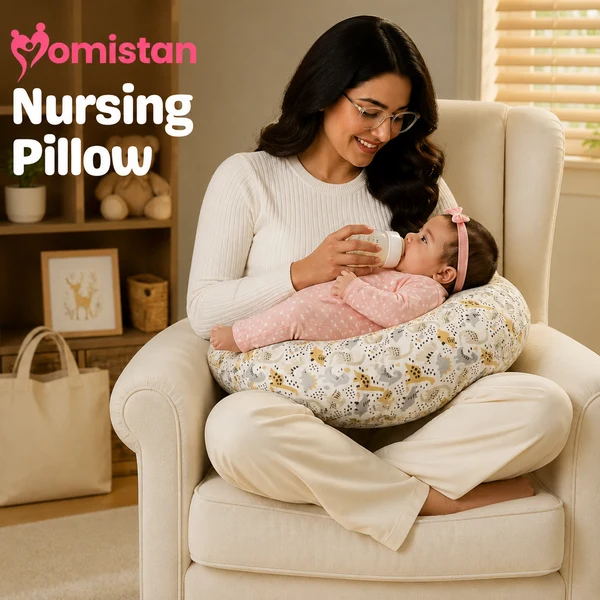
From eliminating back strain to mastering a painless latch, here is why a good feeding pillow is the ultimate nursery essential.
Before my first baby arrived, I foolishly assumed breastfeeding meant relaxing in a rocking chair with a sleeping infant peacefully perched in my arms. The reality? By day three, my lower back felt like I had spent eight hours digging ditches. My shoulders were constantly hiked up to my ears. My left wrist was throbbing from holding up a tiny, surprisingly heavy head.
Newborns eat eight to twelve times a day. If each session takes 30 to 45 minutes, you spend roughly six to eight hours every single day feeding your child. That is a full-time job.
Holding that position without proper support destroys your posture quickly. That is precisely where understanding real nursing pillow benefits changes everything. A quality nursing pillow isn’t just a plush nursery accessory or an aesthetic couch accent. It is an ergonomic survival tool designed to protect your body and set your baby up for feeding success.
Let’s look at why this simple tool is an absolute non-negotiable for nursing and bottle-feeding mothers alike.
What Exactly Is a Nursing Pillow?
A nursing pillow is a specially shaped cushion designed to support your baby at breast height during feedings. Unlike regular throw pillows, which collapse under pressure or slip away from your hips, a nursing cushion features a curved or contoured shape—often C-shaped, U-shaped, or crescent-shaped—that wraps securely around your waist.
They are crafted with dense, supportive foam or firm fiberfill. This prevents your baby from sinking, keeping them elevated right where you need them.
Why Standard Couch Pillows Fail
We have all tried stacking three bed pillows under our elbows in a pinch. It works for about two minutes. Then a pillow slides out. Your baby shifts. You lose the latch, and you end up hunching forward again.
Breastfeeding pillows stay firmly in place. They fill the awkward gap between your lap and your chest, taking the weight of your baby off your joints completely.
7 Game-Changing Nursing Pillow Benefits
If you are wondering whether adding another baby item to your registry is actually worth it, here is what a dedicated feeding pillow brings to the table.
1. Saves Your Back, Neck, and Shoulders
The single biggest mistake new mothers make is bringing their breast to the baby instead of bringing the baby to their breast. It sounds like a subtle difference, but it is huge.
When you lean over to meet your baby, you strain your spinal column, neck muscles, and upper back. Do that ten times a day, and chronic muscle spasms follow. A nursing pillow lifts your baby directly up to nipple height. You can lean back, relax your shoulders, and bring your baby close without hunching over.
2. Helps Achieve a Deeper, Painless Latch
Nipple soreness is often caused by a shallow latch. When a baby has to strain or reach upward to stay attached, they tend to pinch. Positioning is everything.
By bringing your baby up to the exact height of your chest, the pillow lets your infant align their mouth directly with your breast. Their neck remains relaxed, their chin tucks in comfortably, and they can open wide for a deep, comfortable latch. That alone can save you from days of cracked, painful skin.
3. Provides Crucial Relief After a C-Section
If you have had a Cesarean delivery, having anything press against your abdomen feels agonizing. Yet, you still need to hold your baby close for hours.
A firm nursing pillow acts as a protective shield over your incision site. It redistributes your baby’s weight across your thighs and lap rather than letting them press into your tender belly. C-shaped and wrap-around pillows are especially helpful here because they lock in above the incision line.

4. Gives Hands-Free (or Reduced-Strain) Comfort
Holding a 7 to 10-pound baby in the nook of your arm for forty minutes sounds easy until you try it. Your biceps fatigue rapidly. Your wrist starts aching—a condition so common it is literally nicknamed “mother’s wrist” (De Quervain’s tenosynovitis).
With a nursing pillow supporting the baby’s body, your arms are free to guide your latch, take a sip of water, answer a text, or simply relax. You aren’t squeezing your arms tightly to keep them from sliding down.
Pro-Tip for Mom’s Comfort:
Always rest your elbows on the sides of the nursing pillow before latching. If your shoulders are lifted toward your ears, drop them down and take a deep breath. Let the pillow do 100% of the heavy lifting!
5. Reduces Reflux and Digestive Distress in Babies
Infant acid reflux and painful gas are common issues in the early weeks. Feeding a baby lying completely flat often worsens regurgitation because stomach contents easily creep back up the esophagus.
Many modern nursing pillows are ergonomically angled. This sloped design keeps your baby’s head elevated slightly above their stomach while feeding. Gravity works in your favor, cutting down on spit-up, hiccup fits, and midnight gas pain.
6. Makes Bottle-Feeding Easier for Dads and Caregivers
Here is a secret: nursing pillows aren’t just for breastfeeding!
Partners, grandparents, and caregivers often struggle with arm fatigue during bottle-feeding sessions too. Using a feeding pillow gives them the same ergonomic support. It also positions the baby at an eye-contact angle, promoting sweet bonding moments between your baby and partner.
7. Versatility That Grows with Your Baby
A good nursing cushion isn’t a single-use tool that gets tossed after three months. Most quality designs transition through several developmental stages during your baby’s first year:
- 0+ Months: Breastfeeding and bottle-feeding support.
- 3+ Months: Propping up your baby after feeds to digest safely.
- 6+ Months: Tummy time support to build neck and shoulder strength.
- 9+ Months: A soft cushion surround for when your baby is learning to sit independently.
How to Use a Nursing Pillow in Different Feeding Positions
Not every mom feeds the same way. The beauty of a structured pillow is that it adapts to several classic nursing positions effortlessly.
The Cradle Hold
This is the classic position. Place the pillow across your lap and wrap it around your torso. Lay your baby horizontally on top of the pillow, belly-to-belly against you. Rest your baby’s head in the crook of your arm, resting your forearm directly on the cushion.
The Football (Clutch) Hold
Ideal for mothers who had a C-section or those with larger breasts. Tuck the pillow along your side, under the arm you will feed from. Slide your baby along your side under your arm, like holding a football, with their feet pointed toward your back. The pillow supports their body so you can easily control their head with your wrist and fingers.
The Cross-Cradle Hold
Similar to the cradle hold, but you support your baby’s head with the hand opposite to the breast you are offering. The pillow takes all the body weight, allowing your dominant hand to shape the breast and guide the mouth easily.
How to Choose the Right Nursing Pillow for You
Walk into any baby store, and you will quickly see that not all nursing pillows are created equal. To find the right fit, pay attention to these three crucial factors:
Firmness and Structure
Soft, squishy pillows look cozy, but they are often terrible for feeding. If the pillow sags when you put a 9-pound baby on it, your posture suffers. Look for high-density foam or firm, resilient fiberfill that keeps its shape under pressure.
Adjustability and Waist Fit
Our bodies change rapidly postpartum. Some pillows slide on casually, while others come with adjustable belts or buckles that clip around your back. If you want maximum security without constant readjustment while getting out of a chair, go for a strapped design.
Common Mistakes to Avoid When Using a Breastfeeding Pillow
Even with a great pillow, minor setup errors can cause discomfort. Watch out for these common traps:
- Placing the pillow too low: If the pillow rests flat on your thighs and your baby is still below chest level, place a small folded blanket underneath the pillow to raise it up.
- Forgetting back support: The pillow supports your front, but don’t forget your back! Put a firm lumbar cushion behind your hips to prevent slouching.
- Using it as a sleep surface: Nursing pillows are designed for awake, supervised time. Never leave your baby to sleep unsupervised on or in a nursing pillow, as it poses a suffocation risk.
Frequently Asked Questions
Final Thoughts
Feeding your newborn is one of the most rewarding bonding experiences you will ever share. But it shouldn’t leave you sore, exhausted, and aching every time your baby gets hungry.
Investing in a good nursing pillow gives your body the physical support it desperately needs during those demanding first months. By lifting the weight off your arms, keeping your spine aligned, and helping your baby latch smoothly, a feeding cushion turns marathon feeding sessions into moments of quiet, pain-free connection.
Give your back a break—your body will thank you after the very first night feed.