It starts with a small thing. A request you said no to. A snack you forgot to bring. A turn that didn’t happen fast enough. And then—right there in the middle of the supermarket, the pharmacy, the wedding hall, wherever you happen to be—your toddler is on the floor, screaming, and every single person within thirty feet has turned to look.
The tantrum itself isn’t the hardest part. The hardest part is staying calm while it’s happening, while people are watching, while your own embarrassment and frustration and exhaustion are all spiking at once.
This article is specifically about the public version of tantrums — what makes them feel so much harder than at-home meltdowns, what’s actually going on in your toddler’s brain, and a clear, step-by-step approach that actually works without requiring you to be a perfectly zen parent who never loses their cool.
You’re not a bad parent because your toddler is having a tantrum in public. You’re just a parent.
Why Public Tantrums Feel So Much Harder
At home, a tantrum is exhausting. In public, it’s exhausting and humiliating — or at least that’s how it feels in the moment. That difference is worth unpacking, because it’s not just in your head.
When a toddler melts down at home, you can respond the way you actually want to. You can get on the floor with them, wait it out, ignore the noise, or do whatever your instincts or your approach tells you to do. Nobody’s watching. Nobody’s judging. You have space.
In public, you suddenly have an audience. And that audience changes everything — not because they’re actually judging you as severely as you imagine, but because the feeling of being watched makes you want to fix the tantrum fast. That urgency is what leads to the responses that make things worse: bribing, caving, shouting, physically hauling a screaming child out while doing the awkward apologetic nod to strangers.
The Audience Is Mostly Irrelevant
Here’s a reframe worth carrying with you: most people watching a public tantrum are either parents who have been exactly where you are, or they’re people who have simply forgotten what toddlers are actually like. The ones who look disapproving are rarely the ones whose opinion should matter to you.
Nobody in that supermarket is going to remember this in an hour. You might. Your toddler definitely won’t. The stakes you feel in the moment are almost entirely manufactured by social pressure, not by any real consequence.
What’s Actually Happening in Your Toddler’s Brain
This part makes the whole thing make more sense — and makes it a lot easier to respond without taking it personally.
The prefrontal cortex — the part of the brain responsible for impulse control, emotional regulation, and rational decision-making — isn’t fully developed until the mid-twenties. In a two-year-old, it’s barely online. When a toddler hits a trigger and their emotional brain fires, there is literally no internal brake system adequate to the job of stopping the reaction.
They’re not being manipulative. They’re not doing it to embarrass you. They’re having a full neurological storm that they have no capacity to control or end on their own — and they need a regulated adult to help them through it. That’s the job. Not stopping the tantrum. Not fixing the feeling. Stay regulated enough yourself to help them come back down.
✓ The Key Insight
A toddler in a full meltdown cannot hear reason, respond to negotiation, or understand consequences in the moment. The emotional brain has completely overridden the thinking brain. Trying to reason, explain, or bargain during a tantrum is like trying to have a conversation with someone mid-sneeze. You wait until it’s over, then you talk.
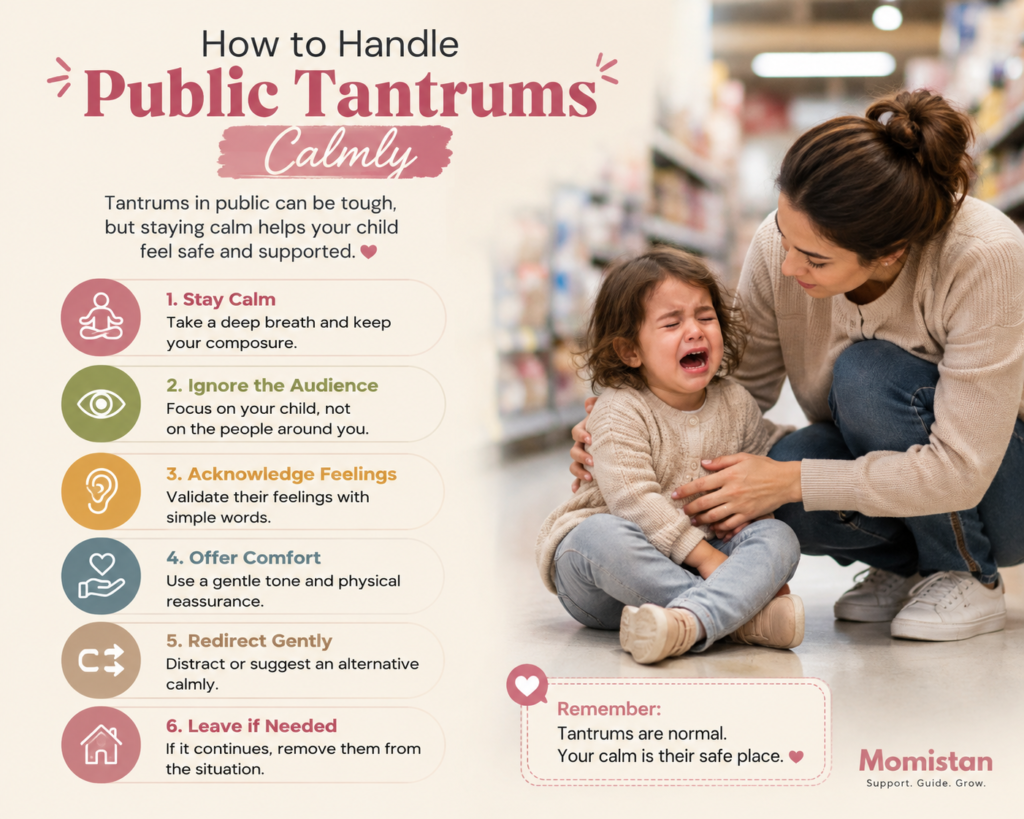
Step-by-Step: How to Handle It in the Moment
These steps work because they’re designed around what’s actually happening neurologically — not around what looks good to bystanders.
1 Regulate Yourself First
Before you do anything else, take one slow breath. Not because it’s a magic fix, but because your nervous system state is directly contagious to your child. A tense, raised-voice parent escalates a meltdown. A physically calm parent — even one who is internally stressed — gives the child’s nervous system something to co-regulate with. This is the hardest step and the most important one.
2 Get Down to Their Level
Crouch or kneel so you’re at eye level rather than standing over them. This one physical change does several things at once—it signals that you’re present and not retreating, it reduces the power dynamic that can intensify defiance, and it makes the interaction more private even in a public space. You’re no longer two people with an audience; you’re two people having a moment.
3 Name the Feeling Without Judgement.
A simple, calm statement of what you observe: “You’re really upset right now.” Or “You really wanted that, and you’re angry that you can’t have it.” Don’t ask questions, don’t negotiate, don’t explain why they can’t have the thing. Just name the emotion. This sounds too simple to work — it isn’t. Being named and understood activates the part of the brain that can begin to settle.
4 Hold the Limit Firmly and Quietly
The reason for the tantrum — whatever you said no to — stays no. Not because rules matter more than feelings, but because changing the answer mid-tantrum teaches the child that meltdowns produce results. You can absolutely say, “I hear you, and the answer is still no.” Once. Calmly. Then stop repeating it. You don’t have to justify the limit twenty more times.
5 Move If You Can
If the situation allows, moving to a quieter or less public space — outside, in a corner, or in the car — removes the audience pressure from both of you. This isn’t retreat; it’s sensible. Less stimulation helps a dysregulated brain settle faster. And you’re allowed to want to handle this without thirty people watching.
6 Wait It Out
A tantrum has a natural arc. It peaks, and then it winds down. Your job during the peak is to stay present and calm — not to end it artificially with bribes or punishments. Sit nearby, stay quiet, avoid eye contact if that helps reduce escalation, and wait. The duration shortens significantly when a parent stays calm rather than matching the child’s energy or trying to force an early resolution.
7 Reconnect After It Passes
Once the storm is over and the child is calm again, a brief reconnection moment matters – a hug, a quiet “you okay? okay? ” or just a moment of warmth before moving on. Not a long debrief, not a lecture about the tantrum. Just a signal that the relationship is intact. This is the step that prevents tantrums from leaving residue on the day.
What to Avoid Doing
These aren’t judgements — they’re patterns that almost every parent falls into, especially in public, and they all make the situation last longer.
✖ Giving In to Stop the Noise
It works immediately, and it teaches the child that a loud enough meltdown produces results. Once that pattern is established, the tantrums get both louder and more frequent. If the answer was no before the tantrum, it needs to stay no—even in public, even with an audience, even when you’re mortified.
✖ Raising Your Voice to Match Theirs
It feels like it should create authority. In practice, it escalates the child’s stress response — already maxed out — further. A quieter parent voice is genuinely more effective than a louder one during a meltdown, even though every instinct is telling you to raise it.
✖ Reasoning and Explaining at Length During the Meltdown
The rational brain is offline. Long explanations about why they can’t have the thing, delivered while they’re screaming, genuinely do not register. Save the conversation for afterwards, when both of you are calm, and the thinking brain is back online.
✖ Shaming or Threatening in Front of Others
“Everyone is looking at you; this is embarrassing.” “Stop or I’m leaving you here.” These are desperation moves, and they add shame to an already overwhelmed nervous system. Shame doesn’t teach self-regulation — it just adds a layer of bad feeling on top of the original one.
✖ Ignoring the Child Completely
There’s a difference between not engaging with the tantrum behaviour and completely abandoning the child emotionally. A toddler who is ignored entirely during a meltdown often escalates — the feeling of disconnection adds to the distress. Staying physically present and emotionally available, even silently, is different from giving the tantrum attention.
Prevention: What You Can Do Before You Leave the House
Not every public tantrum is preventable. But a significant number of them are triggered by the same predictable factors — and addressing those in advance genuinely reduces frequency.
| Common Trigger | What It Looks Like | What Helps |
| Hunger | Fine at home, melts down twenty minutes into a trip | Feed before you go; bring snacks for longer outings |
| Tiredness | Everything becomes a catastrophe after midday | Schedule errands during peak-alert hours, not nap windows |
| Overstimulation | Holds it together for an hour, then suddenly collapses | Build in breaks; keep outings shorter than the child’s threshold |
| Unmet expectations | Assumed they’d get something they didn’t | Preview the outing: “We’re going to the shops; we’re not buying toys today.” |
| Transitions | Tantrum when it’s time to leave somewhere fun | Give 5-minute warnings; don’t spring departures without notice |
| Loss of control | Protests everything they can’t choose | Offer small choices wherever possible during the outing |
A Real Example Worth Sharing
A mum I know described taking her 2.5-year-old to a family gathering — long drive, no nap, later than usual, and over-excited on arrival. Predictably, an hour in, her daughter hit a wall over something small. A cup of juice handed to a cousin first. That was it. Full meltdown, on the floor, in front of thirty relatives.
Her instinct was to pick her up and disappear. Instead, she crouched next to her, put a hand lightly on her back, said quietly — “I know, you’re so tired, and that felt unfair” — and just stayed there. Didn’t try to end it. Didn’t explain or negotiate. Waited.
Her daughter was done in about four minutes. Not because of anything dramatic, but because nobody escalated it. They had a brief hug, the daughter asked for water, and they moved on.
She said afterward that the hardest part was ignoring the people watching. The second hardest part was resisting the urge to fix it faster than it was going to fix itself. Once she stopped fighting those two impulses, the rest was just waiting.
Conclusion
Public tantrums are one of the most universally shared experiences of early parenting—even if nobody talks about theirs afterward. Every parent has stood in a shop or a restaurant or a car park wondering how this is their life. It’s not a reflection of your parenting. It’s a reflection of your child’s developmental stage, which is temporary.
What you actually have control over is your own response. Not the tantrum itself — that’s happening regardless. But whether you stay calm enough to help your child through it, whether you hold the limit without cruelty, and whether you reconnect warmly on the other side.
That’s the whole job. Stay regulated. Name the feeling. Hold the line. Wait.
You’ve survived every public tantrum so far. You’ll survive this one too.
FAQs
Disclaimer: This article is for informational and educational purposes only and is not intended as medical, psychological, or nutritional advice, diagnosis, or treatment. Every child, body, and pregnancy is different — please consult your pediatrician, doctor, or a qualified healthcare provider for advice specific to your situation.