Quick Answer
- Gentle parenting in a Pakistani joint family means guiding your child with empathy and firm boundaries without shouting or hitting while respecting elders through calm communication, not confrontation.
- The biggest wins come from three habits: explaining your “why” to grandparents privately, staying consistent on non-negotiables (safety, no hitting, no shaming), and letting minor preferences (an extra biscuit from Nani) go.
Introduction: The Scene Every Pakistani Parent Knows
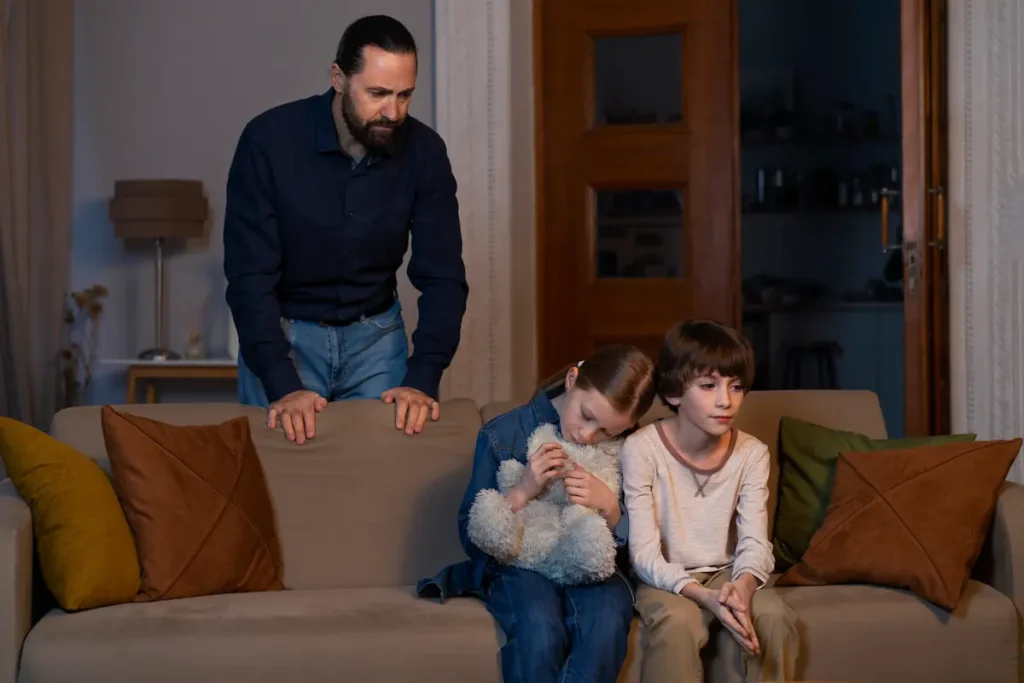
It’s 8 p.m. in a Lahore drawing room. Your three-year-old is mid-tantrum on the floor because dinner is daal instead of nuggets, and the room has gone quiet the way it does when everyone is watching to see what you’ll do. Your mother-in-law reaches for her chappal-in-spirit line: “Hamare zamane mein aik thappar se sab theek ho jata tha” (In our time, one slap fixed everything). You want to kneel, validate your child’s frustration, and offer a calm choice — the way every parenting reel on your phone has taught you. But you also love this house, this family, and the aunty sitting across from you who raised five children of her own. This is gentle parenting in a joint family, and it plays out every evening in homes from Karachi’s Gulshan-e-Iqbal to a courtyard in rural Multan.
Whether you live in a high-rise in Islamabad or a shared family compound in interior Sindh, the tension is the same: you are trying to practice gentle parenting — an approach rooted in empathy, connection, and calm boundaries — inside a household built on hierarchy, respect for elders, and “what worked for us.” This guide walks through the real challenges of gentle parenting in a joint family, what credible research actually says about discipline, and practical, respectful scripts you can use starting tonight.
What Is Gentle Parenting? (Quick Definition)
Gentle parenting is an approach to raising children that focuses on empathy, respect, and understanding, while still holding firm, age-appropriate boundaries. It is sometimes confused with permissive parenting, but the two are not the same.
Gentle parenting is NOT: letting a child do whatever they want, avoiding rules, or never saying “no.”
Gentle parenting IS setting the same boundary a strict parent might set (bedtime, no hitting, no junk food every day) — but doing it by naming the child’s feelings, staying calm, and avoiding fear, shame, or physical punishment as a tool of control.
In short: traditional discipline asks, “How do I stop this behaviour right now?” Gentle parenting asks, “What is my child feeling, and how do I guide them through it?” Both approaches want a well-behaved, respectful child — they simply disagree on the method.
Timeline: How Parenting Has Evolved in Pakistani Homes
Understanding gentle parenting is easier when you see it as part of a generational shift rather than a rejection of your parents’ love. Here is a simple, text-based timeline of how discipline attitudes have moved across generations in Pakistan:
- 1970s–1980s (Our Grandparents’ Era): Large families, strict hierarchy, and corporal punishment (the famous chappal or danda) widely accepted as normal discipline; child obedience valued above emotional expression.
- 1990s–2000s (Our Parents’ Era): Urbanisation begins; nuclear-family aspirations grow, but joint living remains the norm for most of Pakistan; scolding and comparison (“dekho cousin kitna acha hai”) common, but hitting starts to be questioned by younger, more educated parents.
- 2010s (Digital Awareness Begins): Smartphones and parenting pages introduce Pakistani mothers to attachment theory, AAP guidelines, and international parenting research; “gentle parenting” enters local vocabulary.
- 2020s–Present (2026): Gentle parenting becomes a mainstream search term among Pakistani parents in Lahore, Karachi, Islamabad, and increasingly Tier-2 cities; the real-world challenge shifts from “what is gentle parenting” to “how do I practise it inside a joint family system.”
Why Gentle Parenting Matters: What the Research Actually Says
Gentle parenting isn’t just a trend — it’s grounded in decades of child development research. Two bodies of evidence are worth knowing before your next conversation with a sceptical elder.
Attachment Theory: The Foundation
British psychiatrist John Bowlby’s and developmental psychologist Mary Ainsworth’s attachment theory research found that children who experience a consistent, emotionally responsive carer develop what is called “secure attachment.” Securely attached children tend to explore the world more confidently, manage stress better, and form healthier relationships later in life — because they trust that a carer will respond to their distress rather than punish or ignore it.
What the Data Shows
- The American Academy of Paediatrics (AAP) updated its official policy in 2018 to state that corporal punishment and verbal shaming are “minimally effective in the short term and not effective in the long term” and are linked to increased aggression and behavioural problems in children.
- In a 2016 US survey cited by the AAP, only 6% of paediatricians held positive attitudes toward spanking, and 78% disagreed that spanking is “the only way to get a child to behave”.
- According to Pakistan’s 2023 Digital Census, the average household size nationally is 6.3 people, and Pakistan Demographic Survey data shows more than 60% of households have three or more related adults living together — meaning most Pakistani children are raised with multiple carers, not just one parenting style.
This is precisely why the joint family conversation matters so much in Pakistan: if research shows children thrive on consistency and emotional safety, then a household with several adults using different discipline styles isn’t automatically “wrong” — but it does need a coordinated approach so the child isn’t caught between two opposite responses to the same behaviour.
The Real Challenge: Gentle Parenting in a Pakistani Joint Family
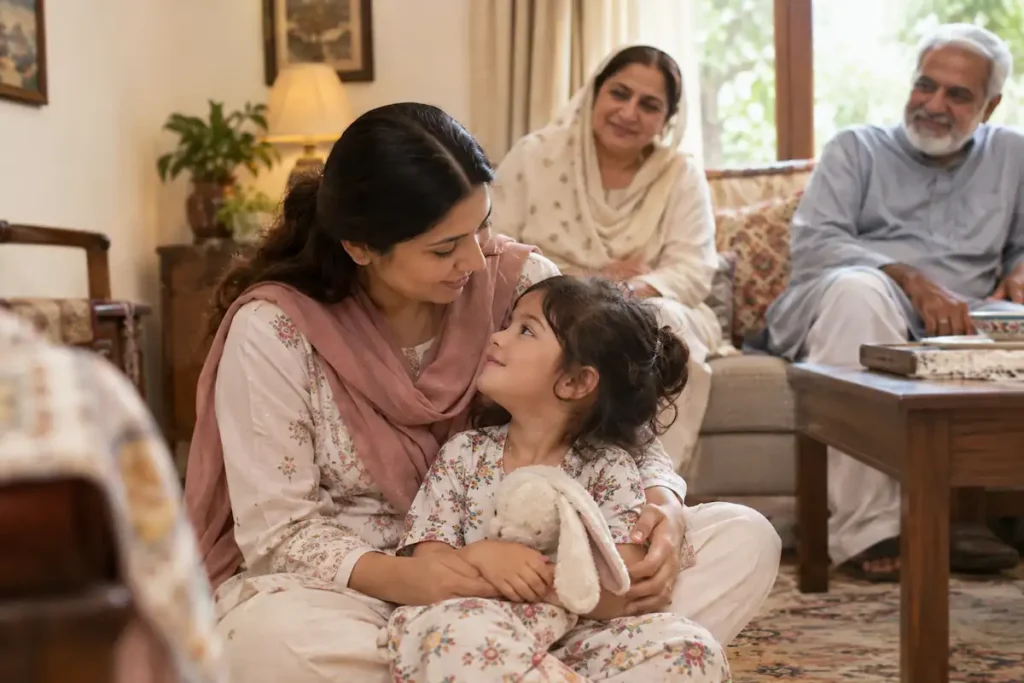
In a joint family, you are rarely parenting alone. Dadi may believe a crying child should be distracted with a toffee. Chacha may think a firm “chup!” is simply respect. Khala might roll her eyes at “yeh angrezi tareeqay” (these Western methods). None of this usually comes from malice—it comes from love and from the honest belief that the old ways worked because “hum bhi to theek nikle” (we turned out fine too).
The real friction isn’t about who loves the child more. It’s about two different theories of how children learn: fear-based compliance versus connection-based cooperation. Understanding that difference — and choosing your battles — is what makes gentle parenting workable inside a joint family, instead of another source of household tension.
Common Mistake to Avoid
- Correcting a grandparent’s discipline method in front of the child. This confuses the child about who is in charge, embarrasses the elder, and often triggers a bigger family conflict than the original tantrum ever did.
How to Handle Parenting Differences With Grandparents
This is the single most-searched concern among Pakistani parents trying to practise gentle parenting at home. Here is a practical, step-by-step approach.
1. Separate the Non-Negotiables From the Negotiables
Not every disagreement deserves a boundary conversation. Decide in advance, with your spouse, which issues are truly non-negotiable (physical discipline, verbal shaming, safety, screen-time limits at bedtime) versus which ones you can let go (an extra sweet from Nana, a later bedtime on Eid night, a slightly different bedtime story ritual with Dadi).
2. Talk Privately, Not in the Moment
Never contradict an elder in front of your child — it creates a power struggle and teaches the child to play adults against each other. Instead, gently redirect in the moment (“Chalo hum apna room mein chalte hain, thori der cool down karte hain”), then discuss the issue privately later, when everyone is calm.
3. Frame It as “What’s Working for Him”, Not “You’re Wrong”
Elders respond far better to information than confrontation. Instead of “Aap ka tareeqa purana hai” (your method is outdated), try: “Ammi, jab main chillati hoon to woh aur zyada dar jata hai. Main yeh naya tareeqa try kar rahi hoon, aap ka support chahiye.” (Mom, when I yell, he gets more scared. I’m trying this new approach, and I’d really appreciate your support. This turns the elder into a teammate rather than an opponent.
4. Be Your Child’s Translator
When a grandparent reacts harshly, you can’t always change it in the moment — but you can help your child process it afterward. Privately, say something like, “Dada zor se bole kyunke woh dar gaye thay ke aap gir jayenge, lekin main jaanti hoon aapko bura laga.” (Dada spoke loudly because he was scared you’d fall, but I know it upset you.) This validates the child’s feelings without villainising the grandparent.
Traditional vs. Gentle Responses: A Quick Comparison
Sometimes the hardest part isn’t the philosophy it’s finding the right words in the heat of the moment. Here are common Pakistani household situations, translated into both styles:
| Situation | Traditional Response | Gentle Response |
|---|---|---|
| Toddler tantrum in front of guests | “Chup ho jao, sab dekh rahe hain!” (Be quiet, everyone is watching) | “Main samajh sakti hoon aap pareshan hain. Chalein thori der baad baat karte hain.” (I understand you’re upset. Let’s talk in a bit) |
| Child refuses to eat | “Zabardasti khilao, kamzor ho jayega.” (Force-feed him, or he’ll become weak) | “Abhi pait bhara lag raha hai. Thori der mein dobara koshish karte hain.” (His tummy seems full. We’ll try again shortly) |
| Child breaks something | “Hath mat lagao, tum sab tod dete ho!” (Don’t touch anything, you break everything) | “Koi baat nahi, galti ho gayi. Chalein milkar saaf kar lein.” (It’s okay, it was an accident. Let’s clean it together) |
| Bedtime resistance | “So jao abhi, subah school hai!” (Sleep now, there’s school tomorrow) | “Khelna chorna mushkil hai na? Ek kahani sun kar sotay hain.” (It’s hard to stop playing, isn’t it? Let’s read one story and sleep) |
| Sibling/cousin conflict over toys | “Bara ho kar bhi larhte ho, sharam nahi aati?” (Fighting even at this age, aren’t you ashamed?) | “Dono ka mann samajhti hoon. Baari baari khelte hain, main timer laga deti hoon.” (I understand both of you. Let’s take turns — I’ll set a timer) |
Gentle Parenting Tips: What to Do and What to Avoid
✅ Do This
- Get down to your child’s eye level before speaking, especially during a meltdown.
- Name the emotion out loud (“Aap gussay mein hain”) before offering a solution.
- Offer limited choices (“Daal pehle khayen ya roti?”) so the child feels some control.
- Involve grandparents in positive ways — bedtime stories, park visits, praise — so boundaries don’t feel like exclusion.
- Repair after you lose your temper: a simple “Sorry, main chilla di, mujhe aisa nahi karna chahiye tha” models accountability.
⚠ Avoid This
- Arguing with elders about parenting in front of relatives or guests — it embarrasses everyone and rarely changes minds.
- Using threats involving other family members (“Abbu ko bata dungi”) as your main discipline tool.
- Comparing your child to cousins or siblings out loud — it damages self-esteem and fuels sibling rivalry.
- Expecting to “win” every disagreement. Pick the boundaries that protect safety and dignity; let smaller preferences go.
Pros and Cons of Raising Kids in a Joint Family System
Joint family life is not simply an obstacle to gentle parenting — for most Pakistani households, it’s also a genuine support system. A balanced view helps you use the good parts instead of only fighting the difficult ones.
| What Joint Family Living Offers | What Often Creates Friction |
|---|---|
| Extra hands during the newborn phase and school-run chaos | Multiple, sometimes conflicting, opinions on discipline |
| Built-in companionship and a sense of security for children | Limited privacy for calm, uninterrupted parent-child moments |
| Shared household and financial load, especially for working mothers | Pressure to discipline “the old way” in front of relatives |
| Cultural and religious values passed down naturally | Mixed messages when rules differ between cousins |
For Working Parents: Gentle Parenting While Juggling a Career
For working mothers and fathers in Pakistan, joint family living often provides essential childcare support — but it can also blur boundaries around discipline, especially when a nanny, Dadi, or Khala is the primary daytime carer. Here’s how working parents can stay consistent without being physically present all day.
- Create one shared “house rulebook” in simple language (even a WhatsApp voice note works) covering the 3–4 non-negotiables — no hitting, no phone during meals, consistent nap/bedtime — so every carer, including domestic staff, follows the same script.
- Use your commute or lunch break for a two-minute voice or video check-in with your child, not just a status update from the carer. Connection matters more than duration.
- Protect the first 15 minutes after you walk in the door. Resist the urge to immediately correct the day’s discipline “mistakes” — greet, hug, and reconnect first; address parenting concerns with the family later, privately.
- If your workplace allows hybrid or flexible hours, use them strategically around high-conflict times of day (usually bedtime and homework), since consistency at those two moments has an outsized effect on a child’s sense of security.
- Talk to your employer’s HR or manager about realistic school-run or sick-day flexibility — in many Pakistani offices this is more available than parents assume but rarely offered unless asked.
✅ Working Parent Tip
- If guilt about “not being there enough” is driving permissiveness on weekends, remember: research on attachment consistently shows children need quality, responsive connection — not maximum hours — to feel secure.
Mom Burnout in a Full House: You Need Care Too
Living in a joint family means you are rarely alone — yet many Pakistani mothers describe feeling deeply lonely in their parenting decisions. The “invisible load” of school fees, a mother-in-law’s medicine schedule, a toddler’s vaccination date, and tomorrow’s lunch menu adds up quietly, and it is a leading contributor to parental burnout.
You cannot pour empathy into a tantrum if your own emotional tank is empty. Small, realistic resets matter more than an unrealistic two-hour break you’ll never get:
- A 10-minute walk on the roof or in the lane outside, stated plainly to the family: “Main thori der ke liye jaa rahi hoon, phir acha feel karungi.”
- Trading 20-minute childcare slots with your spouse or a sibling-in-law, rather than waiting for a full free evening.
- Naming your limit out loud before you reach breaking point: “Mujhe abhi 5 minute chahiye, phir main baat karti hoon.”
If persistent exhaustion, irritability, or sadness is affecting your daily functioning, this is worth raising with a doctor — in Pakistan, maternal mental health is increasingly discussed openly at teaching hospitals and through platforms offering telehealth counselling, and asking for help is a sign of strength, not failure.
Healthcare Access: Getting Support in the Pakistani Context
One real barrier Pakistani parents face is limited access to child psychologists or parenting counsellors, especially outside major cities. A few practical starting points:
- Start with your child’s pediatrician at your nearest teaching hospital (many now include developmental and behavioural guidance as part of routine visits, not just vaccinations).
- Public-sector hospitals in major cities increasingly have child psychology or psychiatry departments; ask your general physician for a referral if concerns persist beyond typical tantrums.
- Where in-person specialists aren’t available, several Pakistani telehealth platforms now offer online consultations with child psychologists, which can be more accessible for smaller cities and rural areas.
- School counsellors, where available, are an underused resource for behavioural concerns that show up more at school than at home.
⚠ When to Seek Professional Help
- If your child shows persistent aggression, extreme withdrawal, or developmental regression, or if family conflict over discipline is causing ongoing distress for you or your child, consult a paediatrician or child psychologist rather than relying on family advice alone.
Frequently Asked Questions
A Gentle Reminder Before You Go
Gentle parenting inside a Pakistani joint family isn’t about winning an argument with your elders or raising a “perfect” child who never cries in public. It’s about consistency, repair after mistakes, and choosing which battles actually matter. You will lose your temper sometimes — that’s not failure, it’s parenthood. What matters is what you do next: apologise, reconnect, and keep going.
If this guide helped you, save it for the next difficult evening, and share it with another parent in your family who might be having the same quiet struggle.
Resources and References
- American Academy of Paediatrics — “Effective Discipline to Raise Healthy Children” (2018 Policy Statement):
- HealthyChildren.org (AAP) — “AAP Updates Policy on Corporal Punishment”: https://www.healthychildren.org/English/news/Pages/AAP-Updates-Corporal-Punishment-Policy.aspx
- Pakistan Bureau of Statistics — Pakistan Demographic Survey (PDS-2020), average household size: https://www.pbs.gov.pk/docs/pakistan-demographic-survey-pds-2020/
- Pakistan Bureau of Statistics — 2023 Digital Census results and social statistics tables: https://www.pbs.gov.pk/population-tables
- Demographic and Health Surveys Program — household composition and joint family prevalence data for Pakistan: https://dhsprogram.com/pubs/pdf/FR29/03Chapter3.pdf
Note: This article references publicly available research and government statistics current as of 2026. No downloadable attachments accompany this article; all cited data can be accessed directly via the links above.
Disclaimer: This article is for informational and educational purposes only and is not intended as medical, psychological, or nutritional advice, diagnosis, or treatment. Every child, body, and pregnancy is different — please consult your pediatrician, doctor, or a qualified healthcare provider for advice specific to your situation.
Disclaimer: This article is for informational and educational purposes only and is not intended as medical, psychological, or nutritional advice, diagnosis, or treatment. Every child, body, and pregnancy is different — please consult your pediatrician, doctor, or a qualified healthcare provider for advice specific to your situation.