A quick note before we start: this article shares general information to help you feel informed — it isn’t a diagnosis or a substitute for your doctor’s advice. If something here concerns you, please reach out to a healthcare professional.
If you are a mother in Pakistan, you have probably heard this sentence, or some variation of it, from a well-meaning aunt, grandmother, or neighbour. We live in a society that loves to soothe worried mothers with comforting anecdotes.
You want to believe them. You really do. But deep down, your maternal instinct is whispering something else.
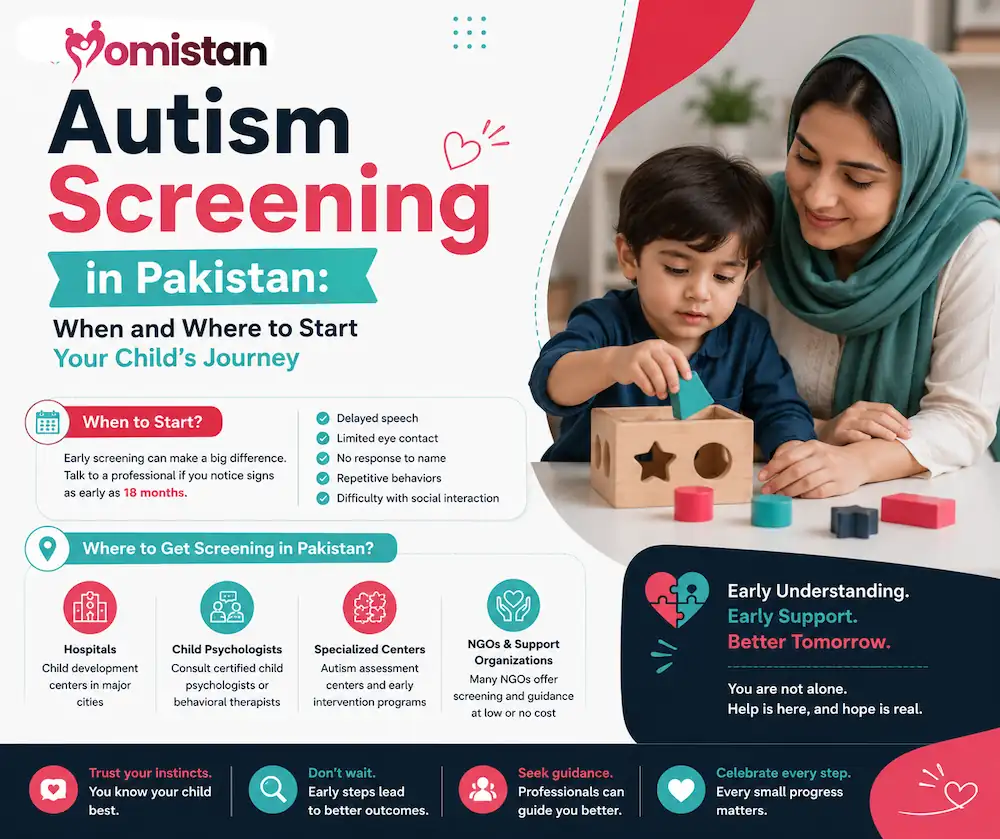
You notice that your eighteen-month-old doesn’t look up when you call their name. They do not point at the crows on the balcony. They seem to prefer spinning the wheels of their toy cars over and over rather than playing with you.
Is it just a developmental delay, or is it something more?
Seeking an autism screening in Pakistan can feel incredibly lonely. The path is often blocked by intense social stigma, lack of clear information, and a confusing healthcare system. But finding answers early can completely transform your child’s future.
Let’s cut through the noise, bypass the neighbourhood gossip, and look at the actual medical realities of tracking milestones, spotting the early signs, and finding professional help in Pakistan.
The Golden Window of Early Intervention
The human brain develops more rapidly during the first three years of life than at any other period. Early autism screening doesn’t label a child; it helps you understand how their unique mind processes the world so you can offer the right support while their brain is highly adaptable.
Understanding Autism in the Pakistani Context
Autism Spectrum Disorder (ASD) is a neurodevelopmental difference that affects how a person communicates, interacts with others, and experiences sensory inputs. It is not a disease, and it certainly is not the result of “bad parenting” or “too much screen time”.
Yet, in Pakistan, mothers are often blamed first. If a child displays signs of autism, family members might blame the mother’s career, her diet, or her use of mobile devices to feed the child. This blame game only delays critical intervention.
The Myth of “He is a Boy, He Will Speak Late”
This is perhaps the most dangerous myth circulating in our households. While it is true that developmental ranges vary, a significant delay in communication is never something to ignore.
Waiting until a child is four or five years old to seek help means missing out on years of natural brain plasticity. If your child is not responding to non-verbal cues, like pointing or waving, the delay is not just about speech. It is about connection.
We need to shift our focus from “speaking late” to “communicating late”. Does your child try to show you things? Do they make eye contact when they want something? These are the real clues.
Denial can feel like protection, but it is actually a barrier. Real love means looking at our children exactly as they are, without fear.
Screening vs. Diagnostic Assessment: What’s the Difference?
Many parents assume that a screening is a formal, scary diagnosis. It isn’t.
A screening is a quick, preliminary check—often a questionnaire or a brief observation—to see if a child is on track with their milestones. Think of it like a vision check. It tells you if you need to visit an eye specialist, but it doesn’t prescribe the glasses themselves.
A formal diagnostic assessment is much more in-depth. It involves multiple clinical visits, speech assessments, cognitive reviews, and standardized testing by a team of developmental experts.
When to Start: Early Warning Signs You Can Watch for at Home
You do not have to wait for a doctor’s appointment to start observing your child’s habits. In fact, you are the world’s leading expert on your own baby.
Let us break down the physical, social, and behavioural signs that indicate you should consider a professional developmental screening.
1. Under 12 Months: The First Communication Loops
Even before words emerge, babies communicate constantly. Watch for these early indicators during the first year:
- No warm, joyful smiles: Your baby doesn’t smile back at you or mirror your expressions by 6 months.
- Limited or no eye contact: They do not hold your gaze while feeding or playing.
- No babbling exchange: By 9 months, they aren’t exchanging sounds, smiles, or facial expressions with you.
- No response to name: By 12 months, they consistently ignore their name when called, though their hearing is perfectly fine otherwise.
2. 12 to 24 Months: Social Milestones
As children reach toddlerhood, their social world should expand. Look out for:
- Lack of gestures: They do not point to show you something, reach to be picked up, wave goodbye, or shake their head “no” by 12-14 months.
- Loss of skills: They suddenly stop saying words or using social gestures they had previously mastered. This is a significant red flag.
- Walking on toes: They consistently walk on their toes rather than flat feet (though occasional toe-walking is common).
- Unusual play patterns: They line up toys in perfect, rigid rows and become highly distressed if any item is moved.
Interactive Milestone Helper (M-CHAT-R Based)
This informal checklist is based on the Modified Checklist for Autism in Toddlers (M-CHAT-R) for children aged 16–30 months. Tick the boxes that represent your child’s typical, everyday behaviour.
If you point at something across the room, does your child look at it? (e.g., pointing at a toy or an animal)
Have you ever wondered if your child might be deaf? (Because they ignore you calling their name)
Does your child play pretend or make-believe? (e.g., pretending to drink from an empty cup, feeding a doll)
Does your child like climbing on things? (e.g., furniture, playground equipment)
Does your child make unusual finger movements near their eyes? (e.g., flapping or wiggling fingers)
Does your child point with one finger to show you something interesting? (Not just pointing to get food)
Does your child seem oversensitive to loud noises? (e.g., screaming or covering ears for vacuum cleaners, blenders, or traffic)
Check My Responses
Where to Go: Finding Trusted Specialists in Pakistan
Once you decide to take the step, the question becomes, ‘Where do I go?’
In Pakistan, paediatric mental health resources are concentrated primarily in larger cities, but options are growing. It’s crucial to seek out qualified clinical psychologists, developmental paediatricians, or child psychiatrists rather than general practitioners.
Important Warning: Avoid “miracle cure” clinics or faith healers claiming they can cure autism overnight with diets or spiritual amulets. Autism is a neurological structure, not an illness. Your child needs evidence-based therapies (like ABA, speech therapy, and occupational therapy), not pseudoscientific interventions.
Trusted Public & Private Facilities in Pakistan
Here is a curated list of established institutes known for reliable developmental screenings and diagnostics:
Karachi Options
- ACELP (Association for Children with Emotional and Learning Problems): One of the oldest and most respected institutions offering testing, speech therapy, and educational support.
- National Institute of Child Health (NICH): Offers developmental assessment clinics at highly affordable rates for families looking for public healthcare.
- Saru/Neurodevelopment Clinic at DUHS (Dow University): Professional clinical diagnostic services led by paediatric experts.
Lahore Options
- The Children’s Hospital Lahore: The Developmental Paediatrics Department here is incredibly well-equipped for multidisciplinary screening and diagnostic charting.
- Oasis School for Autism: Offers excellent screening pathways and educational placement assessments.
- Rising Sun Institute: A major special education and assessment facility providing early physical and sensory evaluations.
Islamabad & Rawalpindi Options
- Autism Society of Pakistan (ASP): Operating in Islamabad, this organisation provides standard diagnostics, parental guidance, and specialised therapy centres.
- PIMS (Pakistan Institute of Medical Sciences): The Child Psychiatry Unit offers structured diagnostic reviews for sensory and cognitive delays.
- Shifa International Hospital: Offers high-end private developmental assessments with a team of child psychologists and speech therapists.
Actionable Next Steps: Preparing for Your First Appointment
Doctors are busy. Often, a developmental paediatrician in Pakistan will only have 15 to 20 minutes to observe your child during an initial consult. This can make screening difficult because children often freeze or act differently in a strange clinic room.
You can help the specialists significantly by preparing beforehand.
The Power of Video Evidence
Instead of trying to explain how your child behaves at home, show them.
Use your phone to record short, 30-second clips of your child in their natural habitat. Record how they play with toys, how they react when you call their name, any repetitive physical movements (like hand flapping), or sensory meltdowns. These videos are incredibly valuable diagnostic clues.
How to Manage Family Denial
One of the heaviest burdens Pakistani mothers carry is the lack of familial support. Your partner or in-laws might accuse you of overthinking. They might refuse to let you take the child to a “special” clinic because they fear what people will say.
Try to reframe the conversation. Instead of saying, “I think our child has autism,” try focusing on specific skills. Use phrases like, “I want to take him for a speech review because his vocabulary isn’t growing,” or “The doctor wants to check his hearing and focus.”
This approach reduces immediate defensiveness while allowing you to get your child in front of the right medical professionals.
Your Roadmap from Suspicion to Support
| Stage | Key Action Needed | Practical Outcome |
| 1. Home Tracking | Keep a 2-week log of communication habits and take video recordings of atypical behaviours. | Provides clear, objective evidence for doctors. |
| 2. Pediatric Review | Visit a developmental paediatrician or child psychologist for basic screenings. | Confirms if deeper diagnostic testing is warranted. |
| 3. Multidisciplinary Assessment | Complete comprehensive evaluations (ADOS, CARS, speech, and occupational diagnostics). | Establishes an official developmental profile and customised therapy targets. |
| 4. Therapy & Action | Start speech, sensory integration, and behaviour therapies at home or at a centre. | Builds functional daily life skills and communication pathways for your child. |
Your Instinct Is Your Superpower
Motherhood does not come with an instruction manual, but it does come with a built-in compass.
If your heart tells you that your child needs help to connect with the world, do not let anyone shame you into silence. Seeking an autism screening is not a sign of failure. It is an act of profound bravery.
You are giving your child the tools to thrive in a world that might not always understand them. Take it one day at a time, gather your evidence, and book that first consultation. You are your child’s best advocate, and you have got this.
Frequently Asked Questions
Medical Disclaimer: The information provided in this article, including the interactive milestone checklist, is purely for educational purposes and is not a clinical diagnostic tool. If you have concerns about your child’s development, please consult a qualified developmental paediatrician or healthcare professional for a formal assessment.
Disclaimer: This article is for informational and educational purposes only and is not intended as medical, psychological, or nutritional advice, diagnosis, or treatment. Every child, body, and pregnancy is different — please consult your pediatrician, doctor, or a qualified healthcare provider for advice specific to your situation.