Picture this. You’ve just come home with a newborn. You’re exhausted, sore, not sure if the baby is feeding well, and not sure if you are okay. And downstairs — or in the next room, or sometimes right in yours — there is a whole household of people. Your mother-in-law who holds opinions on feeding. Your husband’s sisters who constantly want to hold the baby. Your SaaS who has raised children but maybe not the way you’d like to raise yours.
Yeh scenario lagbhag har Pakistani new mum ko pata hai.
Joint family parenting is one of those topics that gets talked about in extremes. Either it’s romanticised — kitna support hota hai, baby kabhi akela nahi hota — or it’s treated like a guaranteed source of stress and conflict. The honest answer, as with most things in parenting, sits somewhere in the middle. There are real, genuine benefits. And there are real, often unspoken challenges that deserve to be named properly.
This article tries to do both, honestly, for Pakistani parents who are living this reality — not for the version of joint family life that exists in ideals, but for the one that actually exists in houses across Karachi, Lahore, and Islamabad every day.
Joint family life isn’t better or worse than nuclear family life. It’s different — and understanding the difference helps you navigate it.
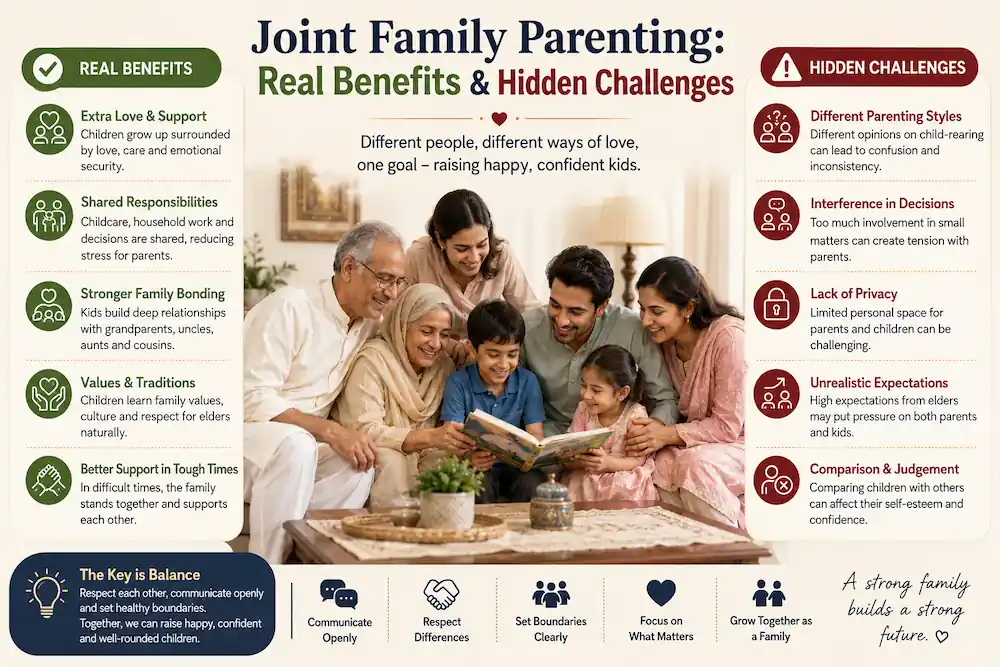
The Real Benefits of Raising Children in a Joint Family
Let’s start here, because the advantages are genuine and worth acknowledging — especially since they often get dismissed in conversations about joint family stress.
✓ A Built-In Support Network From Day One
A new mother in a nuclear setup is essentially on her own — or dependent on scheduled visits and hired help. In a joint family, there are hands available. Someone to hold the baby while you shower. Someone to watch the toddler while you tend to the newborn. Someone to bring you chai when you haven’t moved from the feeding chair in two hours. That practical support, even when it comes with opinions attached, is nothing. It is, in many cases, the thing that gets a new mother through the first few months.
✓ Children Grow Up With Emotional Breadth
Children raised in joint families learn, early and naturally, how to navigate relationships with people of different ages, temperaments, and communication styles. They have grandparents to learn patience from, cousins to figure out sharing with, and aunts and uncles who provide different kinds of connection from their parents. Research consistently links strong extended family relationships with better social development in children – and kids from joint families tend to build those skills earlier and more naturally than their nuclear family peers.
✓ Grandparents as Active, Present Caregivers
The relationship between a child and their grandparents is one of the most under-appreciated developmental assets. Daada, Daadi, Nana, Nani — these relationships provide children with a sense of belonging, continuity, and unconditional love that is distinct from what parents give. Studies on child wellbeing consistently show that strong grandparent relationships are associated with lower rates of anxiety and depression in children. In a joint family, this relationship is woven into daily life rather than limited to weekend visits.
✓ Financial and Practical Resilience
Shared living means shared costs – rent, utilities, groceries, and childcare. For a young couple in Pakistan’s current economic climate, this is not a small thing. It allows parents to make different choices – about working hours, about education spending, and about the pace of family life – than they might be able to make otherwise. The financial cushion of a joint family system is a genuine advantage, even when it’s rarely framed that way.
✓ Cultural Continuity and Identity
Children raised in joint families tend to have a stronger, more embodied sense of cultural identity. They hear the stories, they learn the traditions, they observe the relationships that connect them to something bigger than their immediate nuclear unit. In a globalised world where cultural rootlessness is its own kind of challenge for young people, this is a genuine gift — even when the traditions being passed down occasionally come with friction.
The Hidden Challenges Nobody Warns You About
And now for the honest part. Because the challenges are just as real as the benefits — and they tend to surface most acutely around parenting decisions, which is exactly when the stakes feel highest.
✖ Conflicting Parenting Philosophies Under One Roof
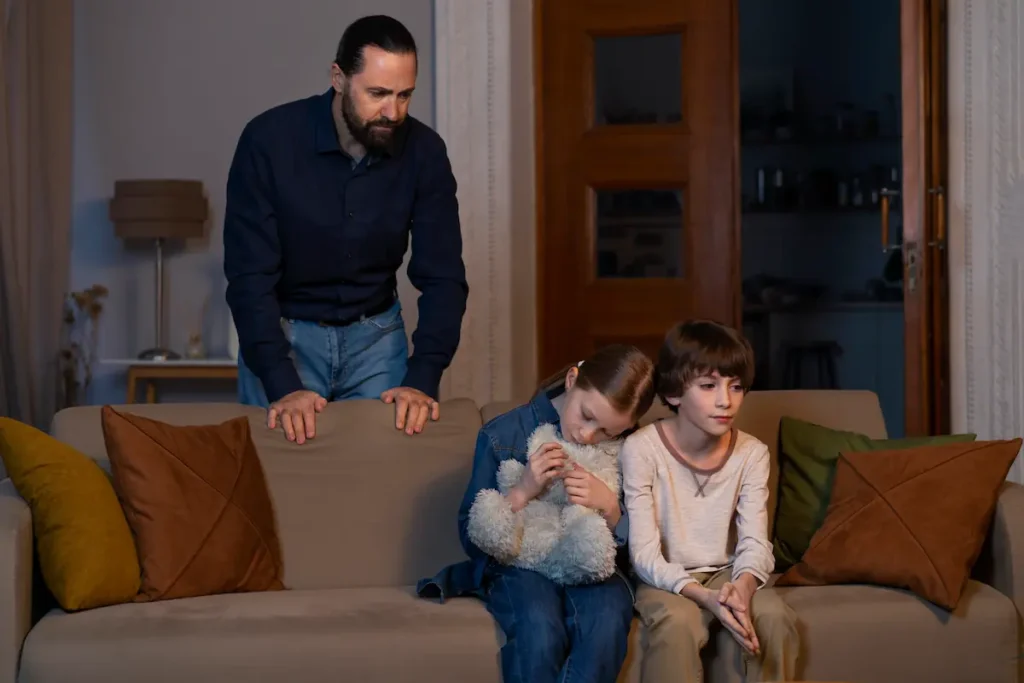
Your SaaS raised children in a different era, with different information, different expectations, and different everything. She may believe in feeding schedules you don’t believe in, sleep arrangements you’ve been told are unsafe, and discipline methods you disagree with entirely. In a nuclear family, you simply make a decision and implement it. In a joint family, every parenting decision becomes potentially visible, potentially subject to comment, and potentially a source of conflict. This is one of the most consistently cited stressors among Pakistani mothers in joint family setups.
✖ The Mother’s Authority Gets Undermined — Often Quietly
This one is subtle, and it’s significant. When a mother sets a boundary — bedtime, screen time, food choices, a discipline approach — and another family member consistently overrides it, the child receives a confusing message: Mama’s rules don’t actually apply. Over time, this can seriously undermine parental authority and create behavioural patterns that are very difficult to address. ‘Daadi ne de diya’ is a sentence every Pakistani mother in a joint family knows – and the implications go deeper than the biscuit.
✖ There Is No “Off” Switch
In a nuclear family, when the door closes, you have your space. In a joint family, the space is always shared — emotionally, physically, logistically. For a parent who needs quiet time to recharge, who needs to make a parenting call without an audience, who needs to have a difficult conversation with their spouse privately, the constant presence of others can become genuinely exhausting. The lack of psychological privacy is a real challenge, and it’s rarely acknowledged as such.
✖ The Mother Carries the Most Invisible Load
Joint family life often distributes support unevenly. The mother benefits from help with the baby — yes. But she is also simultaneously expected to manage her relationship with her in-laws, manage her husband’s relationship with his family, contribute to household functioning, and maintain the invisible emotional labour that keeps a complex household running. The bahu role and the mother role coexist – and they don’t always make each other easier. This dual load is one of the most underreported sources of maternal burnout in Pakistan.
✖ Spoiling and Inconsistency From Extended Family
A grandparent’s love is genuine and beautiful. It’s also not always governed by the same boundaries the parents are trying to establish. Unlimited mithai, staying up past bedtime, being picked up every time they cry, and being told yes when the parents said no — these individual moments feel harmless. The cumulative pattern across months and years can genuinely complicate behaviour management and make the parent’s job harder.
What the Research Actually Shows
Beyond the lived experience, what does the evidence say about children raised in joint family systems?
| Area | Joint Family Tends to… | Nuclear Family Tends to… |
| Social skills | Build earlier through constant multi-generational interaction | Build through more structured peer settings |
| Emotional security | Benefit from multiple secure attachment figures | More concentrated attachment to parents specifically |
| Parenting consistency | More challenging with multiple authority figures | Easier to maintain consistent rules |
| Maternal mental health | Varies – support helps, conflict harms | Isolation is a risk; autonomy is a benefit |
| Cultural identity | Strong — embedded in daily family life | Requires more deliberate cultivation |
| Financial stability | Generally stronger for young families | More financial pressure and independence simultaneously |
The research picture is genuinely mixed, which reflects lived experience accurately. There isn’t a clear “winner”. What matters most isn’t the family structure itself — it’s the quality of relationships within it, the degree to which parental authority is respected, and the extent to which the mother’s well-being is treated as important rather than incidental.
A Scenario That Will Sound Familiar
A mother in Karachi described her first year after marriage as a constant negotiation. She had a baby at eight months, and the joint family was, in many ways, a lifeline. Her mother-in-law took the baby for hours at a stretch. Her husband’s sister would sit with her at 2 AM when the baby wouldn’t settle. She had company and support in a way her friends in nuclear setups genuinely envied.
But she also couldn’t make a single parenting decision without it becoming a household discussion. When she wanted to stop swaddling at four months, her mother-in-law was convinced the baby would catch a chill. When she stopped giving the baby ghee on the advice of her paediatrician, there were three days of tension. When she asked for the baby’s bedtime to be respected — no picking him up after 8 PM — she was told she was being rigid.
“I loved having them there,” she said. “And I also felt like I wasn’t fully the mother in my own house. Both things were true at the same time.”
That last sentence is the most honest description of joint family parenting anyone can give. Both things are true at the same time. The support is real. The friction is real. Acknowledging both doesn’t mean you’re ungrateful — it means you’re being honest about your experience.
Practical Ways to Make Joint Family Parenting Work Better
Have the Parenting Conversation With Your Spouse First
Before any conversation with extended family about parenting decisions, you and your husband need to be aligned. A united front — hum dono ne yeh decide kiya hai — is far more effective than one parent trying to hold a position while the other stays silent or defers to elders. Your husband’s role in this is not optional. He needs to be the one having difficult conversations with his own family, not leaving you to manage them alone.
Be Clear About Non-Negotiables — And Flexible About Everything Else
Not every parenting preference is worth fighting for in a joint family setup. Sleep safety guidelines, medical advice, and vaccination schedules — these are non-negotiables. Whether the baby wears socks indoors or how many layers they sleep in — these might be places to choose peace over principle. Identifying which is which, in advance, saves significant emotional energy.
Name What You Need — Specifically
Vague requests in joint families get vague responses. “Main thak gayi hoon” is easily dismissed. “Kya aap agle do ghante baby ko sambhal sakti hain taake main so sakoon? ” is much harder to ignore. The more specific the ask, the more likely it is to be met — and the less likely it is to become a source of resentment on either side.
Protect Your Marital Relationship Deliberately
Joint family life can swallow a couple’s relationship if they’re not intentional about protecting it. Regular time alone — even thirty minutes of private conversation, even a walk outside — matters enormously. The couple who parents together well is almost always the couple who also maintains their connection to each other, separately from their roles in the larger family system.
Let Some Things Go
This is perhaps the most practically useful advice in this entire article. In a joint family, you will not win every battle. Some grandparent spoiling will happen. Some advice you didn’t ask for will arrive. Some boundary you set will get quietly crossed. Choosing which things to address and which to absorb without comment is a skill — and learning it is one of the most effective things a parent in a joint family can do for their own peace of mind.
⚠ When to Get Support
If joint family dynamics are significantly affecting your mental health, your marriage, or your ability to parent the way you believe is right—that’s worth professional support. A counsellor or therapist, even for a few sessions, can help navigate specific conflicts and build communication strategies that work in a South Asian family context. Seeking help is not a sign of failure. It’s a sign that you take your family seriously enough to invest in it.
Conclusion
Joint family parenting in Pakistan is not a problem to be solved or a blessing to be celebrated without qualification. It’s a complex, dynamic reality that most Pakistani parents are navigating without a roadmap.
The children who do best in joint families tend to have parents who took the benefits seriously, named the challenges honestly, protected their parental authority without going to war over everything, and maintained their own relationship at the centre of it all.
The mothers who do best are the ones who asked for what they needed, accepted help without feeling like they had to trade their autonomy for it, and permitted themselves to find the setup genuinely hard sometimes — without that difficulty meaning anything negative about them, their family, or their love for their children.
Jo ghar mein rehta hai woh samajhta hai — and so do you, better than anyone on the outside ever could.