You’ve washed the bear. You bought a backup, identical in every way you could find — the same brand, the same size, and the same slightly worn ear. And somehow, your toddler knows. They hold the new one for two seconds, frown, and hand it back like you’ve tried to pull one over on them.
If you’ve ever lived through a lost-blanket crisis at 9 PM or watched a three-year-old refuse to leave the house without one specific, increasingly disgusting stuffed rabbit, you already know how serious this can get.
It’s easy to write this off as stubbornness or just a toddler being a toddler. But there’s real psychology behind why kids latch onto one specific object — and once you understand it, the whole thing makes a lot more sense. It’s not a phase to discourage. It’s actually doing something useful.
This article walks through what’s really going on when a toddler gets attached to objects, why it matters more than it looks like it does, and what to actually do when the inevitable happens — the blanket gets lost, the bear falls apart, or you’re just wondering if this is something to worry about at all.
It’s Called a “Transitional Object” for a Reason
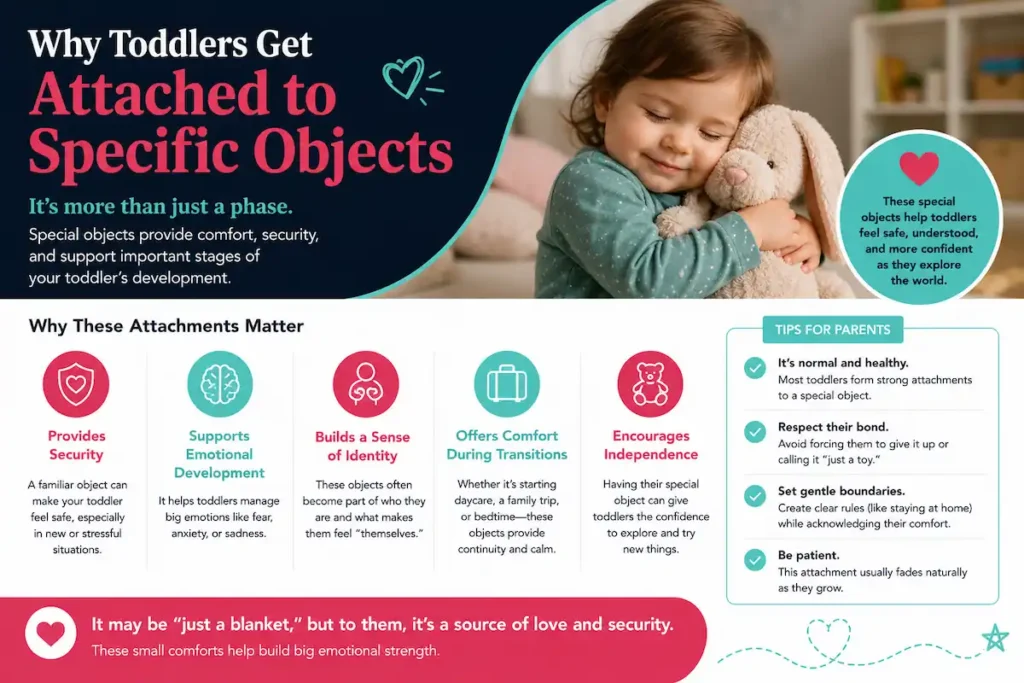
The technical term for this – the blanket, the bear, the slightly chewed-on piece of fabric – is a transitional object. The concept comes from a paediatrician and psychoanalyst named Donald Winnicott, who described it back in the 1950s, and the core idea has held up remarkably well since then.
The word “transitional” is the key part. These objects aren’t really about the object itself. They’re about helping a child move — transition — from being completely dependent on a parent for comfort to being able to self-soothe on their own.
Think about what a toddler is dealing with developmentally. They’re starting to understand that they’re a separate person from their parent. That’s a big, sometimes unsettling realisation for a small brain to process. A transitional object becomes a stand-in — something that represents safety and comfort that the child can carry with them even when a parent isn’t physically present.
It’s Not About the Object — It’s About What It Represents
This is the part that explains why the backup bear never works. The new bear smells different. It’s stiffer. It doesn’t have the same worn-down ear from years of being chewed on during naps. To an adult, it looks identical. To a toddler, it’s a completely different object — because the attachment was never really about the bear’s physical form. It was about the specific, familiar sensory experience tied to that exact item.
Why This Behavior Is Actually a Good Sign
Here’s something that tends to surprise parents who are worried their toddler is “too attached” to a blanket: research generally points the other way. Having a transitional object is linked to healthy emotional development, not a red flag.
It Builds Independence, Not Dependence
This sounds backwards at first. How does clinging to a blanket build independence? But think about what the object allows a child to do — fall asleep alone, sit through a stressful car ride, and handle a parent leaving the room — all without needing an adult right there for reassurance.
A child who’s developed a reliable comfort strategy using an object is, in a sense, practising self-regulation. They’re learning that they can manage difficult feelings without a parent intervening every single time. That’s a skill that gets built on for years.
It Often Shows Up Right When Separation Becomes a Bigger Deal
Attachment to a specific object tends to ramp up around the same time separation anxiety peaks — usually somewhere between 8 months and 2 years old, though it varies a lot. That timing isn’t a coincidence. As toddlers become more aware of being separate from their parents, that awareness can be unsettling, and a familiar object helps bridge the gap.
A love bite isn’t a sign that something’s wrong. It’s often a sign your toddler is doing exactly the emotional work they’re supposed to be doing at this age.
When Does This Start, and When Does It Usually Fade?
Like most toddler behaviours, there’s a general pattern, but plenty of normal variation within it.
| Age Range | What’s Typically Happening |
| 6–12 months | Some early signs of preference for a specific texture or item |
| 1–2 years | Clear attachment often forms, especially around sleep and separation |
| 2–4 years | Peak attachment — object often needed for sleep, comfort, and big transitions |
| 4–6 years | Attachment usually starts loosening, though bedtime use can persist |
| 6+ years | Most children have moved on, though some keep an object for years without issue |
It’s worth saying clearly: there’s no fixed age by which a child “should” give up a comfort object. Plenty of perfectly well-adjusted kids keep a special blanket tucked under their pillow well into elementary school. This isn’t something that needs to be rushed.
What’s Normal vs. What’s Worth a Closer Look
Most attachment-to-objects behaviour falls comfortably within the normal range. But there are some patterns worth paying a bit more attention to.
Generally Fine
✓ Typical Attachment
Wanting the object at bedtime, naptime, or during stressful moments like doctor visits. Becoming upset when it’s lost, but able to be comforted and eventually settle without it if truly necessary. Carrying it around at home, but being willing to leave it behind for short outings, especially as the child gets a bit older.
Worth Mentioning to a Pediatrician
⚠ Pattern to Watch
Complete inability to function — eat, sleep, engage at all — without the object present at all times, even for brief moments. Extreme distress that doesn’t ease with comfort and reassurance. Attachment that seems to replace interest in people or social interaction altogether, rather than supplementing it.
Even in these cases, it’s rarely the object itself that’s the issue — it’s more about understanding what’s driving the intensity behind it, which a paediatrician or child psychologist can help unpack.
A Real-World Example
A coworker of mine spent an entire weekend in a near-panic after her son’s blanket — a worn, slightly grey rectangle of fabric that had once been white — went missing somewhere between a family trip and unpacking the car.
Bedtime that night was rough. Genuinely rough. Her son cried, refused to settle, and kept asking where it was. She’d tried a backup blanket months earlier as a precaution, and as expected, it didn’t work – too clean, too soft, and completely wrong.

She ended up doing something simple: she sat with him longer than usual, talked through what happened, and let him pick a different comfort item — an old t-shirt of hers — for that one night. Not a replacement exactly, just a temporary bridge.
The blanket turned up two days later, jammed behind the car seat. Bedtime went back to normal that same night; no lasting issue.
What stood out to me about this story wasn’t the panic – every parent panics over a lost lovey at some point. It was that her son adapted, with support, even without the actual object. That’s the resilience this whole process is quietly building.
Practical Tips for Parents Navigating This Stage
Get a Backup Early — But Don’t Expect It to Be a Perfect Swap
If your toddler’s object is something replaceable, like a mass-produced stuffed animal, buying a second one early on is smart. Rotate the two from the start so neither becomes uniquely “the one”, or use the backup specifically for situations where loss is more likely, like travel.
Let Them Lead on When to Leave It Behind
Forcing a toddler to give up a comfort object before they’re ready tends to backfire, sometimes increasing anxiety rather than resolving it. It’s more effective to gently encourage independence at specific moments — “Let’s leave Bear in the car while we’re at the park” — rather than pushing for a full, permanent goodbye.
Have a Plan B for the Inevitable Loss or Wash Day
At some point, the object will need to be washed, or worse, will go missing. Having a backup comfort strategy — a specific song, a particular way of being held, a substitute item — gives you something to lean on in the moment rather than scrambling.
Don’t Shame the Attachment, Even as Kids Get Older
As children get a little older, comments from relatives or even well-meaning teachers about a comfort object being “babyish” can create unnecessary shame around something that’s developmentally appropriate. If your child still wants their object at age 5 or 6, that’s not something to apologize for or rush them out of.
Conclusion
The attachment your toddler has to that one specific blanket or bear isn’t stubbornness, and it’s not something to worry your way through. It’s a genuine developmental tool — one that helps them manage separation, regulate big emotions, and build the early skills they’ll need for independence later on.
The object itself is almost beside the point. What matters is what it represents: familiarity, safety, something steady in a world that, from a toddler’s perspective, can feel unpredictable a lot of the time.
Let them have the blanket. Let it get worn out and a little gross. That’s not a failure of parenting — that’s the object doing exactly what it’s there to do.
FAQs
Disclaimer: This article is for informational and educational purposes only and is not intended as medical, psychological, or nutritional advice, diagnosis, or treatment. Every child, body, and pregnancy is different — please consult your pediatrician, doctor, or a qualified healthcare provider for advice specific to your situation.