

Cut through registry noise with an evidence-based buyer’s guide. Learn how to support your posture, protect your baby’s delicate airway, and select the safest cushions for home and travel.
Building a baby registry feels like preparing for an expedition to another planet. There are hundreds of gadgets claiming to be essential, each decorated with soft pastel covers and glowing testimonials. You add a feeding cushion here, a head support insert there, and suddenly your nursery closet is overflowing with foam.
Then you actually bring your baby home.
At 3:00 AM on night four, your lower back feels like a crushed accordion. Your neck is locked in a tight shrug, your arms are numb, and your baby’s head keeps tilting sideways into an awkward chin-to-chest slouch.
That is the moment you realize not all support cushions are created equal.
Support tools aren’t just decorative accessories—they are daily physical gear. When used correctly, a great nursing cushion saves your back, while proper daytime head support keeps your baby’s delicate airway open and comfortable. But when chosen blindly, ineffective pillows can cause chronic joint pain or, even worse, introduce dangerous safe-sleep hazards.
To help you separate true nursery necessities from registry fluff, we built this comprehensive new mom pillow checklist. Let’s walk through what you actually need, what features matter, and how to keep your newborn completely safe.
Why Pillow Support Matters for Newborns (And New Moms!)
Before diving into buying criteria, it helps to understand why specialized support is so critical during the fourth trimester.
Feeding and holding a newborn isn’t a quick ten-minute task. Newborns feed between 8 and 12 times in every 24-hour cycle. If each feeding session lasts 30 to 45 minutes, you spend up to eight hours every day carrying body weight on your lap.
Without structured support, your natural reaction is to hunch over. You bring your body down to meet your baby. Doing that dozens of times a day causes muscle tension and discomfort in your back and shoulders.
The Newborn Anatomy Factor
On the baby’s side of the equation, structural physics are working against them. A newborn’s head accounts for nearly 25% of their total body weight, yet their neck muscles are virtually non-existent for the first three months.
Furthermore, an infant’s trachea (windpipe) is narrow and soft as a paper straw. If their head slumps forward onto their chest or twists backward unnaturally, that soft windpipe can kink, leading to silent positional airway constriction. The right support setup helps keep your baby in a comfortable, supported position during feeds and supervised awake time.
The Nursing Pillow Checklist: What to Look For
If you ask three experienced mothers which nursing pillow is best, you will likely get three completely different answers. That is because body shapes, torso lengths, and feeding styles vary greatly.
However, regardless of brand or style, every high-performing nursing cushion must meet these non-negotiable standards:
Nursing Pillow Buyer’s Checklist
Firm, High-Density Core: Does the cushion stay firm under a 9-pound weight without sinking flat down to your lap?
Ergonomic Contour & Waist Fit: Does it wrap around your torso without leaving a wide gap where your baby could slip through?
Latching Height Elevation: Does it lift your baby directly to nipple level so you don’t have to hunch forward?
Abdominal Protection: Does it rest comfortably above your lap to rests comfortably above your lap, away from your midsection?
Arm & Shoulder Relief: Is there space to rest your forearms so your wrists don’t bear all the baby’s weight?
1. Firmness Beats Plushness Every Time
When shopping in a store, your instinct is to press your hand into the softest, fluffiest pillow on the shelf. Resist that impulse!
A pillow that feels like a soft feather cloud will collapse straight down as soon as you lay your baby across it. Once it flattens out, you end up hunching over anyway, defeating the entire purpose of the cushion. Look for high-density molded foam or firmly packed fiberfill that holds its height under weight.
2. Secure Waist Attachment for C-Section Recovery
If you give birth via C-section, holding anything against your lower abdomen is deeply uncomfortable. Loose throw pillows shift around and press against lower belly incision lines.
A structured nursing pillow with a waist strap or contoured C-shape locks into place around your midsection. It creates an elevated shelf across your thighs, carrying your baby’s weight high above your surgical scar.

The Head Support Pillow Checklist: Awake vs. Sleep Rules
Now let’s talk about infant head support pillows. This category often creates massive confusion for new parents because marketing images show sleeping babies surrounded by soft, contoured cushions.
We need to make an absolute, clear distinction here: Daytime awake support vs. in-crib sleep safety.
Daytime Gear Support (Strollers, Swings & Bouncers)
When babies rest in semi-upright gear like strollers or swings during supervised awake hours, gravity pulls their heavy heads sideways or forward. Dedicated neck rolls or stroller inserts can keep their head centered and upright.
Daytime Head Support Checklist
Breathable Mesh Fabrics: Ensure the material allows full airflow to prevent overheating.
Nested Jaw Support: The insert should cradle the sides of the skull without pushing the back of the head forward.
Strap Compatibility: Must allow car seat or stroller harness straps to pass through correctly without compromising harness tightness.
Slim Back Profile: Avoid thick padding behind the skull that forces the baby’s chin down toward their chest.
CRITICAL SAFE SLEEP RULE: Keep Pillows OUT of the Crib
Never place head support pillows, positioners, or wedge cushions inside a crib, bassinet, or playpen. According to the American Academy of Pediatrics (AAP), infants must sleep on a firm, completely flat mattress free of soft bedding, pillows, or toys to prevent suffocation and positional asphyxiation.
While head support pillows are heavily advertised online for preventing flat spots (plagiocephaly), using them in a sleeping baby’s crib introduces serious hazards. A flat head can be corrected with supervised tummy time and position changes; compromised breathing cannot. Keep all pillows out of the crib!
Comparing Popular Pillow Types: Quick Buyer’s Matrix
To help you choose the right options for your nursery layout, here is a quick breakdown of common pillow designs, their primary benefits, and best use cases.
| Pillow Type | Best For | Key Feature | Watch Out For |
| Classic C-Shape | Quick living room feeds & versatile lap use | Wraps around waist easily without straps | May shift or slip away on slippery leather couches |
| Strapped U-Shape | C-Section recovery & maximum stability | Clips securely around torso; zero sliding | Slightly more cumbersome to put on one-handed |
| Multi-Layer Adjustable | Long torsos & multiple feeding angles | Stackable fabric layers alter elevation angle | More fabric layers mean extra laundry maintenance |
| Stroller Head Insert | Supervised walks & preventing side-flopping | Side bolsters cradle head on bumpy paths | Must not be used inside a crib or bassinet |
5 Common Pillow Pitfalls New Moms Make (And How to Fix Them)
Even with great gear in your nursery, small setup errors can cause frustration. Here are five frequent mistakes new parents make and simple ways to correct them:
1. Bringing Your Breast Down to the Baby
This is the single most common posture mistake. If your pillow is resting on your lap and you still have to lean forward two inches to meet your baby’s mouth, the pillow isn’t high enough. Place a folded blanket or throw cushion underneath the nursing pillow to bring it up to true chest level.
2. Using Thick Cushion Padding Behind Car Seat Heads
Many parents buy bulky aftermarket cushions to put behind their baby’s head in an infant car seat. If the cushion is thick behind the skull, it pushes the baby’s head forward, causing their chin to drop onto their chest. Only use inserts provided or approved by your specific car seat manufacturer.
3. Forgetting Lumbar Support for Yourself
You can have the best nursing cushion on your lap, but if your lower back is slouching into a soft couch, you will still experience spinal pain. Place a firm lumbar pillow behind your lower back before you clip on your nursing cushion.
4. Ignoring Bottle-Feeding Needs
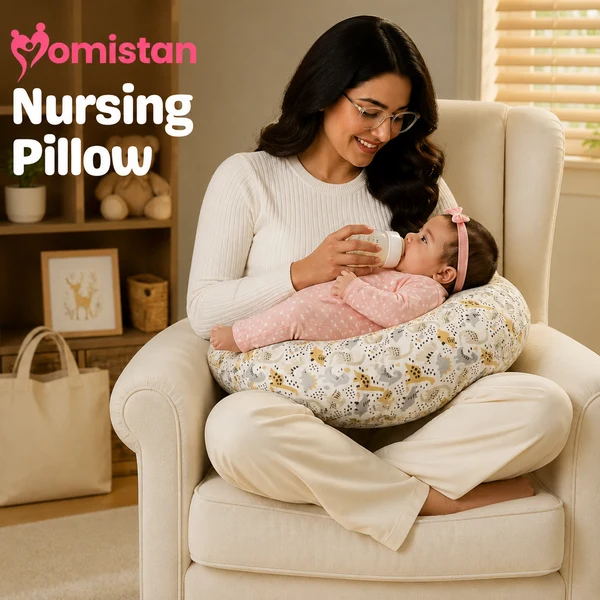
There is a widespread misconception that nursing pillows are strictly for breastfeeding moms. In reality, bottle-feeding parents and caregivers experience the same arm strain! A structured feeding pillow holds the baby at a comfortable 45-degree angle, which also reduces swallowable air and gas bubbles.
5. Letting Babies Sleep Unsupervised on Loungers
Plush lounger pillows look comfy for baby naps. However, if an infant rolls their face into the padded side wall or slumps forward, their airway can easily become obstructed. Always transfer a sleeping baby to a flat mattress.
Frequently Asked Questions
Preparing for your baby’s arrival doesn’t mean buying every gadget on the store shelf. It means choosing thoughtful, functional gear that protects your health and keeps your newborn safe and comfortable.
By prioritizing firm support, ergonomic fit, and strict safe-sleep boundaries, your nursing cushion and daytime head support will quickly become your most relied-upon nursery tools. Give your shoulders a break, keep your sleep spaces clear, and enjoy those peaceful feeding moments!
Disclaimer: This article is for informational and educational purposes only and is not intended as medical, psychological, or nutritional advice, diagnosis, or treatment. Every child, body, and pregnancy is different — please consult your pediatrician, doctor, or a qualified healthcare provider for advice specific to your situation.