How do you talk to your mother? I remember my mother saying this to me in a way that made my stomach fall, not because I had done something terrible, but because that was the way respect was taught in most Pakistani homes—you had to sit up straight, not argue, not ask why, and just listen; otherwise.
Many of us were brought up in that manner and now, as we have our own children, are asking ourselves whether there isn’t another way of bringing up a respectful child—one that doesn’t include using a raised hand, a raised voice, or the continual threat of “Wait till your father gets home”.
It is the case; all you have to do is unlearn a little first.
Why Fear and Respect Aren’t the Same Thing
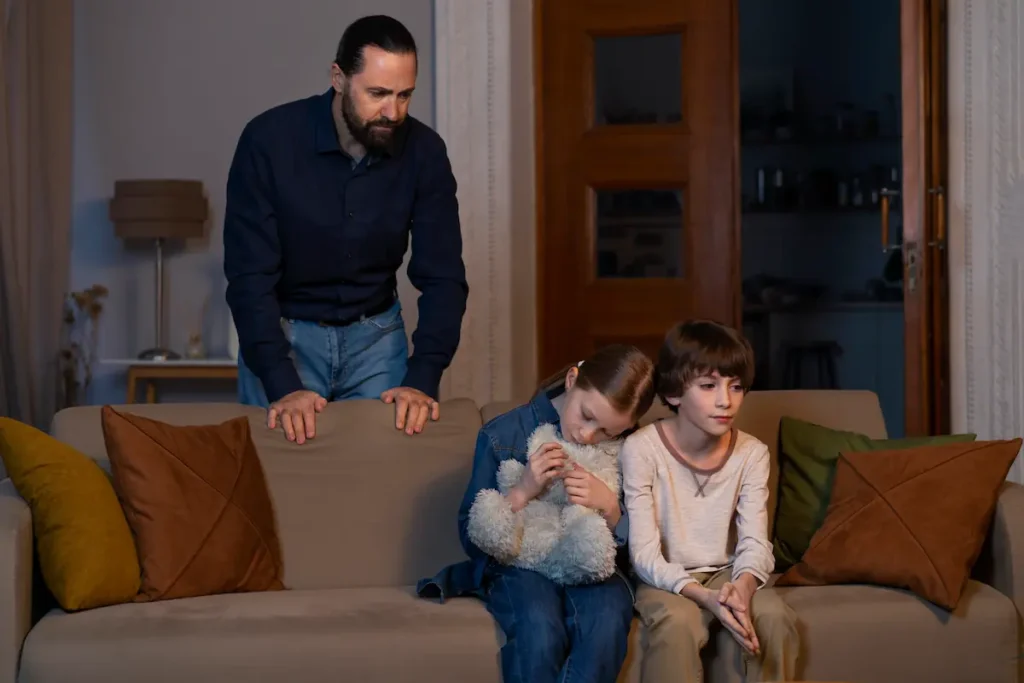
The confusion that we have all passed down is this: we assume that a child who is afraid of us is a child who respects us. However, fear and respect are in fact two entirely different things, and they lead to completely different kinds of children.
A child will comply with you as long as you’re in the room; as soon as you’re gone, the rules no longer count since the rules weren’t really theirs in the first place; they had only been avoiding punishment. That is called compliance, not respect.
On the other hand, a child who truly respects you will obey the rules whether or not you are watching; they do not fail to obey out of fear of the consequences but because they understand the reason for the rule and have confidence in the idea that you are acting in their best interests.
The Long-Term Difference
It’s not merely a good idea since it can be seen in the character children end up with; those brought up mainly through fear either grow up to be people-pleasers who have difficulty saying no, or else they strongly rebel as soon as they are given some independence. None of these results is something most parents really desire, even if using fear seems to be having a short-term effect.
What Fear-Based Discipline Actually Looks Like
We often fail to recognise the fact that we’re using fear, since it doesn’t always involve shouting or hitting; it can, in fact, be quieter.
- Threats that you don’t actually follow through on (“I’ll leave you here” or “I’m calling your teacher right now”)
- Comparing your child to a sibling or cousin who “never behaves this way”
- Using shame in front of guests or relatives
- Withdrawing affection when a child misbehaves
- Bringing up a scary figure — a doctor giving an injection, a “bhoot”, a police officer — to get instant obedience.
This doesn’t mean that a parent is thereby a bad parent. We usually adopt these methods because they are the ones we ourselves experienced as children, and in truth they do have an effect in the short term. A frightened child ceases crying quickly. It is for this reason that it is so difficult to give up the habit – it produces immediate results, even if the long-term consequences are serious.
What Respect Without Fear Actually Requires
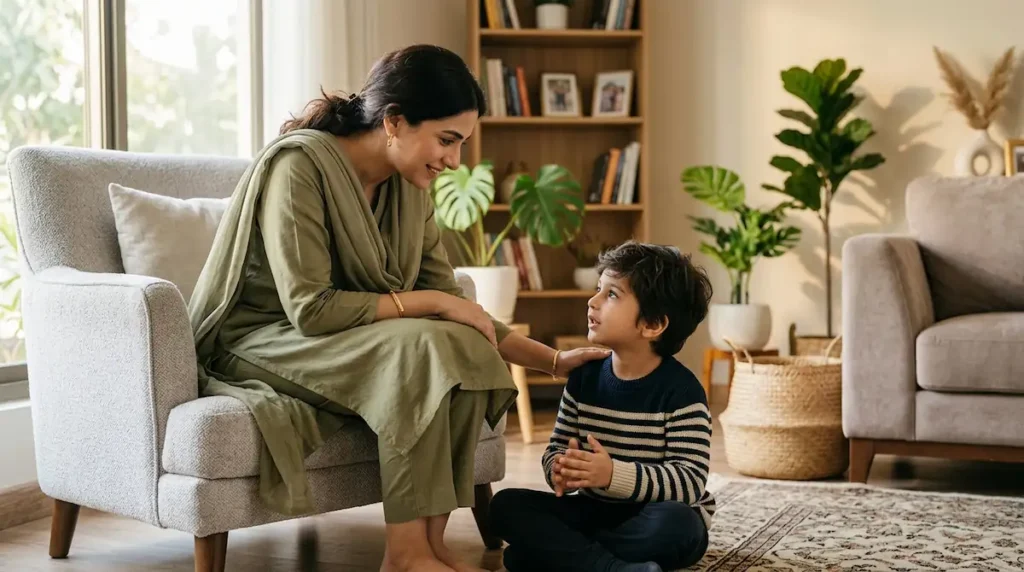
Gaining respect calmly requires more patience at the start, and there’s no getting around that fact. However, it is worthwhile since it results in a child who genuinely wants to do the right thing by you, rather than one who is only trying to avoid trouble.
1. Always explain the “why,” even to toddlers.
A lengthy explanation isn’t necessary since even a two-year-old can grasp a brief explanation. Saying “We hold hands when crossing the road because cars could hurt us” has a completely different effect from saying “Because I said so”. Children are much more likely to obey a rule when they understand the reason for it, even if nobody is looking.
2. Establish boundaries calmly, not loudly.
A firm voice is not a loud voice. It’s possible to say “No, we don’t hit” in a completely calm tone and still convey determination. In fact, yelling has a tendency to cause children to tune out more quickly — beyond a certain point, they stop hearing the words and simply wait for the noise.
3. Let natural consequences take some of the responsibility.
If you let your child feel a bit cold by not dressing them in a jacket when the weather is mild—doing so in a safe and temporary way—this usually teaches them more effectively than any lecture could. It is because natural consequences show the relationship between cause and effect without causing any fear.
4. Act in such a way that you will receive the respect that you desire
This is awkward but significant because children learn to show respect by seeing how you treat them and how you treat other people — for example, the domestic staff, a waiter, or your own parents. Whenever a child is constantly overruled, teased, or ignored, no amount of talking about respecting one’s elders will counteract what they actually see.
5. Provide options within limitations.
Giving a toddler the choice of whether to brush their teeth before or after the story makes them feel in control without actually letting them make the final decision. Toddlers who have a sense of ownership over small everyday decisions are generally less likely to resist the larger, non-negotiable rules.
6. Repair After Conflict
It’s impossible to remain calm all the time. Should you snap or react too strongly, there’s nothing wrong with coming back later and saying, “Earlier I was rather loud; I’m sorry. Let’s discuss it.” This is not a sign of weakness; on the contrary, it earns you more respect since your child realises that accountability applies to both of you in the relationship, not just the child to the parent.
Real-World Example: The Homework Battle
Suppose that your ten-year-old child refuses to sit down and complete his or her homework. The version of this situation based on fear includes the use of threats, perhaps raising your voice, perhaps saying ‘no TV for a month’ angrily and then later forgetting it (by the way, this kind of thing teaches children that consequences aren’t actually going to happen).
An approach based on respect could instead be put like this: “I see that you’re tired; the homework still has to be done before dinner, so should we do the math or the Urdu first?” It takes longer and may still include some complaining. However, it teaches the child to cope with their resistance rather than simply complying out of fear of what will happen next.
What about discipline in the case of more serious offences—such as lying, hitting, and showing disrespect to elders?
Respect without fear does not imply that there are no consequences; it means that the consequences are linked to the behaviour and are made clear, not that they are intended to intimidate.
When a child lies, the reaction could be a calm discussion on the subject of trust, possibly involving the loss of a privilege linked to that trust, rather than having a shouting argument. In the case of a child hitting a sibling, they would probably have to spend a cooling-off period and then take part in a conversation regarding what emotions they had felt and what they could do differently next time. The aim is education, not punishment, just so that the child will be frightened into avoiding the behaviour again.
When Extended Family Pushes Back
It’s a very genuine problem for many Pakistani parents. Suppose you choose to parent in a gentle way; then a grandparent, an aunt, or a neighbour will tell you that your child is “being spoilt” or “needs a harder approach”. This situation can be very upsetting and make you feel alone.
It’s not necessary to defend your approach to parenting at each family gathering. All you generally need to say is, “We’re giving him a different kind of upbringing, and it’s working for us.” At the same time, you can show respect for the older generation’s experience without agreeing to methods that don’t please you.
Common Mistakes Parents Make When Trying This Approach
Confusing Gentle with Permissive
Respect without fear still requires setting boundaries since children actually feel more secure when there are clear limits—what we want to do is get rid of the fear tactics, not get rid of the rules altogether.
Expecting Instant Results
When you start using a different method from one based on fear, your child may try the new rules more closely at first, and that is entirely normal; it usually settles down after a few weeks of consistency.
Giving Up Under Pressure
It might be tempting to revert to old habits when a calm approach fails the first time, so you should try the new method more than once before concluding that it ‘doesn’t work’ with your child.
A Quick Word for Parents Who Grew Up With Fear-Based Parenting
It’s reasonable to feel that way if that’s the way you were brought up and yet turned out all right. However, ‘fine’ doesn’t always mean ‘the best possible outcome’. A great many adults who were brought up with a form of discipline based on fear say that they still have difficulty with confrontation, speaking up, or trusting their own judgement as adults. It’s important to acknowledge that, even though it may be uncomfortable.
It wouldn’t make you a bad parent to have used those methods earlier; changing your approach now is just starting a new chapter, not a criticism of the previous one.
Conclusion
You don’t need to frighten your child to raise them respectfully; instead, you need to be consistent, to explain your reasons, and to build a relationship in which your child knows that you’re their supporter even when you have to set a boundary that they don’t particularly like. This method is slower than using fear, but it is much more lasting and usually influences the way your child behaves towards other people long after they have left your home.
Respect, which is based on trust, doesn’t vanish the moment you get out of the room—that’s exactly the point.
Frequently Asked Questions
Disclaimer: This article is for informational and educational purposes only and is not intended as medical, psychological, or nutritional advice, diagnosis, or treatment. Every child, body, and pregnancy is different — please consult your pediatrician, doctor, or a qualified healthcare provider for advice specific to your situation.