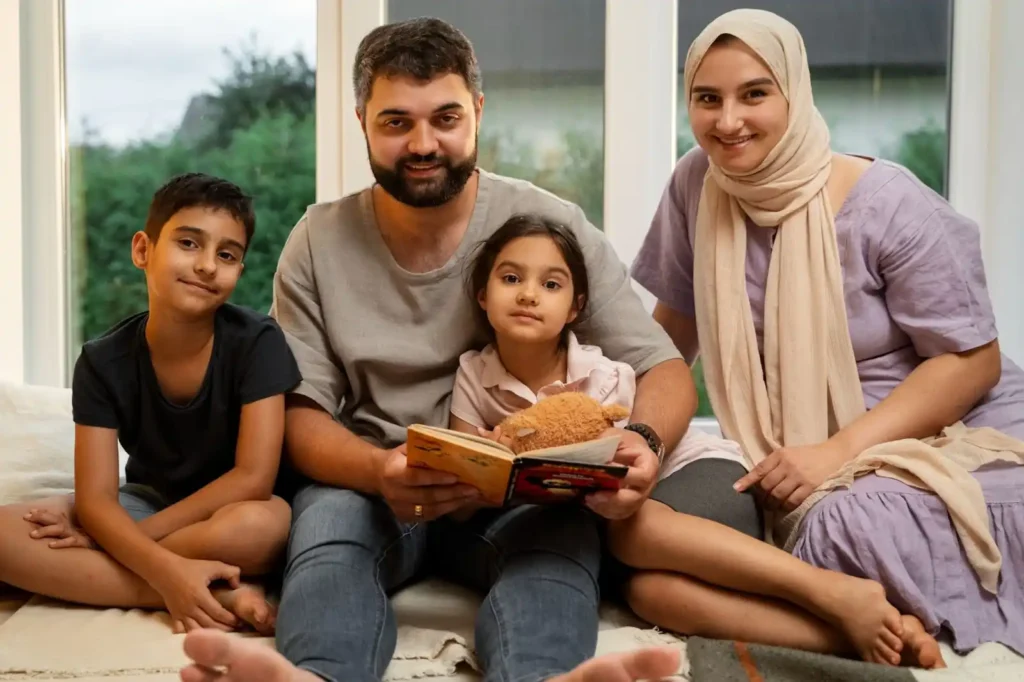
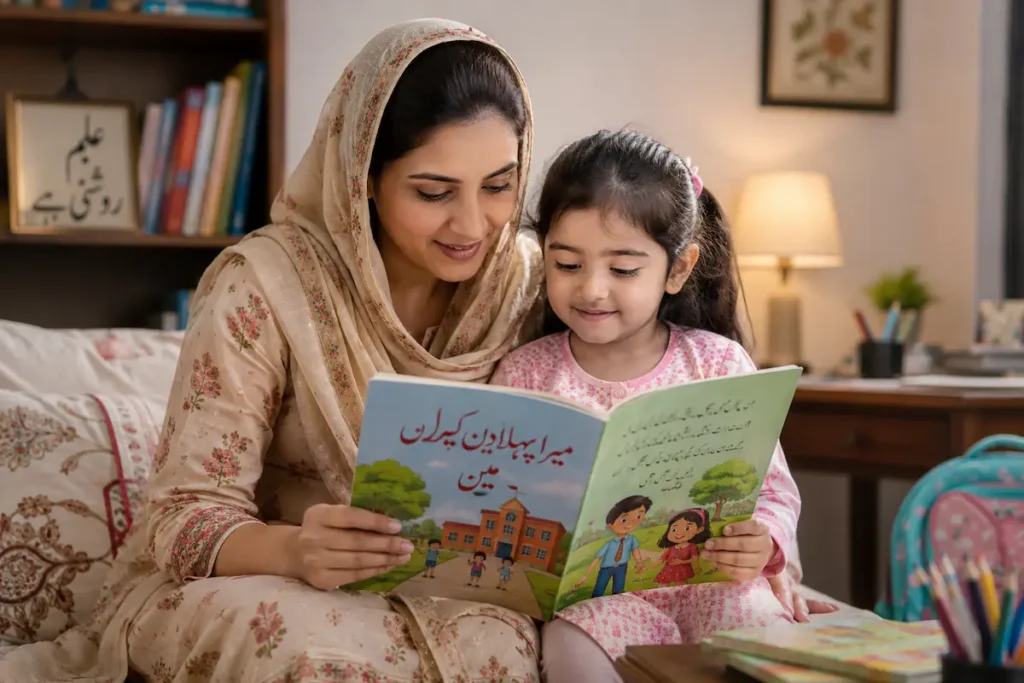
Knowing how to prepare a child emotionally for school means building confidence through routine, positive conversations, school visits, and role-play. Pakistani parents should start 4 to 6 weeks before school begins. Key steps: familiarize children with the school environment, strengthen social skills, read school-themed stories together, and ensure warm, consistent goodbyes on the first day. Research shows emotionally prepared children adapt faster, perform better academically, and experience significantly lower anxiety.
1. A Story Every Pakistani Parent Will Recognize
Imagine this: It is 7 am on a hot August morning in Lahore. Ammi is frantically packing a school bag while Dadi coaxes little 5-year-old Hassan to eat his breakfast. Hassan has not slept well. He keeps asking, “Ammi, kya teacher mujhe marengi?” (Will the teacher hit me?) His eyes are full of tears. Abba is already late for work. Everyone is stressed.
This scene is not unique to Lahore. Across Pakistan — from Karachi’s busy apartment buildings to the mud-walled homes of rural Sindh — millions of children start school every year carrying a heavy backpack of emotional fear, uncertainty, and anxiety. And millions of parents feel helpless, not knowing how to prepare their child emotionally for school.
The truth is: buying the right uniform, choosing the best school, and getting all the stationery is only half the job. The other half — arguably the more important half — is emotional preparation. And in Pakistan, this part is almost always neglected.
This guide is for every Pakistani parent — whether you are a working mother in Islamabad, a father in Faisalabad, or grandparents in a joint family in Multan — who wants to give their child the best possible start to their school journey.
2. What Does “Emotional Readiness for School” Really Mean?
Emotional readiness is not about whether a child can read or count. It is about whether a child can manage their feelings, get along with others, follow a teacher’s instructions, and handle the normal ups and downs of a school day.
According to the American Academy of Pediatrics (AAP), school readiness covers five key developmental areas:
| Developmental Area | What It Means | Real-Life Example |
| Social and Emotional | Can share, take turns, and manage frustration | Plays without fighting for 10+ minutes |
| Language and Communication | Expresses needs and follows instructions | Says “I need water” instead of crying |
| Cognitive Skills | Can focus, remember, and problem-solve | Completes a simple puzzle independently |
| Physical Development | Fine motor control, self-care basics | Buttons owns a shirt and holds a pencil correctly |
| Approaches to Learning | Shows curiosity, persistence, and confidence | Tries again after failing a task |
Researchers Bingham and Whitebread (2012) describe school readiness as ensuring children have the social, emotional, cognitive, and language competencies needed not just to enter school, but to thrive in it. In Pakistan’s context, emotional readiness also means helping a child cope with the transition from a warm, joint-family home to an unfamiliar classroom.
3. Why Pakistani Children Face Unique Challenges
Pakistani children are not just starting school. They are navigating a world of competing pressures that most Western research frameworks do not even consider. Here is what makes the Pakistani context so distinct:
- Joint Family Transitions: Most Pakistani children grow up surrounded by chacha, khala, dadi, and multiple cousins at all times. School suddenly removes them from this familiar crowd and places them alone in a classroom with strangers. This can be deeply jarring.
- Language Confusion: A child may speak Punjabi, Sindhi, Pashto, or Balochi at home, but face Urdu or even English as the medium of instruction at school. This creates both a language barrier and an emotional one.
- Academic Pressure from Day One: Pakistani culture places enormous emphasis on grades. Even before children enter school, parents and relatives ask, “Number 1 aaye ga?” (Will you come first?) This creates performance anxiety in children as young as 3 to 4 years old.
- Limited Mental Health Awareness: According to the Pakistan Journal of Medical Sciences (2020), approximately 25% of Pakistani children aged 10 to 19 experience some form of psychological distress. Yet mental health support in most Pakistani schools remains almost nonexistent.
- Cultural Silence Around Emotions: In many Pakistani households, expressing fear or sadness is seen as weakness. Children are told “rona nahi” (do not cry) rather than having their feelings validated and understood.
In a country where nearly 80% of schools lack trained, emotionally aware teachers, the burden of emotional preparation falls entirely on parents — most of whom were never taught how to do it themselves.— Based on Pakistan Education Statistics, 2024
4. Statistics: The School Readiness Crisis in Pakistan
| Key Statistic | Year | Source |
| 22 million children are out of school in Pakistan | 2024 | UNICEF Pakistan |
| Only 0.60% of GDP is spent on education | 2024 | Pakistan Economic Survey |
| 25% of children aged 10-19 face psychological distress | 2020 | Pak Journal of Medical Sciences |
| Less than 5% of Pakistani schools have a trained counselor | 2025 | Alif Ailaan Education Report |
| Emotionally prepared children are 40% more likely to complete primary school | 2023 | OECD Early Learning Report |
| SEL programs reduce bullying by 30% in implementing schools | 2023 | CASEL Meta-Analysis |
| Strong self-regulation skills = 11 percentile point academic gain | 2022 | American Psychological Association |
What These Numbers Mean for You
The statistics paint a clear picture: Pakistan’s education system is not designed to support children’s emotional needs. The school environment can feel cold, competitive, and confusing. That is why what YOU do at home before school starts — and in those critical first weeks — makes all the difference in the world.
5. Seven Expert Tips to Prepare Your Child Emotionally for School
These tips are based on attachment theory (Bowlby, 1969), AAP guidelines, the CASEL social-emotional learning framework, and insights from Pakistani early childhood educators. They are designed for Pakistani families — joint or nuclear, urban or rural, working parents or stay-at-home.
Tip 1: Start the Conversation Early — 4 to 6 Weeks Before School
The best way to reduce first-day-of-school anxiety is to talk about school well before the first day arrives. Do not wait until the night before. Instead, start casual conversations 4-6 weeks early.
How to Do This in a Pakistani Family Setting:
- At dinner, share your own positive school memories: “Meri teacher bahut achi thi, woh hum se pehle sunti thin” (My teacher was very kind, she always listened first).
- Use storytelling. Ask dadi or nani to share their own school stories from their time — this is deeply effective in Pakistani culture.
- Name the new school often and positively: “School mein tum naye dost banaoge” (You will make new friends at school).
- Answer questions honestly but simply. If your child asks, “Will I miss you?”, say: “Yes, you might miss me, and that is completely normal. But I will be right there when school ends.”
What NOT to Say — Common Harmful Phrases in Pakistani Homes
Avoid: “Agar school nahi gaye toh police aa jayegi” — This creates fear, not readiness.Avoid: “School mein sab tum se zyada smart hain” — This destroys confidence before it begins.Avoid: “Teacher bahut strict hain, dhyan rakhna” — This builds dread instead of excitement.
Tip 2: Visit the School Before the First Day — One of the Best School Readiness Tips for Parents
One of the most powerful school readiness tips for parents is what researchers call environmental familiarization. Simply put: show your child the school before they have to go there alone.
Research from the University of Sheffield (Kay, 2018) shows that children who are familiar with their school environment before the first day show significantly lower anxiety and adjustment difficulties.
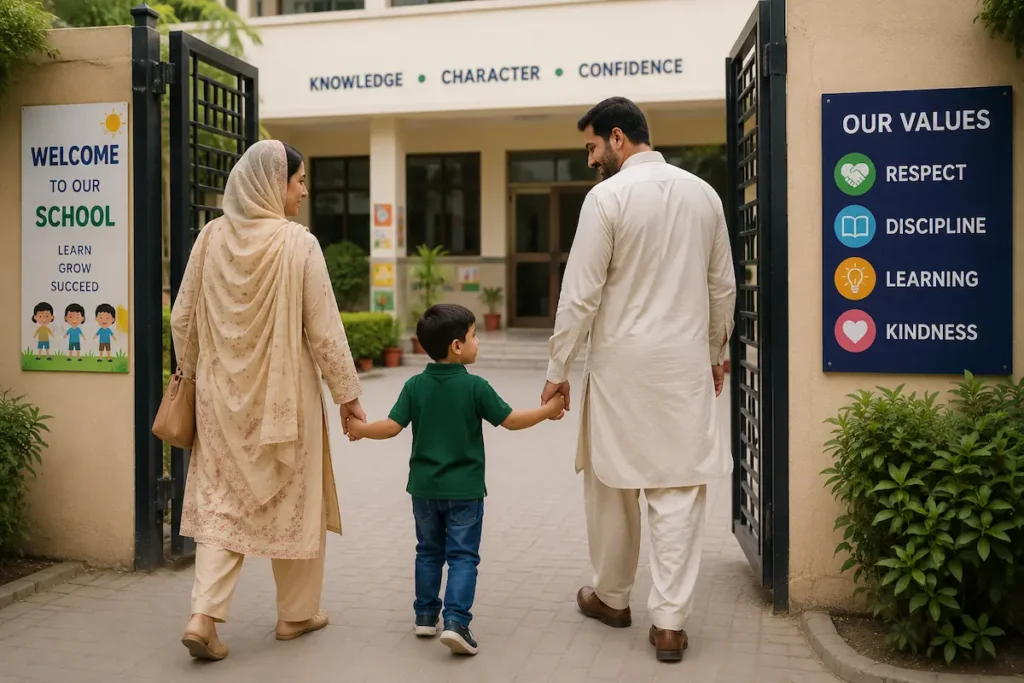
- Visit the school campus together, even if to walk through the gate. Many Pakistani schools allow this before the term begins.
- Show your child where the bathrooms are. Many young children avoid school toilets because they do not know where they are or how to ask.
- Introduce your child to the class teacher, even briefly. A familiar adult face reduces fear enormously on Day One.
- If your child will eat a packed lunch, practice using the same lunch box at home before school starts.
- Let your child carry the school bag around the house to get comfortable with the feel and weight of it.
Tip 3: Build a Predictable Routine — The Secret Weapon of Emotional Preparation for Starting School
Children feel emotionally safe when their world is predictable. One of the most effective back-to-school tips for parents in Pakistan is to start a school-like routine 2 to 3 weeks before term begins:
- Fixed wake-up time: ideally 6:00 to 6:30 am for morning schools
- Morning sequence: wash face, change clothes, eat breakfast in order, every single day
- A quiet reading or story time after lunch to simulate calm classroom periods
- Fixed bedtime: children aged 5 to 7 need 10 to 11 hours of sleep per night (AAP, 2023)
Pakistani context note: In joint families, this routine may be disrupted by late-night gatherings or relatives visiting. It is perfectly acceptable to explain to family members that your child needs consistent sleep before school starts. Most Pakistani families are very supportive when they understand the reason why.
Tip 4: Practice Social Skills at Home — The Best Way to Prepare Kids for School
School is not just a place for learning letters and numbers. It is a social environment. Children who cannot share, take turns, or manage small conflicts are at a serious disadvantage from day one. Here is how to practice social skills at home before school begins:
- Playdates: Arrange playdates with neighborhood children or cousins. Even 2 to 3 per week makes a major difference in social confidence.
- Role-play school scenarios: You play the teacher, your child plays the student. Practice raising a hand to speak, waiting for a turn, and saying “Excuse me.”
- Emotion naming: Every day, name emotions together: “Aap khush ho ya udas?” (Are you happy or sad?) This builds emotional vocabulary essential for classroom communication.
- Responsibility tasks: Give your child small daily responsibilities — packing their bag, putting their shoes by the door, carrying their own water bottle. This builds independence and self-confidence.
Tip 5: Handle Goodbye Anxiety the Right Way — Tackling First Day of School Anxiety
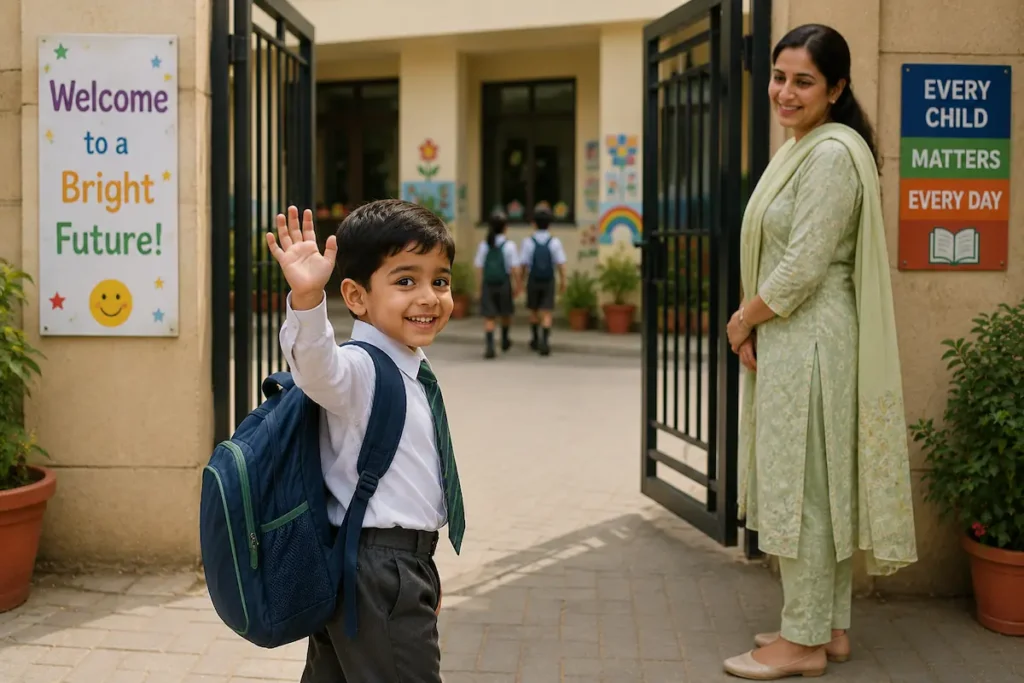
The school gate goodbye is one of the most emotionally charged moments in a child’s early life. How you handle it shapes your child’s relationship with school for years. Attachment theory (Bowlby, 1969) tells us that children who have a secure attachment to their caregivers transition more easily to new environments — IF goodbyes are handled well.
- Be calm and confident. Children read your emotions. If you look anxious, they become anxious.
- Keep goodbyes short and warm. A hug, a kiss, a reassuring phrase: “Main school ke baad aajaunga” (I will come after school). Then leave.
- Do NOT sneak away. It feels kind, but it destroys trust. Your child needs to predict your behavior.
- Create a small goodbye ritual — maybe a special handshake, or a phrase only you two share. This gives the child something to hold onto emotionally throughout the day.
- Do NOT return if your child cries. Research consistently shows children typically stop crying within 5 to 10 minutes of a parent leaving. Returning extends the anxiety.
Tip: Dua Before School
Many Pakistani families already do this: before entering the school gate, recite a dua together. This small ritual provides enormous emotional comfort to children and reinforces the sense that they are protected and loved. Use Surah Al-Fatiha or “Rabbi zidni ilma” — whatever feels natural to your family.
Tip 6: Read School-Themed Stories Together
Books are one of the most powerful tools for emotional preparation for starting school. Reading stories about school helps children mentally rehearse the experience in a safe, fictional setting. The child processes emotions through the character before they have to face them in real life.
- Books about the first days of school — available in Urdu at Liberty Books and other Pakistani bookstores
- Stories about friendship and making new friends
- Stories about children who felt scared but were brave anyway
- Books about different types of families — some with working mums, some in joint families
If books are not easily available, tell oral stories. Make up a character — “Hasan aur uski nayi school” (Hassan and his new school) — and walk your child through a positive school day story at bedtime. This technique is just as effective as picture books for emotional processing, and it costs absolutely nothing.
Tip 7: Celebrate Effort, Not Just Results — How to Reduce School Anxiety in Children Long-Term
One of the most research-backed ways to reduce school anxiety in children is to shift the family conversation from results to effort. Pakistani culture is deeply result-oriented. The first question many relatives ask is “Kitne number aaye?” (How many marks did you get?) This places enormous pressure on young children before they have even settled in.
Instead, try these phrases every day after school:
- “Aaj school mein kya naya seekha?” (What new thing did you learn today?) — Focuses on growth, not performance.
- “Tum ne aaj bohot mehnat ki” (You worked hard today) — Rewards effort, not just outcome.
- “Kya koi naya dost bana?” (Did you make a new friend?) — Emphasizes social connection over grades.
- “Koi mushkil aayi? Usse kaise solve kiya?” (Did you face a challenge? How did you solve it?) — Builds problem-solving confidence.
Research from Stanford University professor Carol Dweck on “growth mindset” shows that children praised for effort over results develop greater resilience, lower anxiety, and significantly better long-term academic performance.
6. What NOT to Do: Common Mistakes Pakistani Parents Make
| Common Mistake | Better Alternative |
| Scaring children with strict teacher stories | Share warm, positive teacher experiences instead. |
| Dismissing school anxiety (“Sher bacha hai!”) | Validate feelings: “I understand you are nervous, that is okay.” |
| Overloading children with worksheets before school | Focus on play, curiosity, and social skills. |
| Sneaking away at the school gate | Give a confident, warm, consistent goodbye ritual. |
| Asking only about marks and results | Ask about friends, experiences, and what they enjoyed. |
| Comparing siblings or cousins unfavorably | Celebrate each child’s unique progress and strengths. |
| Waiting until the night before to prepare | Start emotional preparation 4 to 6 weeks ahead |
| Using school as a punishment or threat | Frame school as an exciting adventure and opportunity |
7. Comparison Table: Emotionally Ready vs. Not Ready for School
| Area | Emotionally Ready Child | Not Emotionally Ready Child |
| Separation at the gate | May feel briefly sad but settles within 10 min | Extreme crying lasting 30+ minutes daily |
| Social interaction | Initiates play, shares toys, and can take turns | Hits, withdraws, or refuses to engage |
| Classroom behavior | Sits and listens for 10 to 15 minutes | Constantly disrupts, unable to focus at all |
| Expressing needs | Says “I need help” or “I am hungry.” | Shuts down, has tantrums, cannot communicate |
| Handling failure | Tries again with encouragement | Gives up immediately, has severe meltdowns |
| Routine acceptance | Follows the school schedule with minor resistance | Refuses attendance, frequent morning stomach aches |
| Academic engagement | Curious, asks questions, participates actively | Disengaged, anxious, and afraid to answer questions |
8. A Special Section for Working Parents in Pakistan
For Working Mothers and Dual-Income Families
Pakistan’s working mothers face a unique challenge. You are managing career demands while trying to be emotionally present for your child during this critical transition. Know this: the quantity of time matters less than the quality of time.
Practical Tips for Working Parents:
The 20-Minute Connection Ritual: Every evening, give your child 20 minutes of completely undivided attention — no phone, no chores, just connection. Ask about their day, listen fully, and play a small game. This builds emotional security faster than hours of distracted presence.Morning Goodbye Matters: Even if you leave before your child goes to school, send a voice note: “Ammi ney dua ki, school mein achi tarah jao” (Ammi prayed for you, have a wonderful day at school). This small act is enormously reassuring.Delegate Emotionally, Not Just Logistically: If Dadi or a caregiver drops off your child, ensure that person knows your child’s specific fears and has been coached in the goodbye ritual.Weekend Preparation: Use weekends for school-focused playdates, story time, and routine practice. This compensates effectively for weekday time constraints.Communicate with Teachers: Meet the class teacher in the first week. Explain your child’s specific anxieties and ask for regular updates. Pakistani teachers, especially in private schools, are generally very receptive and supportive.
9. Role of Joint Families in School Readiness
Pakistan’s joint family system is both an advantage and a challenge when it comes to school readiness.
The Advantages of Joint Family Living
- Children in joint families often have better social skills because they are used to navigating relationships with multiple adults and children of different ages.
- Grandparents can be powerful emotional anchors — a dadi’s stories and dua are often more comforting to a child than any purchased book or therapy tool.
- When both parents work, the joint family provides emotional continuity and warm care for the child after school hours.
The Challenges of Joint Family Living
- Inconsistent messages: If Ammi says “school is fun,” and Chacha says “school mein bohot maarte hain” (they discipline children a lot there), the child receives conflicting signals that increase anxiety.
- Overprotection: Grandparents may coddle children by feeding them, dressing them, and doing everything for them. This makes the self-care demands of school feel overwhelming.
- Late nights: Joint family social gatherings often run late, disrupting the sleep schedule children critically need for emotional regulation.
Solution: Hold a brief family conversation before school starts. Align everyone on the same positive messages about school, agree on a sleep routine, and gently encourage grandparents to allow the child to practice small acts of independence daily.
10. Warning Signs: When to Seek Extra Support
Warning Signs That Need Professional Attention
Most school anxiety is normal and passes within 2 to 4 weeks. However, please seek professional support if your child shows any of the following signs:Crying or tantrums lasting more than 4 weeks after school beginsFrequent physical complaints — stomach aches, headaches — every school morning, with no medical causeRegression in previously learned skills, such as bedwetting or thumb-sucking, resumingNightmares or extreme sleep difficulties for more than 2 consecutive weeksComplete refusal to eat, speak, or engage during school hoursAggressive behavior toward siblings or parents is dramatically different from before school
Where to get help in Pakistan: Child psychologists are available at Aga Khan University Hospital (Karachi), Shaukat Khanum Memorial (Lahore and Peshawar), INMOL Hospital (Lahore), and some Child Protection Bureau centers. Many offer affordable consultations.
11. Social and Emotional Learning (SEL): Pakistan’s Missing Piece
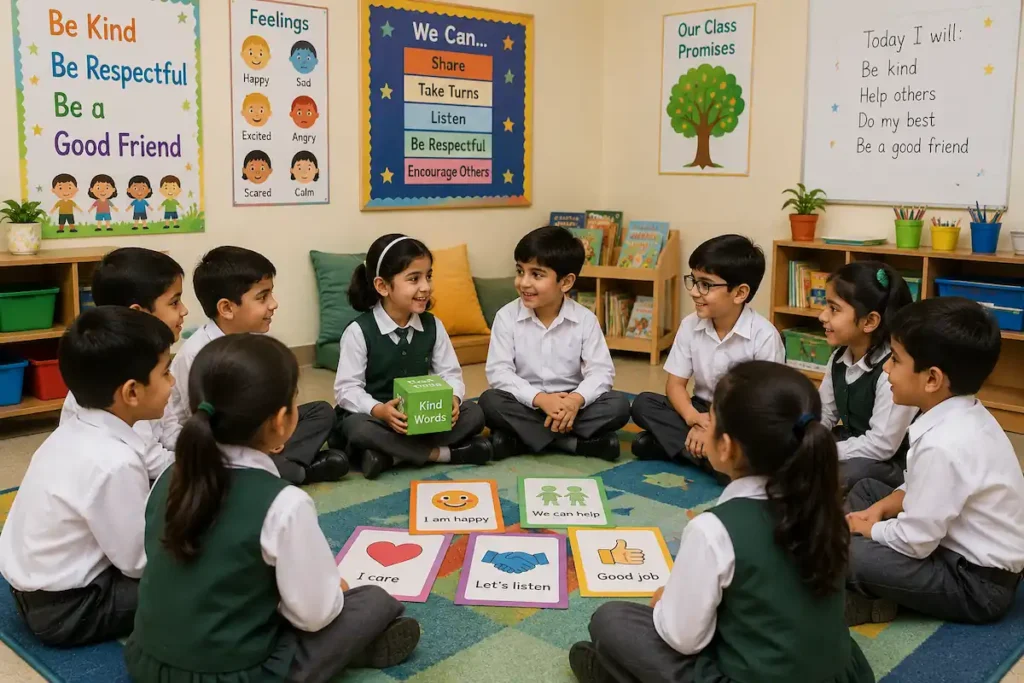
Social and Emotional Learning (SEL) is an educational approach that teaches children how to understand their emotions, manage them, build relationships, and make responsible decisions. It was formally developed by CASEL (Collaborative for Academic, Social, and Emotional Learning) in 1994, with overwhelming research evidence for its effectiveness.
A landmark 2011 meta-analysis by Durlak et al., published in Child Development, analyzed 213 school-based SEL programs and found that students in SEL programs showed an 11 percentile point gain in academic achievement, behavioral problems decreased by 24%, and rates of depression and anxiety dropped measurably.
In Pakistan, however, SEL is almost absent from the national curriculum. Daniel Goleman (1995) described emotional intelligence as the ability to “feel, manage, use, and regulate emotions of oneself and others.” Pakistan’s education system currently measures only academic intelligence (IQ), while entirely ignoring the emotional intelligence (EQ) that research shows matters equally for life success.
What Pakistani Schools Adopting SEL Are Seeing
| School / Institution | Location | SEL Initiative | Reported Outcome |
| Beaconhouse School System | Multiple Cities | Empathy Workshops and Peer Mediation | 30% reduction in bullying incidents |
| Roots International Schools | Islamabad | Emotional Intelligence Curriculum | Improved student-teacher relationships |
| Convent of Jesus and Mary | Lahore | Mental Health Awareness Campaigns | 20% reduction in absenteeism |
| Aga Khan Education Service | Gilgit-Baltistan | Whole-Child Development Approach | Higher parental engagement reported |
What you can do as a parent: Even if your child’s school does not teach SEL, you can practice its core principles at home. Name emotions together daily, teach problem-solving through role-play, model empathy in your own behavior, and celebrate kindness as much as academic achievement.
12. Resources and References
Trusted Sources and Further Reading
American Academy of Pediatrics (AAP) — School Readiness Guidelines: www.healthychildren.orgCASEL — Collaborative for Academic, Social, and Emotional Learning: www.casel.orgUNICEF Pakistan Education Resources: www.unicef.org/pakistan/educationAlif Ailaan Pakistan Education Campaign: www.alifailaan.pkIdara-e-Taleem-o-Aagahi (ITA) Pakistan: www.itacec.orgBingham, S. and Whitebread, D. (2012). School Readiness: A Critical Review. University of Cambridge.Durlak, J.A. et al. (2011). The Impact of Enhancing Students’ Social and Emotional Learning. Child Development Journal.Goleman, D. (1995). Emotional Intelligence: Why It Can Matter More Than IQ. Bantam Books.Bowlby, J. (1969). Attachment and Loss. Basic Books.Kay, L. (2018). School Readiness: A Culture of Compliance? University of Sheffield.Pakistan Journal of Medical Sciences (2020). Prevalence of Mental Health Problems Among Pakistani Adolescents.Dweck, C. (2006). Mindset: The New Psychology of Success. Random House.Hayes, D. (2025). Early Child Development. Children and Young People Now, 2025(1), 27-29.
13. Frequently Asked Questions (FAQs)
Share This With a Parent Who Needs It
If this guide helped you, please share it with another parent in your family, mohalla, WhatsApp group, or school community. Every child in Pakistan deserves to start school with confidence, curiosity, and joy — not fear and anxiety. You have the power to make that happen, starting today.For more support, speak with your child’s school counselor, visit UNICEF Pakistan at www.unicef.org/pakistan, or contact Idara-e-Taleem-o-Aagahi at www.itacec.org.
Disclaimer: This article is for informational and educational purposes only and is not intended as medical, psychological, or nutritional advice, diagnosis, or treatment. Every child, body, and pregnancy is different — please consult your pediatrician, doctor, or a qualified healthcare provider for advice specific to your situation.