
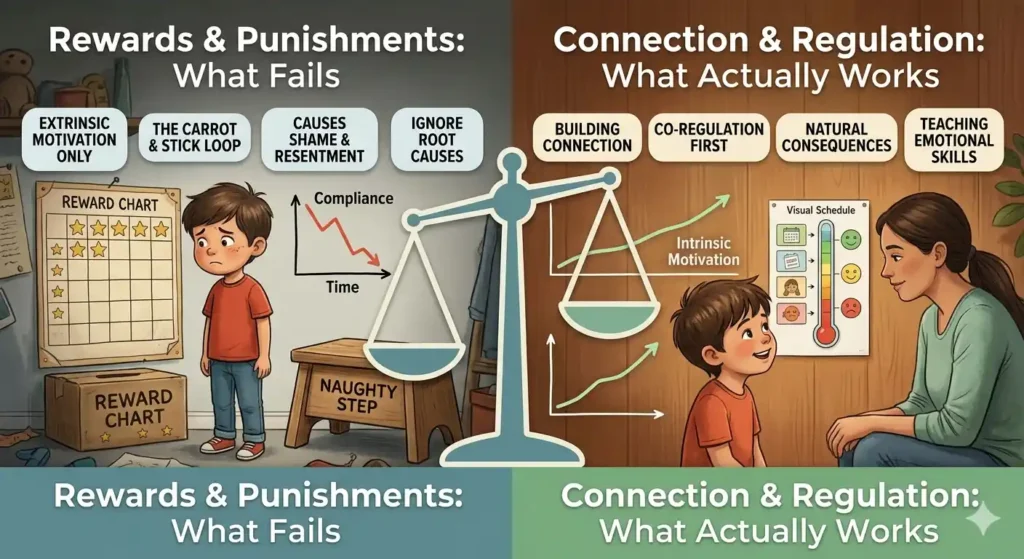
You’ve tried the sticker chart. You’ve tried taking away screen time. Maybe you’ve even tried bribing your kid with chocolate just to get through a grocery store trip without a meltdown.
And for a while, it worked. Sort of.
Then one day, it just… stopped. The sticker chart got ignored. The threats lost their bite. Your child started asking, “What do I get?” before doing anything you asked.
If this sounds familiar, you’re not failing as a parent. You’ve just run into one of the most well-documented patterns in child psychology: rewards and punishments are powerful in the short term, but they tend to lose their grip over time — and sometimes they backfire in ways nobody warned you about.
It isn’t an article telling you to throw away every reward system you’ve ever used. It’s a close look at why these tools have limits, what’s actually happening in your child’s brain when you use them, and what tends to work better for the long haul.
The Quick Fix That Doesn’t Stay Fixed
Here’s the thing about rewards and punishments: they’re designed for compliance, not understanding.
When a child gets a sticker for brushing their teeth, they learn “brushing teeth equals a sticker. “When a child loses iPad time for hitting their sibling, they learn ‘hitting equals no iPad.”
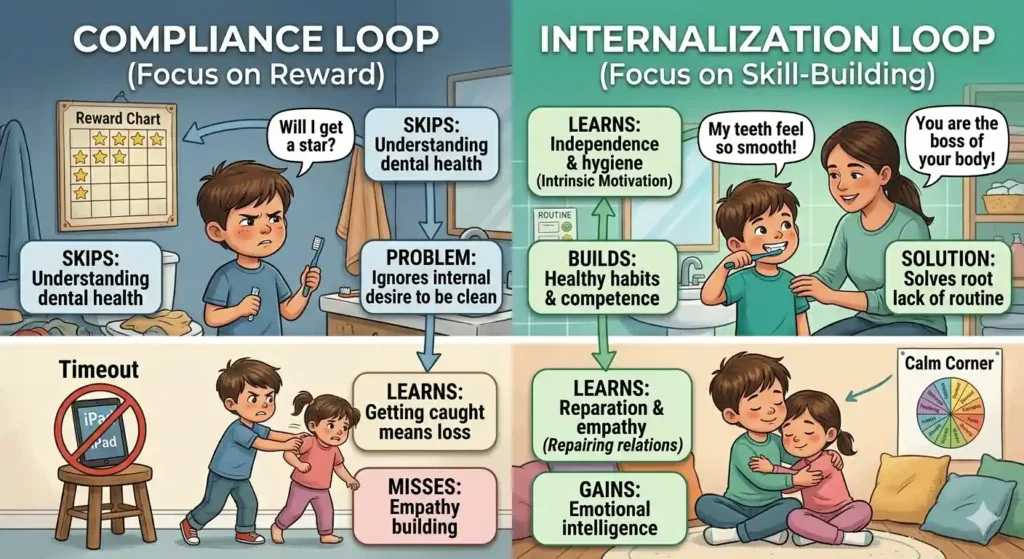
Notice what’s missing in both of those sentences? Any actual understanding of why the behaviour matters.
Brushing teeth matters because of dental health, just because of the discomfort of a cavity down the road, and due to habits that carry into adulthood. Not hitting matters because it hurts someone, because relationships matter, and because there are better ways to handle anger.
None of that gets taught through a sticker or a timeout. What gets taught is ‘do this, get that’ — or ‘don’t do this, avoid that’.
Compliance vs. Internal Motivation
Psychologists call this the difference between extrinsic motivation (doing something for an external reward or to avoid punishment) and intrinsic motivation (doing something because you understand its value or because it aligns with who you are).
Here’s a simple way to picture it. Imagine two kids who both clean their rooms every Saturday.
Kid A does it because if they don’t, they lose dessert that night.
Kid B does it because a messy room stresses them out, and they like how it feels to have things in order.
What happens when Kid A moves out and there’s no parent around to enforce the dessert rule? Probably… the room stays messy. What happens with Kid B? The habit sticks because it was never about the consequence in the first place.
This is the core problem. Rewards and punishments can shape behaviour while you’re watching – but the moment you’re not, the behaviour often goes with you.
Why Rewards Specifically Tend to Backfire
Rewards feel positive. They feel encouraged. So why would something that feels so nice cause problems?
The Overjustification Effect
There’s a classic study from the 1970s where researchers gave kids markers and paper to draw with. Some kids were promised a reward for drawing. Others weren’t told anything in advance but were given a surprise reward afterward. A third group got nothing at all.
A couple of weeks later, researchers brought the markers back out and just watched. The kids who’d been promised a reward beforehand drew significantly less than the other two groups.
Why? Because once a reward is promised in advance, the activity itself starts to feel like “work” rather than something done for its own sake. The brain reclassifies it. Drawing wasn’t fun anymore — it was a job, and the job was over.
This is called the overjustification effect, and it shows up constantly in parenting. Kids who get paid for every grade, every chore, every act of kindness can start to lose its natural inclination toward those things. The external reward crowds out the internal reason.
Reward Inflation
There’s also a practical problem: rewards tend to need to get bigger over time.
A sticker was exciting at age 4. By age 7, your kid wants a toy. By age 10, they want money. And the behaviour that used to be “normal expectations” — helping out, being kind, doing homework — now comes with a price tag attached.
Parents often don’t notice this happening gradually. It’s a slow creep. And then one day, you realise you’re basically negotiating with a tiny union rep over the terms of basic household participation.
What Rewards Teach About Conditional Worth
Here’s a subtler issue. When kids are constantly rewarded for good behaviour, they can start to internalise the idea that good behaviour is what earns approval — rather than something that’s simply part of who they are.
This sounds abstract, but it plays out in real ways. Some kids become anxious about messing up because they’re afraid of losing the “good kid” status they’ve earned. Others become very focused on being seen doing the right thing, rather than actually doing it when no one’s looking.
Why Punishments Often Don’t Work Either
Punishments have the opposite problem from rewards, but they land in a similar place.
Punishment Stops Behavior — It Doesn’t Teach Alternatives
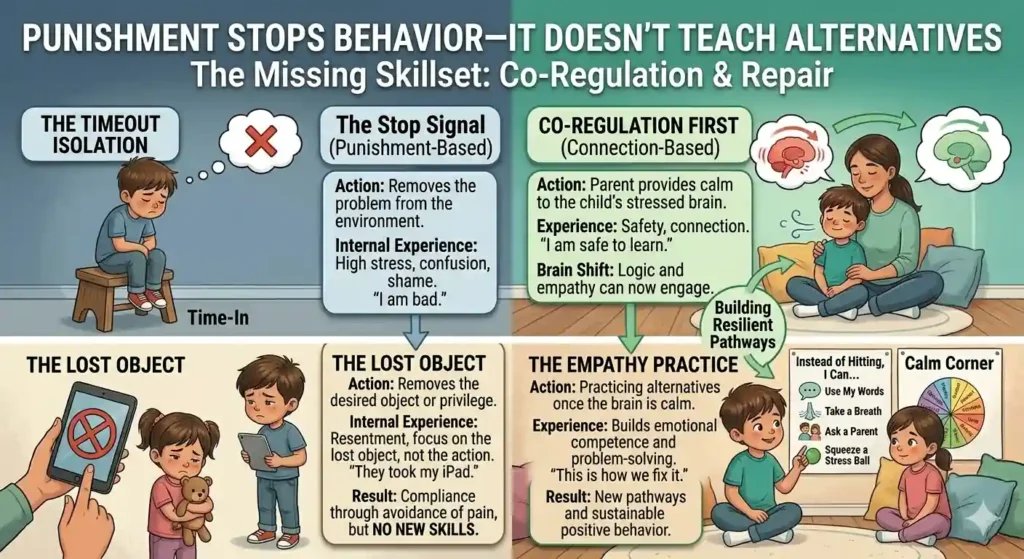
When a child gets punished for something — say, yelling at a sibling — the punishment communicates, “Don’t do that.” It does not communicate, “Here’s what to do instead when you’re frustrated.”
So the yelling might stop. But the underlying frustration is still there. And without a replacement skill, that frustration often comes out somewhere else — maybe as sulking, maybe as a different kind of outburst, maybe just bottled up until it explodes later.
The Fear Factor
Punishment relies on a kid wanting to avoid something unpleasant. That can work in the moment. But it also teaches kids to focus on not getting caught rather than on whether something is actually right or wrong.
Ever notice how some kids are perfectly behaved in front of certain adults and completely different the second that adult leaves the room? That’s often what’s happening. The behaviour was never really about values — it was about avoiding consequences from a specific person.
It Can Damage the Relationship
This one’s harder to quantify, but it matters a lot. Punishment, especially when it’s frequent or harsh, can create distance between a parent and child. Kids might start hiding things, lying more, or becoming defensive rather than open.
And here’s the irony: the more a child hides from a parent, the less that parent can actually guide them.
The relationship is what gives a parent influence in the first place. Punishment-heavy approaches can quietly erode exactly the thing a parent needs most.
So What Actually Works?
Okay, so if sticker charts and timeouts aren’t the magic answer, what is?
The honest answer is that nothing is a magic fix. But some approaches tend to build longer-lasting change because they focus on understanding and skill-building rather than just compliance.
Natural Consequences
Sometimes the best teacher is just… reality. If a kid refuses to wear a coat and gets cold, that’s a lesson the world teaches without you having to say a word. If they don’t do their homework and get a bad grade, that consequence is connected directly to the behaviour in a way no punishment can fully replicate.
This doesn’t work for everything — obviously, you can’t let a toddler “naturally experience” running into traffic. But in many everyday situations, letting natural consequences play out (within reason) teaches cause and effect in a way that sticks.
Connection Before Correction
This phrase gets thrown around a lot in parenting circles, but there’s real substance behind it. When kids feel emotionally connected to a parent — when they feel seen, heard, and understood — they’re far more receptive to guidance.
A kid who’s mid-meltdown isn’t in a state to “learn a lesson”. Their brain is in survival mode. Getting down to their level, acknowledging the feeling (“You’re really mad that we have to leave the park”), and waiting for the storm to pass – before talking about behaviour – tends to work better than diving straight into consequences.
Problem-Solving Together
Instead of “You hit your brother, so no tablet for the rest of the day,” try something like, “I noticed you hit your brother when he took your toy. What happened there? What could you do differently next time?”
This takes longer. It’s messier. Kids don’t always have great answers right away. But over time, this kind of conversation builds actual thinking skills — the ability to pause, reflect, and choose a different response. That’s the skill that sticks around long after any reward chart is forgotten.
Clear, Consistent Expectations (Without the Bribery)
There’s a difference between “If you clean your room, you get ice cream” and “In our house, everyone helps keep shared spaces tidy.” The second one frames the behaviour as a normal expectation — part of being part of the family — rather than something extra that deserves a prize.
Kids actually do better with clear, consistent expectations than with constantly shifting reward systems. Predictability matters more than incentives.
Real Praise, Used Thoughtfully
This doesn’t mean praise is bad — far from it. But there’s a difference between “Good job!” tossed out reflexively for everything and specific, genuine acknowledgement: “I noticed you waited your turn even though you really wanted to go first. That took patience.”
Specific praise like this helps kids connect their actions to character traits (“I’m more than just chasing the next ‘good job”).
A Real-World Example
Let’s say a child keeps leaving their shoes in the middle of the hallway, and people keep tripping over them.
The reward/punishment approach might look like this: “If you put your shoes away every day this week, you get a treat on Friday.” Or: “If I find your shoes in the hallway again, there’s no TV tonight.”
Both might work for a few days. But they don’t really address why the shoes end up there, and they frame the behaviour as something that needs an external push.
A different approach might sound like, “Hey, I keep tripping over your shoes in the hallway — that’s actually kind of dangerous. Can we figure out a spot near the door where they could go instead?” Then maybe you set up a little shoe basket together. The kid had input. The reasoning was explained. And the solution addresses the actual problem — not just the symptom.
It’s a small example, but this pattern — explain, involve, and problem-solve — scales up to bigger issues too.
Conclusion
Rewards and punishments aren’t “wrong”, exactly. They’re tools, and like most tools, they’re useful for some jobs and not others. A small reward here and there isn’t going to ruin a kid. An occasional consequence for a serious safety issue isn’t going to damage a relationship.
The trouble comes when these become the primary way a household runs — when every good behaviour needs an incentive, and every mistake needs a punishment. That’s when kids start optimising for the reward or the avoidance, rather than developing their own internal compass.
Building that internal compass takes longer. It’s less tidy than a chart with stickers on it. But it’s also the thing that’s still there when no one’s watching — which, ultimately, is the whole point.
Frequently Asked Question
Related Reading
- Toddler Brain Development & Foods: A Desi Guide
- Toddlers & Early Tantrums Before Age 2
- What Every Parent Should Know About Toddler Biting and Hitting
Disclaimer: This article is for informational and educational purposes only and is not intended as medical, psychological, or nutritional advice, diagnosis, or treatment. Every child, body, and pregnancy is different — please consult your pediatrician, doctor, or a qualified healthcare provider for advice specific to your situation.


Great content! Keep up the good work!