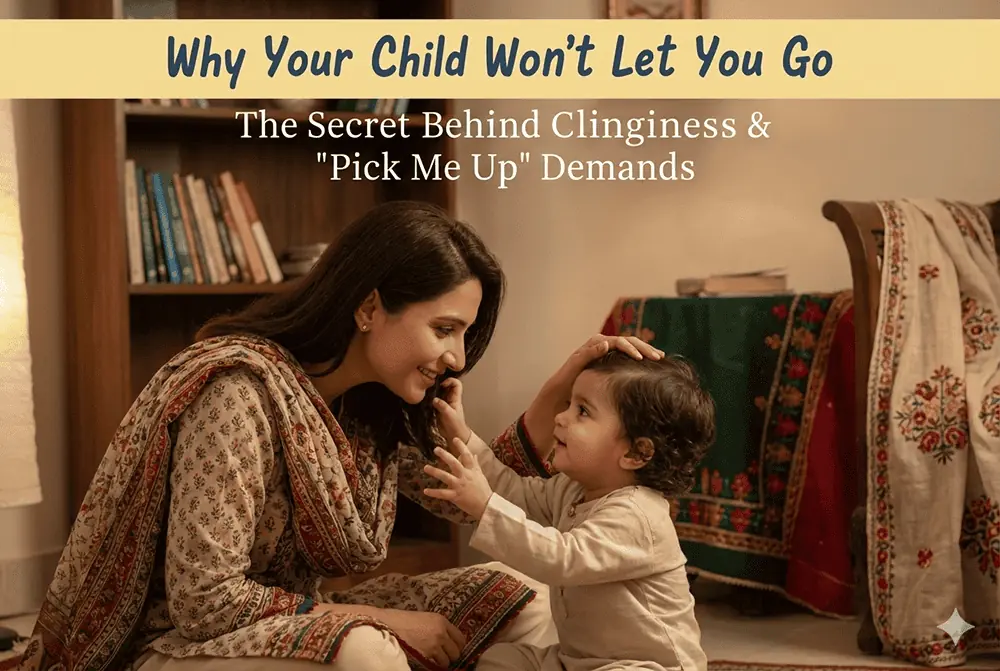
Stranger anxiety is a completely normal developmental phase where babies and toddlers become fearful or upset around unfamiliar people. It typically begins around 6-9 months, peaks at 12-15 months, and usually fades by age 2-3. It is a sign of healthy bonding — not bad parenting.
Table of Contents
1. The Scene Every Pakistani Family Knows
2. What Is Stranger Anxiety? (Simple Definition)
3. Key Facts & Numbers at a Glance
4. Stranger Anxiety Age Timeline: Month by Month
5. Signs of Stranger Anxiety in Babies & Toddlers
6. Stranger Anxiety vs. Separation Anxiety
7. Why Does Stranger Anxiety Happen? The Science Behind It
8. Joint Family Dynamics & Cultural Pressures in Pakistan
9. 7 Gentle Strategies to Help Your Baby
10. Special Section: For Working Parents & Mothers in Pakistan
11. What NOT to Do — Common Mistakes
12. When to Seek Professional Help
13. People Also Ask — Quick Answers
14. FAQs (10 Questions)
15. Trusted Resources & References
16. Schema Markup (JSON-LD)
17. Final SEO Checklist
1. The Scene Every Pakistani Family Knows
PICTURE THIS
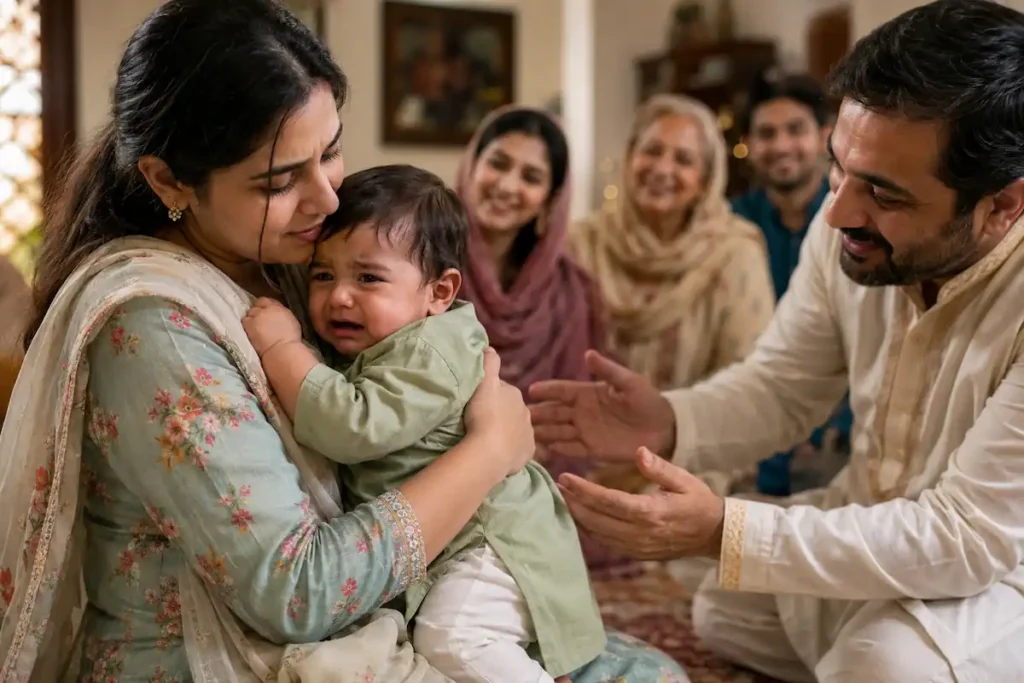
Imagine this: Eid gatherings at the family home in Lahore. Chaachu has travelled all the way from Karachi. Baji Bano has driven from the next mohalla. Everyone is excited to hold baby Zaid, who is now 9 months old. But the moment your joyful, cooing baby is passed to Chaachu – the warm-hearted man Zaid has seen in video calls – your child bursts into tears and lunges back toward you, burying his face in your dupatta. Chaachu looks hurt. Dadi mutters something about you ‘spoiling the baby. And you stand there, embarrassed, unsure whether to soothe your child or hand him back to keep the peace. Sound familiar? If yes, you are absolutely not alone, and your baby is doing exactly what is developmentally expected.
This is stranger anxiety — one of the most common yet least understood phases of early childhood. In Pakistan, where family gatherings are frequent, joint family systems are common, and babies are often passed from arm to arm as a sign of love, this phase can feel especially confusing. Parents face pressure from elders who think something is wrong with the child or with the parenting.
The good news? Stranger anxiety is not a problem to solve — it is a milestone to understand and a phase to gently navigate. This guide covers everything: what stranger anxiety is, when it starts (including baby stranger anxiety at 4 months and 5 months), how long it lasts, and 7 research-backed, culturally relevant strategies to help your child feel safe.
2. What Is Stranger Anxiety? A Simple Definition
Stranger anxiety (also called ‘fear of strangers’) is when a baby or young child becomes upset, clingy, or frightened around people they do not recognise – even people they may have met before. This happens because your baby’s brain has grown smart enough to tell the difference between familiar and unfamiliar faces. This is a sign of healthy development, not a problem.
According to the American Academy of Paediatrics (AAP), stranger anxiety is a normal and expected developmental milestone. The American Psychological Association (APA) describes it as part of a child’s cognitive development — the growing ability to recognise and prefer their primary carers.
Psychologist John Bowlby’s attachment theory helps explain this beautifully: babies are biologically wired to form strong emotional bonds with their main carers (usually parents). Once this bond is formed, unfamiliar people feel unsafe around them — and they react accordingly.
3. Key Facts & Numbers at a Glance
Some babies show stranger anxiety by 9 months old
Months: the most common age at which it first appears
months: typical peak of stranger anxiety
The age at which most children outgrow it
Do NOT develop social anxiety disorder
fall into two main anxiety patterns
Sources: 2017 longitudinal study in the Journal of Child Psychology; 2018 infant preference research; AAP developmental milestone guidelines (2026 update).
4. Stranger Anxiety Age Timeline: Month by Month
One of the most common questions parents ask is: At what age does stranger anxiety start? Here is a clear timeline based on research:
4-5 mo
Baby Stranger Anxiety at 4-5 Months: Early Signs
Most babies still smile at strangers, but some may become quieter around new faces. Baby stranger anxiety at 4 months and 5 months is an early precursor, not the peak
6-8 mo
True Stranger Anxiety Begins
By 6-8 months, babies clearly differentiate familiar faces from strangers. Crying, clinging, and hiding become common. Object permanence also develops now.
9-12 mo
Intensifying Phase
Stranger anxiety grows stronger. About 70% of babies show clear signs by 9 months. Your baby may refuse to go to grandparents or cling tightly in new environments.
12-15 mo
PEAK PHASE
Stranger anxiety peaks. Toddlers may even fear relatives they’ve met before. Tantrums, clinging, hiding, and silent freezing are all common.
18-24 mo
Gradual Improvement
Most toddlers begin to ease out of the peak phase. With gentle exposure to new people and environments, fear gradually decreases.
2-3 yr
Resolution
By age 2-3, most children have grown out of stranger anxiety. Language skills and social confidence replace the fear response.
5. Signs of Stranger Anxiety in Babies & Toddlers
In Infants (6-12 Months)
- Crying or screaming when held by a new person
- Reaching back toward the parent or familiar caregiver
- Turning the head or body away from the unfamiliar face
- Freezing or going silent when a stranger approaches
- Avoiding eye contact with unfamiliar people
In Toddlers (12 Months – 3 Years)
- Hiding behind the parents’ legs
- Clinging and refusing to let go
- Saying ‘no’ or shaking one’s head at new people
- Running away to another room
- Tantrums when forced to interact
- Becoming unusually quiet or ‘zoning out’ around strangers
- Physical symptoms — stomach ache, flushed cheeks
REASSURANCE TIP
When your baby clings to you in fear, this is a beautiful sign: it means your child has formed a healthy, secure attachment to you. Well-meaning relatives who say you are ‘spoiling’ your baby by comforting them are simply misinformed. Responding to your baby’s fear with warmth and patience builds their long-term emotional resilience.
6. Stranger Anxiety vs. Separation Anxiety
These two terms are often confused, but they refer to different fears:
| Feature | Stranger Anxiety | Separation Anxiety |
|---|---|---|
| What triggers it? | Unfamiliar people (even if the caregiver is present) | Being separated from a familiar caregiver |
| Typical age of onset | 6-9 months | 18 months – 3 years |
| Peak age | 12-15 months | 18 months – 2.5 years |
| Common behaviors | Crying, hiding, clinging when new people arrive | Tantrums when the parent leaves; distress at school drop-off |
| Typically resolves by | Age 2-3 | Age 3-4 (school entry helps) |
| Professional help if… | Persists after age 3 or is extreme | Persists past school age or is extremely disruptive |
7. Why Does Stranger Anxiety Happen? The Science Behind It
1. Attachment Theory (John Bowlby)
British psychiatrist John Bowlby’s landmark attachment theory established that human infants are biologically programmed to seek closeness to a primary carer for safety. As this bond strengthens in the first year, anything unfamiliar feels like a threat. Stranger anxiety is the natural result of this healthy bonding process.
2. Object Permanence (Jean Piaget)
Swiss developmental psychologist Jean Piaget identified that babies develop object permanence — understanding that people and objects continue to exist even when out of sight — around 6-12 months. Once a baby understands that Mama still exists when she leaves the room, they become more aware of their dependence on her – and more anxious when surrounded by unfamiliar people.
3. Evolutionary Survival Instinct
From an evolutionary perspective, stranger anxiety made sense for early human survival. Infants who stayed close to trusted family members and were cautious around strangers were less likely to come to harm. Research shows that infants demonstrate measurable increases in heart rate and cortisol (stress hormone) levels when exposed to unfamiliar adults.
4. Cognitive Development: Recognizing Familiar vs. Unfamiliar
Around 7-8 months, the brain’s facial recognition systems mature significantly. A baby who once smiled at any smiling face now clearly distinguishes between a familiar smile (safe) and an unfamiliar smile (unknown = potentially unsafe). This is a cognitive leap forward — and the fear is the temporary side effect of growing smarter.
RESEARCH INSIGHT
A 2017 longitudinal study (published in the Journal of Child Psychology) followed 107 children from 6 months to 3 years old. It found that children who showed a sharp, sudden increase in stranger fear were more likely to be described as anxious by age 8. However, it also confirmed that 60% of children with stranger anxiety did NOT develop social anxiety disorder – meaning most children naturally outgrow it.
8. Joint Family Dynamics & Cultural Pressures in Pakistan
CULTURAL CONTEXT
In many Pakistani families — both in urban centres like Karachi, Lahore, and Islamabad, and in rural areas — babies are considered ‘shared joy. Grandparents, aunts, uncles, cousins, and neighbours all feel entitled to hold and cuddle the baby. When a baby cries around these beloved relatives, it can feel socially awkward and create real tension. Elders may say, ‘Bachay ko aap ne sar charha rakha hai’ (You’ve spoiled the baby) or ‘Dena do, rota nahi rehta’ (Give him, he won’t keep crying). These feelings come from love — but forcing a baby to be passed around actually increases anxiety.
How to Gently Handle Joint Family Situations
- Explain the science to elders — frame it as ‘The doctor told us this is a healthy developmental phase. The more we force him, the longer it lasts.’ Most elders respect medical framing.
- Allow relatives to interact with the baby while you hold him — this lets familiarity build without triggering the fear response.
- Regular video calls before in-person visits — helps babies recognise faces before they arrive.
- Involve relatives in daily routines during visits – feeding, playing with toys – not just picking up the baby suddenly.
- Be the child’s advocate — gently say: ‘Let’s give him a few minutes to get comfortable.’
PAKISTAN CULTURAL TIP
At Eid gatherings, mehndi functions, or large family events, consider creating a safe zone — a quiet corner with familiar toys and a known carer nearby. Let relatives come to the baby on his terms, not the other way around. This small change can make a huge difference.
9. Seven Gentle Strategies to Help Your Baby Overcome Stranger Anxiety
Here are seven research-backed, practically tested, and culturally relevant strategies to help your baby feel safe. These are gentle — not rushed, not forceful. Remember: the goal is to help your child build trust at their own pace.
Strategy 1: Build Positive Association Before the Meeting
Before a new person visits, show your baby photos of them on your phone. Talk about them in a warm, cheerful voice: ‘Phupho is coming! She loves you so much.’ This helps the baby associate the unfamiliar face with safety before they ever meet in person. Licensed therapist Katie Ziskind recommends also letting older toddlers make a drawing or card for the upcoming visitor, reducing anxiety by building anticipation positively.
Strategy 2: Let Your Child Warm Up at Their Own Pace
Never force your child to go to someone they are fearful of. Start with you holding your baby while the new person is nearby. Then let the new person talk and play while you hold the baby. Gradually — over several minutes or even visits — your baby will begin to feel safe enough to interact. Research shows this gradual desensitisation approach can reduce anxiety by up to 30% after just a few exposures.
Strategy 3: Stay Calm — Your Baby Reads You
Children are extraordinarily sensitive to their carer’s emotional state. If you are tense or embarrassed when handing your baby to someone, your baby picks up on that anxiety and intensifies their own. Before a social situation, take a breath. Smile genuinely. Your calm is your child’s calm.
Strategy 4: Try Parallel Play
For toddlers, especially, parallel play is a wonderful bridge. Have the new person sit on the floor and play with something nearby — a toy kitchen, blocks, a book — while your toddler does their own activity. No pressure to interact. Over time, curiosity will naturally draw the child closer. This technique creates safety through proximity without demand.
Strategy 5: Introduce Comfort Objects
A familiar stuffed toy, blanket (‘lovey’), or even a piece of your clothing can serve as a comfort anchor. In environments where your baby might be held by others – a babysitter’s home, the doctor’s office, a relative’s house – having that comfort object present signals safety and stability to your child’s nervous system.
Strategy 6: Use Clear, Honest Goodbyes
When you must leave your baby with a carer, never sneak out. A sneaky goodbye feels like abandonment to a baby, making both stranger anxiety and separation anxiety worse over time. Instead, say clearly: ‘Mama is going to the bazaar. I will be back after your nap.’ The ritual of a warm, consistent goodbye builds trust.
Strategy 7: Validate — Then Gently Encourage
Acknowledge your child’s feelings without amplifying them. Say, ‘I know you feel shy right now. That’s okay. We can just sit here together.’ Then gently encourage small steps: ‘Do you want to wave hello to Chacha? Just a wave — that’s enough.’ Celebration of small, brave moments builds confidence over time.
QUICK STRATEGY SUMMARY
- Show photos and tell warm stories before the in-person meeting
- Let baby warm up gradually — never force interactions
- Stay calm yourself — your child mirrors your emotional state
- Use parallel play to build comfort through proximity
- Bring comfort objects (blanket, stuffed toy) to new environments
- Always say a clear, warm goodbye — never sneak out
- Validate feelings first, then gently encourage small, brave steps
10. For Working Parents & Mothers in Pakistan
WORKING PARENT GUIDANCE
- Show photos and tell warm stories before the in-person meeting
- Let baby warm up gradually — never force interactions
- Stay calm yourself — your child mirrors your emotional state
- Use parallel play to build comfort through proximity
- Bring comfort objects (blanket, stuffed toy) to new environments
- Always say a clear, warm goodbye — never sneak out
- Validate feelings first, then gently encourage small, brave steps
11. What NOT to Do — Common Mistakes to Avoid
WARNING — AVOID THESE MISTAKES
- Forcing your child to hug or kiss strangers teaches them that their feelings do not matter.
- Dismissing feelings with phrases like ‘Don’t be scared!’ or ‘Sharmao nahi!’ (Don’t be shy!).
- Sneaking out without saying goodbye builds mistrust and worsens anxiety long-term.
- Overly rushing introductions — stranger anxiety cannot be overcome in five minutes.
- Apologising profusely to relatives in front of your child communicates shame.
- Isolating your baby from all new people — avoidance does not resolve stranger anxiety.
12. When to Seek Professional Help
Stranger anxiety is almost always a normal, temporary developmental phase. However, there are situations where a professional opinion is recommended. Speak to your child’s paediatrician or a child psychologist if:
- Your child’s stranger anxiety does not show any improvement by age 2.5-3
- The fear is so intense that your child cannot eat, sleep, or function without the primary caregiver present
- Anxiety is increasing rather than gradually decreasing over time
- Your child shows physical symptoms — frequent stomach aches, headaches, vomiting — when around new people
- The anxiety is affecting your child’s ability to attend school or daycare
- There is a family history of anxiety disorders
PAKISTAN HEALTHCARE ACCESS
- Children’s Hospital Lahore — outpatient developmental pediatrics
- Aga Khan University Hospital, Karachi — Child Psychiatry Department
- SIUT & National Institute of Child Health (NICH), Karachi
- Private child psychologists in major cities via oladoc.com or marham.pk
- Your local Basic Health Unit (BHU) for referral guidance in rural areas
13. People Also Ask — Quick Answers
14. Frequently Asked Questions (FAQs)
15. Trusted Resources & References
- [AAP] American Academy of Pediatrics. Developmental Milestones: Baby — 6 to 12 Months. healthychildren.org
- [APA] American Psychological Association. Stranger Anxiety and Cognitive Development. apa.org
- [Study] Brooker, L. et al. (2017). Longitudinal study of stranger fear in 107 infants aged 6 months to 3 years. Journal of Child Psychology and Psychiatry.
- [Study] Famularo, R. et al. (2018). Infant preference for familiar people and early attachment formation. Developmental Psychology Journal.
- [Theory] Bowlby, J. (1969). Attachment and Loss, Vol. 1: Attachment. Basic Books, New York.
- [Theory] Piaget, J. (1954). The Construction of Reality in the Child. Basic Books, New York.
- [Pakistan] Aga Khan University Hospital — Child Psychiatry Department: aku.edu
- [Pakistan] National Institute of Child Health (NICH), Karachi: nich.org.pk
- [Web] BabyCenter. Stranger Anxiety. babycenter.com
- [Web] Healthline. How to Help Your Child Overcome Stranger Anxiety: 10 Tips. healthline.com
- [Web] Verywell Family. If Your Child Gets Stranger Anxiety, These Strategies Could Help. verywellfamily.com
Disclaimer: This article is for informational and educational purposes only and is not intended as medical, psychological, or nutritional advice, diagnosis, or treatment. Every child, body, and pregnancy is different — please consult your pediatrician, doctor, or a qualified healthcare provider for advice specific to your situation.