| ⚡ Quick AnswerComparing children to siblings, cousins, or classmates is harmful because it teaches them that their worth depends on outperforming someone else rather than on their own growth. Research links frequent comparison to lower self-esteem, higher anxiety, and strained sibling relationships. The fix isn’t to stop noticing differences between children—it’s to praise effort and personal progress instead of rank and to say so out loud, often. |
A Familiar Evening in Pakistani Homes
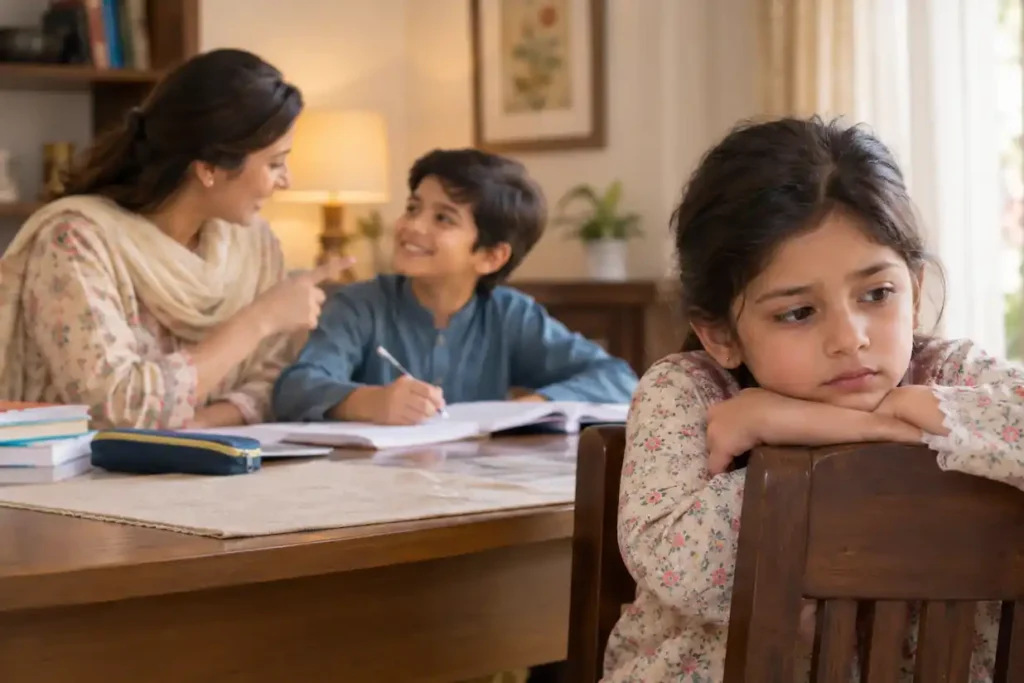
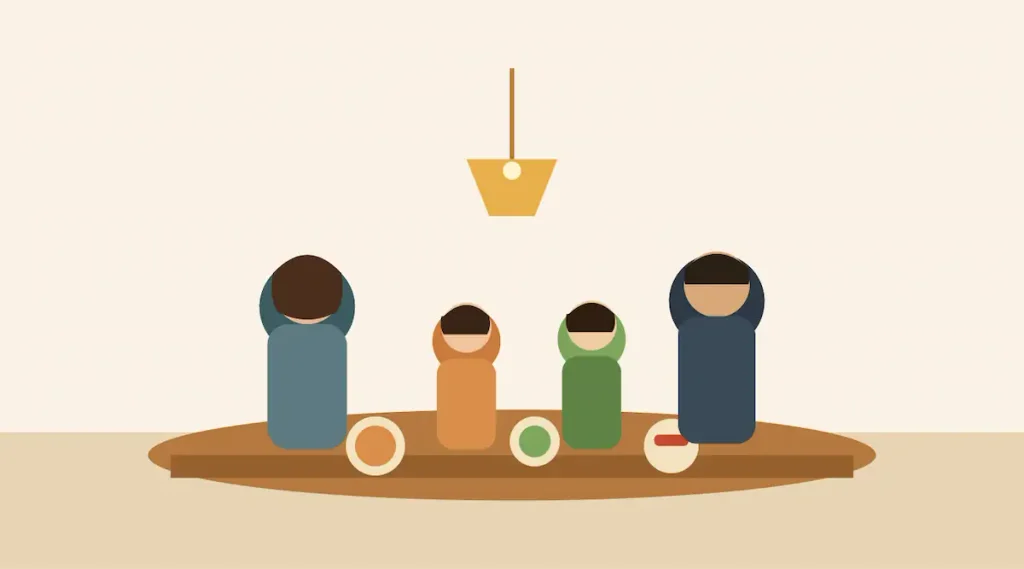
It is a scene that plays out in homes across Lahore, Karachi, Multan, and small towns like Chiniot almost every evening. Dinner is served, homework books are spread across the table, and somewhere between the daal and the report card, a parent says the words that many Pakistani children have heard at least once: “Dekho, tumhari cousin Ayesha kitne acha number laayi hai.” The remark is usually said with love, not malice — parents genuinely want their children to do well. But understanding why comparing children is harmful comes down to one simple truth: comparison quietly teaches a child to measure their worth against someone else instead of learning to value their own growth.
The same pattern shows up outside cities too. In a village in southern Punjab, a father might tell his son that the neighbour’s boy already knows how to handle the tractor or that his cousin scored higher in the matric board exams despite going to a government school with fewer resources. Whether the comparison happens in a joint family drawing room or over a video call with relatives settled abroad, the effects of comparing children can shape how a child sees themselves for years to come — often long after the specific comment is forgotten.
This guide walks through what research actually says about comparison, how it shows up in Pakistani households specifically, and what parents can do instead — without pretending that differences between children do not exist.
What Research Says About Comparing Children
Where the Habit Comes From: Social Comparison Theory
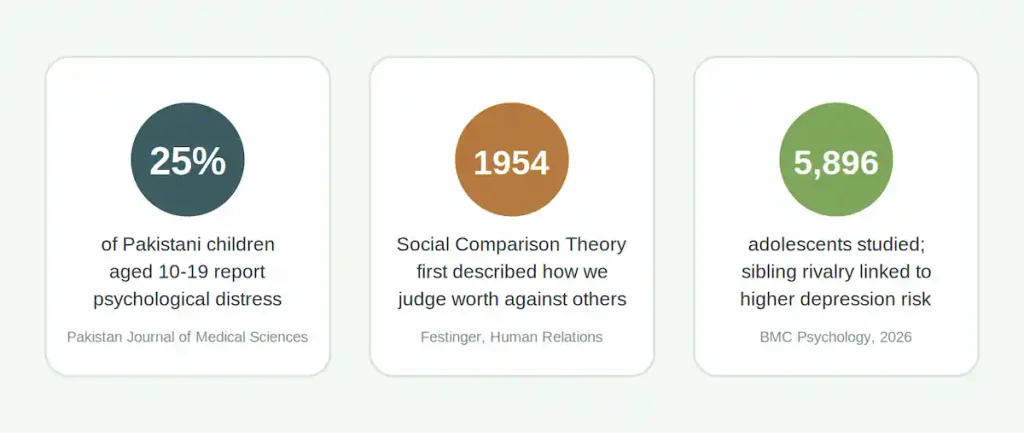
Psychologist Leon Festinger described in 1954 how people naturally evaluate their own abilities and opinions by comparing themselves with others — a tendency now known as social comparison theory. Children are not exempt from this instinct; in fact, they are especially sensitive to it, because their sense of self is still being formed. When parents actively point out that a sibling or cousin is “better,” they are not creating comparison out of nothing — they are amplifying an instinct children already have, at a stage when they have the fewest tools to manage it.
What the Sibling Studies Found
A widely cited sibling-comparison study by researcher Alex Jensen, published in the Journal of Family Psychology, found that parental comparison between siblings is extremely common and is often used as a way for parents to reassure themselves that a child’s development is on track. The trouble is what happens next: a large 2026 study in BMC Psychology followed 5,896 adolescents and found that when siblings feel they are being measured against each other for family resources and parental attention, it fuels rivalry and conflict, and that rivalry is closely tied to higher rates of depressive symptoms during adolescence.
Attachment Theory and Effort-Based Praise
Attachment theory, developed by British psychiatrist John Bowlby, explains that children build their sense of security from consistent, unconditional responses from carers. When approval feels conditional on beating someone else, that sense of security is disrupted. This is echoed by the American Academy of Pediatrics’ parenting guidance on HealthyChildren.org, which recommends praising effort and small improvements rather than outcomes or comparisons, and by peer-reviewed research showing that children praised for ability rather than effort are more likely to give up after failure and avoid future challenges.
How Comparison Shows Up at Every Age
Comparison does not affect every child the same way — it changes shape as children grow. The table below is a simple timeline parents can use to recognise what to watch for at each stage.
| Age Group | What Comparison Looks Like | Typical Impact |
|---|---|---|
| 3–5 years | Comments about height, toys, or who talks/walks earlier | Confusion, mild attention-seeking |
| 6–10 years | School marks, reading level, sports ability compared to classmates or siblings | Reluctance to try new tasks, fear of mistakes |
| 11–15 years | Exam results, board positions, physical appearance, rishta-adjacent remarks | Anxiety, withdrawal, sibling resentment |
| 16 years+ | Career choices, university admissions, marriage prospects vs. peers/cousins | Chronic self-doubt, strained family relationships |
How Comparing Children Affects Self-Esteem
The Self-Worth Trap
When children are repeatedly measured against a sibling or cousin, many begin to believe their value is conditional — that they are only “good” when they outperform someone else. Psychologists call this an external standard of self-worth. Instead of asking, “Am I improving?” a compared child starts asking, “Is someone else doing better than me?” This single shift is at the centre of how comparing children affects self-esteem: it moves the child’s attention away from their own progress, and onto a moving target they cannot control.
Fear of Trying, Not Just Feeling Bad
A well-known study on praise found that children praised for ability rather than effort were more likely to attribute failure to a lack of talent, avoid harder tasks afterward, and make less improvement over time than children praised for effort. Comparison works the same way in a household: a child who is repeatedly told a sibling is “the smart one” often stops raising their hand in class or trying difficult homework, not because they cannot do it, but because they have learned that trying and falling short feels worse than not trying at all.
Consequences That Outlast Childhood
The effects of comparing children rarely stay in childhood. Adults who grew up being compared to a sibling frequently describe carrying the habit into their careers, friendships, and marriages — constantly checking how they measure up rather than trusting their own judgement. This is one reason paediatric and family researchers increasingly recommend addressing comparison early, rather than treating it as a harmless motivational tool.
Cultural Pressures: Joint Families, Rishta Culture, and Exam Season
Comparison in Pakistan rarely comes from parents alone. In joint family systems, comments from a dada, dadi, chachi, or khala at a family gathering can carry just as much weight as anything said at home. A child who scores well is celebrated in front of the whole family; a child who does not may be gently — or not so gently — reminded of a cousin’s report card at the very same gathering. Eid visits, weddings, and Sunday lunches become recurring checkpoints where children are measured against relatives their own age.
Academic pressure adds another layer. Even before children start school, relatives commonly ask, “Number 1 aaye ga?” (Will you come first?) — a question that research on Pakistani school readiness has linked to performance anxiety in children as young as three or four. Later, board exam season and rishta-related comparisons — particularly for teenage girls — bring a second wave of pressure, where a young person’s worth becomes tied to marks, appearance, or how quickly a match is found compared to a cousin or classmate.
Healthcare access makes this harder to address. Mental health support for children remains limited across much of Pakistan: national studies estimate that around a quarter of Pakistani children aged 10 to 19 experience some form of psychological distress, yet less than one percent of the national health budget is directed toward mental health services, and trained child psychologists remain scarce outside major cities. This makes prevention — how families talk to children day to day — even more important than it might be in a context with easier access to counselling.
| ⚠ Warning: Signs Comparison May Already Be Affecting Your Child● Becomes unusually quiet or avoids answering questions about school or siblings● Refuses to attempt new activities, saying “I’m not good at anything anyway.”● Shows resentment or coldness toward a sibling or cousin who is often praised● Develops stomachaches, headaches, or reluctance before family gatherings or exam days● Talks about themselves using harsh, self-critical language they likely picked up from a comparison |
How to Stop Comparing Your Child to Others
Learning how to stop comparing your child to others does not require ignoring real differences between children — it requires changing what you say out loud and how you frame it. The following steps are small enough to start tonight.
- Catch the comparison before it leaves your mouth. Notice phrases that start with “why can’t you be like…” and pause before finishing the sentence.
- Replace ranking with reflection. Instead of “Your cousin got higher marks,” try “What do you think you learned from this test?”
- Praise the specific effort, not the general trait. “You kept trying even when it was hard” works better than “You’re so smart.”
- Set expectations with relatives ahead of gatherings. A quiet request — “Please don’t compare the kids’ marks in front of them” — prevents an awkward moment later.
- Track progress against the child’s own past, not a sibling’s present. A simple notebook of “last month vs. this month” works well for younger children.
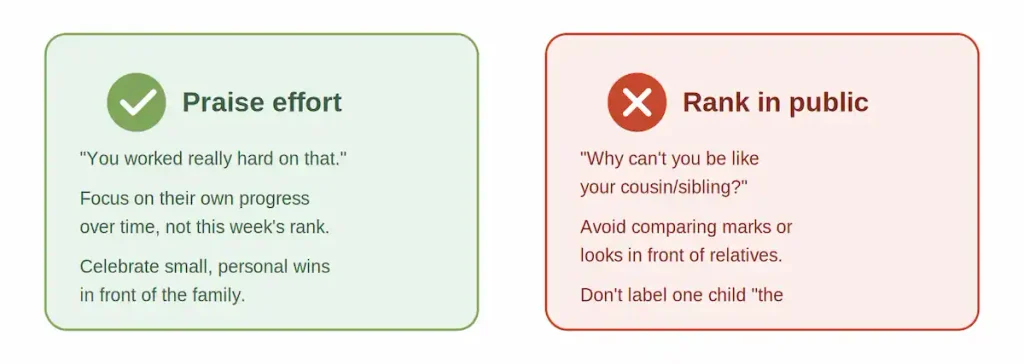
| 💡 Tip: Phrases That Replace ComparisonInstead of “Look how well your brother did,” try “I noticed how much effort you put into this — tell me about it.” Instead of “Why can’t you sit still like your cousin,” try “I know sitting still is hard for you; let’s find a way to make homework time easier.” Small wording changes like these, repeated consistently, do more to build confidence than a single big conversation ever could. |
Best Ways to Build Confidence and Self-Esteem in Kids
Parents often ask what the best way to build self-esteem in children actually looks like day to day, beyond simply avoiding comparison. The tips for building confidence in children below are drawn from paediatric guidance and can be adapted to any household, joint family or otherwise.
Praise Progress, Not Position
Recognise movement, however small: finishing a page of homework without being reminded, trying a new food, or apologising first after an argument. This is one of the most consistent findings in guidance on how to build confidence in kids — celebrate the direction of change, not the ranking.
Create Personal Goals Instead of Family Rankings
A child aiming to go from 60 to 70 percent in a subject experiences success very differently than one whose only goal is beating a cousin’s score. Personal goals keep motivation internal, so success still feels meaningful even when someone else does better.
Give Real Responsibility
Children build genuine confidence by doing things that matter, not by being told they are wonderful. Age-appropriate responsibilities — helping prepare a meal, managing their own school bag, walking a younger sibling to the gate — give children evidence of their own competence that no comparison can take away.
Model Healthy Self-Talk Yourself
Children absorb how parents speak about themselves. A parent who says “I’m so bad at cooking compared to your phupo” is teaching comparison as a habit, even unintentionally. Speaking about your own mistakes with patience shows children how to do the same for themselves.
A Note for Working Parents
For working mothers and dual-income households, the biggest challenge is often not knowing what to say — it’s finding the few consistent minutes a day to say it. A handful of practical adjustments can help:
- Protect one short window daily — even fifteen minutes during the school pickup, dinner, or bedtime routine — for undistracted conversation with each child individually.
- Brief grandparents or caregivers who spend daytime hours with the children on the same approach, so praise for effort continues consistently even when you are at work.
- Use a shared family notebook or phone note to jot down one thing each child did well that week, so both parents can reference specific progress rather than defaulting to comparisons out of convenience.
- If household help or a nanny is involved, include them in the conversation about not comparing siblings — children hear these comments from every adult in the home, not just parents.
- On weekends, use one-on-one outings or errands as a natural setting for the kind of reflective conversation that is hard to fit into a weekday evening.
When to Seek Professional Support
Most day-to-day comparison can be addressed at home with the changes above. However, professional support is worth considering if a child shows persistent sadness or withdrawal lasting more than two weeks, a sharp drop in academic or social engagement, ongoing sleep or appetite changes, or if they express feeling hopeless or say they want to hurt themselves — in that last case, please reach out to a doctor, school counsellor, or mental health professional promptly rather than waiting.
Access to child psychologists is still limited in many parts of Pakistan, but options are growing: several private hospitals in major cities now have child psychology departments, a number of licensed therapists offer online sessions, and some schools have started introducing counsellors. A paediatrician is often the most accessible first point of contact and can refer families onwards if needed.
Healthy Encouragement vs. Harmful Comparison
| Situation | Harmful Comparison | Healthy Encouragement |
|---|---|---|
| Report card day | “Your cousin got an A, why didn’t you?” | “You improved from last term — tell me what worked.” |
| Sibling milestones | “Your sister was walking/reading by this age.” | “Everyone gets there at their own pace — you’re doing great.” |
| Family gathering | Announcing one child’s marks over another’s in front of relatives | Asking each child privately what they enjoyed learning this month |
| Sports or hobbies | “Why can’t you play like your friend?” | “I saw you practising — what do you want to work on next?” |
| Mistakes | “Even your younger cousin wouldn’t make that mistake.” | “Mistakes happen — what would you try differently next time?” |
Frequently Asked Questions
Conclusion: Raising Confident Children Without Comparison
Comparison often comes from a place of care — parents want their children to do well and sometimes reach for the nearest example to make a point. But as the research throughout this guide shows, the effects of comparing children tend to work against that very goal, chipping away at confidence rather than building it. Pakistani families carry an additional layer of pressure from joint family expectations, exam culture, and rishta-related judgement, which makes it even more worthwhile to be deliberate about the words used at home.
The good news is that the shift does not require a dramatic parenting overhaul. Small, repeated changes — praising effort, asking reflective questions, briefing relatives ahead of gatherings, and giving each child room to grow at their own pace — add up over months and years into a child who trusts their own progress rather than constantly measuring it against someone else’s.
If this guide resonated with your own family’s dinner-table moments, consider sharing it with a relative before the next family gathering — sometimes the most useful thing we can do is start the conversation before the comparison does.
Resources & References
Festinger, L. (1954). A Theory of Social Comparison Processes. Human Relations. — https://journals.sagepub.com/doi/10.1177/001872675400700202
Jensen, A. — Sibling comparison study, Journal of Family Psychology (summarised) — https://www.betterup.com/blog/sibling-comparison
Sibling relationships and adolescent depression — BMC Psychology (2026) — https://link.springer.com/article/10.1186/s40359-026-04502-9
Bowlby, J.—Attachment Theory overview, Simply Psychology — https://www.simplypsychology.org/bowlby.html
American Academy of Pediatrics — Building Blocks for Healthy Self-Esteem, HealthyChildren.org — https://www.healthychildren.org/English/ages-stages/gradeschool/Pages/Helping-Your-Child-Develop-A-Healthy-
9 Ways to Boost Your Child’s Self-Esteem — Nemours KidsHealth — https://kidshealth.org/en/parents/boost-self-esteem.html
Effects of Ability and Effort Praise on Children’s Failure Attribution — PMC — https://www.ncbi.nlm.nih.gov/pmc/articles/PMC6176062/
Improving Children’s Mental Health in Pakistan — Annals of King Edward Medical University — https://annalskemu.org/journal/index.php/annals/article/view/6083
Youth Mental Health in Pakistan: Prevalence, Barriers and Strategies — https://developmentinsightslab.com/mental-health-challenges-among-pakistani-youth-a-comprehensive-analysis-of-barriers-global-best-practices-and-strategic-interventions/
7 Expert Tips to Prepare Children Emotionally for School in Pakistan — Momistan — https://momistan.com/blog/prepare-children-emotionally-for-school/
Illustrations in this article are original graphics created for Momistan and are not sourced from third parties.
| DisclaimerThis article is for informational and educational purposes only and is not intended as medical, psychological, or nutritional advice, diagnosis, or treatment. Every child, family, and household is different please consult your paediatrician, doctor, or a qualified healthcare provider for advice specific to your situation. |
Disclaimer: This article is for informational and educational purposes only and is not intended as medical, psychological, or nutritional advice, diagnosis, or treatment. Every child, body, and pregnancy is different — please consult your pediatrician, doctor, or a qualified healthcare provider for advice specific to your situation.