✅ Quick Answer
Baby milestones by age are general ranges, not deadlines, for skills like sitting, crawling, walking, babbling, and first words.
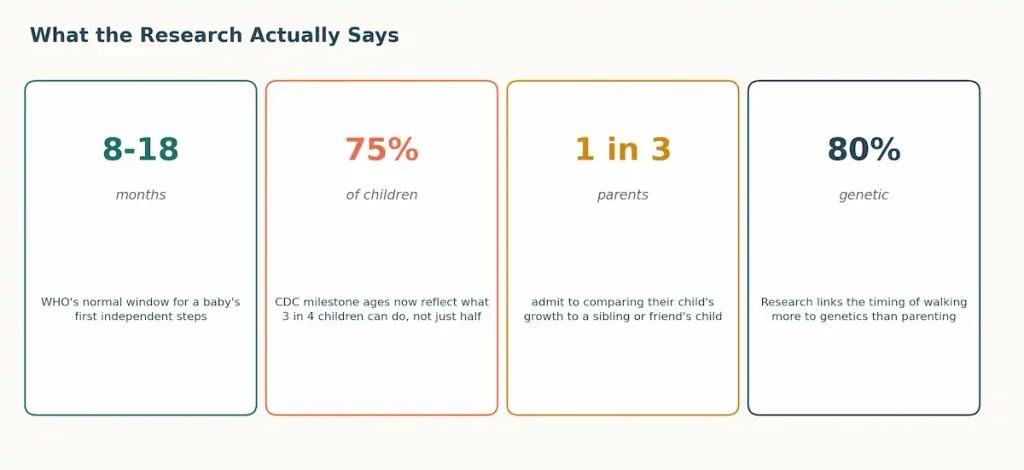
CDC checklists now mark the age by which 75% of children (not just 50%) reach a skill, and WHO research puts independent walking anywhere between 8 and 18 months.
For Pakistani parents navigating joint-family comparisons, the healthiest approach is tracking your own child’s steady progress and speaking to a paediatrician or Lady Health Worker early if you notice lost skills, no progress over several months, or a pattern of concern — not waiting for a scheduled check-up.
Why Every Chai Time Becomes a Comparison Contest
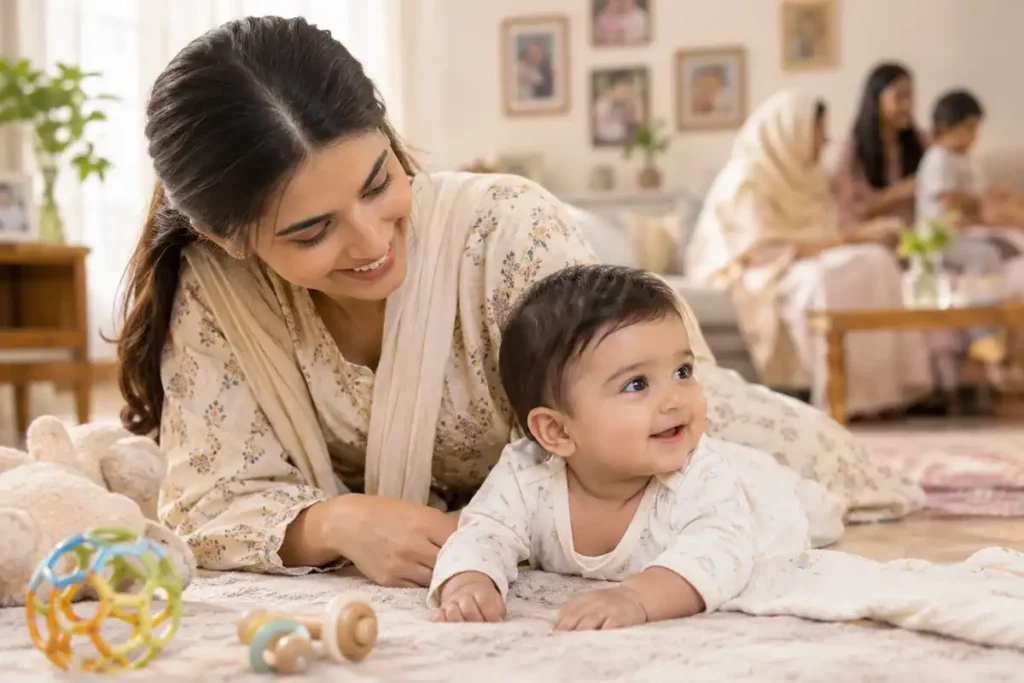
It’s a Sunday afternoon at Dadi’s house in Lahore, and the drawing room is full of relatives, chai cups, and the usual gentle chaos of a joint-family gathering. Your ten-month-old is happily banging a spoon on the floor while your cousin’s baby, born the same week, is already taking wobbly steps across the room. Before anyone says a word, you feel it: that familiar tightening in your chest. Understanding baby milestones by age can turn this exact moment from a source of anxiety into a source of confidence, because once you know what the research actually says about “normal”, the comparison instinct starts to lose its grip.
The scene repeats itself across the country in different settings — a WhatsApp family group where someone posts a video of a first step, a courtyard in a Punjab village where an aunt remarks that “is umar mein tou mera beta bol raha tha”, and a Karachi apartment where two mothers quietly size up whose baby is sitting up straighter. None of it comes from unkindness. It comes from love, worry, and a culture that has always measured children against each other, whether in exams, rishtas, or crawling. But development doesn’t work like a race, and the sooner that becomes clear, the calmer the whole journey feels.
What Are Baby Development Milestones, Really?
Developmental milestones are skills or behaviours that most babies pick up within a given age window, grouped into four broad areas: movement and physical skills (motor), talking and understanding language (communication), thinking and problem-solving (cognitive), and connecting with people (social-emotional). Researchers arrive at these ages by observing thousands of children over time and noting when a skill typically appears — not by deciding what a “correct” baby should do.
This is the part that surprises most parents: a milestone chart was never meant to be a finish line. It’s a statistical description of a range, built from population data, and every child sits somewhere within that range rather than at one fixed point.
In 2022, the CDC (the U.S. Centers for Disease Control and Prevention) revised its milestone checklists together with the American Academy of Paediatrics (AAP) for the first time in nearly two decades. The older lists were based on the 50th percentile — the average child — which meant that by definition, half of all healthy babies had “not yet” reached a listed milestone at that age. The revised checklists now mark the age by which at least 75% of children are expected to show a skill, specifically so that a missing milestone is a clearer, more actionable signal rather than a source of everyday panic.
Baby Milestones by Age: The Complete Timeline
Here is a general timeline of baby development milestones by age, covering movement, communication, and social skills. Remember: these are common patterns, not a checklist your baby has to “pass” on schedule.
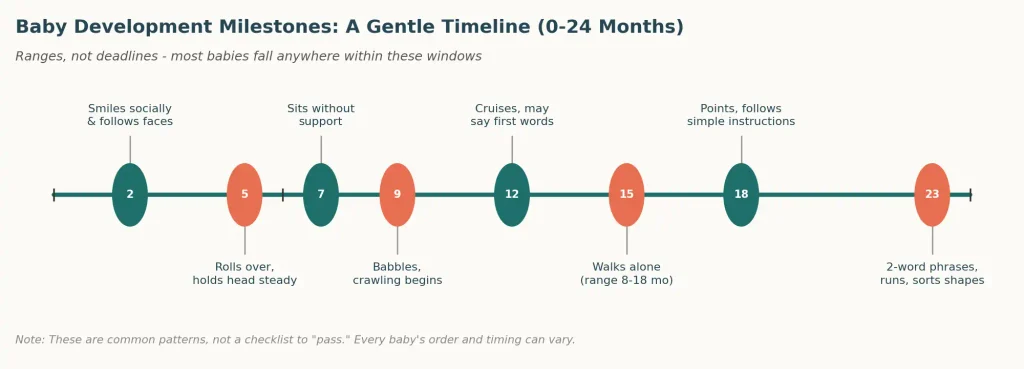
Newborn to 3 Months
- Motor: lifts head briefly during tummy time; moves arms and legs actively.
- Communication: coos, makes throaty sounds, cries differently for hunger versus discomfort.
- Social: begins to smile at familiar faces (usually by 6-8 weeks) and calms when picked up.
4 to 6 Months
- Motor: rolls from tummy to back, holds head steady, and may push up on hands during tummy time.
- Communication: babbles with different sounds, laughs out loud, blows raspberries.
- Social: recognises parents and primary carers, enjoys being played with, reaches for toys.
7 to 9 Months
- Motor: sits without support, begins to move toward crawling — rocking, scooting, or a proper crawl.
- Communication: strings syllables together (“baba,” “mama” without meaning yet), responds to their name.
- Social: shows mild wariness of strangers, plays simple games like peekaboo.
10 to 12 Months
- Motor: pulls up to stand, cruises along furniture, and some babies take independent first steps.
- Communication: waves bye-bye, may say one or two words with meaning (“abba”, “no”).
- Social: points to show interest, imitates simple actions like clapping.
13 to 18 Months
- Motor: walks independently (the broader normal window runs from about 8 to 18 months).
- Communication: vocabulary grows to several words, following simple one-step instructions.
- Social: shows affection, may have early tantrums as independence grows.
19 to 24 Months
- Motor: runs, climbs, kicks a ball, and walks up steps with support.
- Communication: combines two words (“more milk,” “papa aaya”), vocabulary expands rapidly.
- Social: engages in pretend play, plays alongside other children, begins to show independence and preferences.
A quick comparison of “average” versus the genuinely normal range makes the picture clearer:
| Milestone | Commonly cited average | Genuinely normal range |
| Sitting without support | 6 months | About 4 to 9 months |
| Crawling | 8-9 months | About 5 to 13.5 months (some babies skip crawling) |
| Standing alone | 11 months | About 7 to 17 months |
| Walking independently | 12 months | About 8 to 18 months |
| First meaningful word | 12 months | About 10 to 15 months |
| 50-word vocabulary | 24 months (older standard) | By 30 months for 75% of children (2022 CDC update) |
Data ranges drawn from WHO Multicentre Growth Reference Study motor milestone windows and CDC/AAP 2022 milestone checklist revisions; see the Resources section for full references.
How Often Should a Newborn Eat? Feeding Milestones by Age
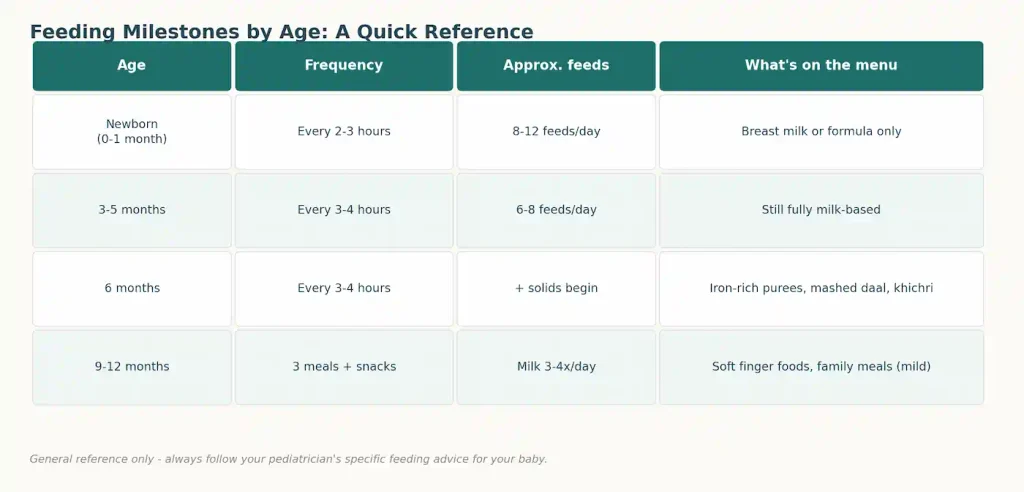
Feeding milestones move alongside developmental ones, and Pakistani parents juggling advice from dadi, the LHW, and the pediatrician often end up with three different schedules. Here is the straightforward version: a newborn typically needs feeding every 2 to 3 hours, which works out to roughly 8 to 12 feeds a day for the first few weeks, whether breastfed or formula-fed. Newborn feeding is demand-led, meaning hunger cues — rooting, sucking on hands, fussing — matter more than the clock.
By 3 to 5 months, most babies stretch feeds to every 3 to 4 hours as their stomach capacity grows and night feeds space out. This is also the stage where families frequently ask about starting solids early; global infant feeding guidance from the WHO and AAP continues to recommend exclusive breastfeeding (or formula, where medically needed) for the first 6 months, with solids introduced after that point.
What Is a Normal Feeding Schedule for a 6-Month-Old?
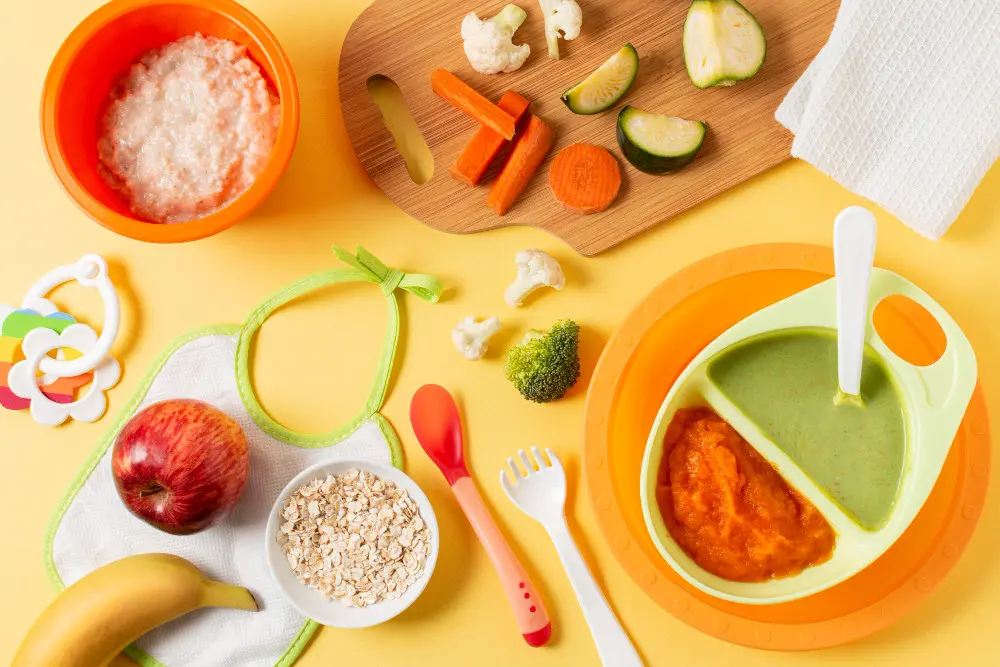
At 6 months, most babies are developmentally ready for solids: they can sit with support, have lost the tongue-thrust reflex that pushes food back out, and show interest in what’s on the family’s plate. A normal feeding schedule for a 6-month-old usually keeps breast milk or formula as the main source of nutrition, with one or two small solid meals added — iron-rich purees, well-mashed daal, khichri, or mashed banana are common and culturally familiar starting foods in Pakistani households.
💡 Tip Box: Starting Solids the Simple Way
Offer single ingredients first for a few days each, so it’s easier to spot any reaction.
Skip added salt, sugar, and honey in the first year; let natural flavours come through.
Let your baby explore texture and mess — self-feeding with fingers builds motor skills faster than being fed only purees.
Keep offering milk feeds on demand; solids at this age are “practice”, not full meals yet.
The Science Behind the Ranges: WHO, CDC and Attachment Theory
The World Health Organization’s Multicentre Growth Reference Study followed thousands of infants across Ghana, India, Norway, Oman, and the United States to map exactly when healthy babies reach six major motor milestones. The results, still cited by pediatricians worldwide, show wide and overlapping windows: sitting without support between roughly 4 and 9 months, hands-and-knees crawling between about 5 and 13.5 months, standing alone between about 7 and 17 months, and walking alone between about 8 and 18 months. The study’s own authors describe these windows as evidence of normal variation, not a race to the earliest number.
On the language side, the CDC’s 2022 revision (developed with AAP input from a panel of child-development experts) pushed several benchmarks later and added new checklists for 15 and 30 months. A 50-word vocabulary, for instance, is now placed at 30 months rather than 24, because that is when 75% of children reliably reach it. The goal was not to lower standards but to make a genuinely missed milestone a clearer signal to seek an evaluation, replacing the old “wait and see” habit.
Alongside physical and language milestones sits emotional development, best explained by attachment theory — the work of British psychiatrist John Bowlby and psychologist Mary Ainsworth. Bowlby proposed that babies are biologically wired to seek closeness with a caregiver who acts as a “secure base”: a safe point to return to that allows the child to explore the world with confidence. Ainsworth’s research showed that a caregiver’s consistent, sensitive response to a baby’s cues — picking them up when they cry, responding to their babbling, making eye contact during feeds — is one of the strongest predictors of secure attachment. For Pakistani families, this is reassuring: attachment theory does not require one exclusive caregiver. A baby comforted reliably by a mother, a dadi, a khala, or a trusted ayah can form secure attachments with all of them, as long as the responses are warm and consistent.
💡 Tip Box: Building Secure Attachment in a Joint Family
Consistency matters more than who is holding the baby — keep responses to crying, hunger, and play warm across every caregiver.
Loop in regular carers (Dadi, Nani, and Ayah) on the baby’s cues and routines so responses stay predictable.
Skin-to-skin contact, eye contact during feeds, and responding promptly to distress all support secure attachment, regardless of who is doing it.
Why Comparison Feels So Natural in Pakistani Families
Comparing children is close to a national pastime, and it rarely comes from malice. A national parenting poll from the University of Michigan found that roughly one in three parents admit to comparing their child’s development to an older sibling or a friend’s child — and in a culture where extended family lives close, gathers often, and speaks its mind freely, that number likely feels low. Joint-family life means more eyes on every milestone: more aunts noticing a late tooth, more uncles remarking on a quiet toddler, and more WhatsApp groups sharing videos of someone else’s baby walking.
The trouble is that this pressure doesn’t stay harmless. Research studying anxiety and growth in Indian paediatric populations — a cultural and clinical context close to Pakistan’s — found measurable links between heightened parental anxiety and children’s developmental and emotional outcomes. In plain terms, a parent’s comparison-driven stress doesn’t stay contained to the parent; it can ripple into the child’s environment. Separate research on developmental screening in South Asian families found that specific, pattern-based concerns (“my child hasn’t gained any new skills in three months”) were far more useful in catching real delays than vague, comparison-based worry (“my child hasn’t caught up to their cousin”).
None of this means relatives should stop caring, or that milestone conversations should be avoided at gatherings. It simply means the question worth asking is not “is my child ahead of or behind theirs?” but “is my child steadily progressing in their own way?” That reframe alone takes most of the sting out of a chai-time comparison.
How to Track Baby Milestones the Right Way
A milestone list is most useful as a memory prompt and a conversation-starter for the pediatrician, not a daily scorecard. Instead of running through a long checklist every evening, try four simple questions once every few weeks:
- What’s new? Look for a small change — a new sound, a more deliberate reach, a gesture to ask for something — rather than a polished performance on demand.
- What are they practising? Development often looks unfinished before it looks obvious; a baby may rock before crawling or repeat sounds for weeks before a real word appears. It’s fine to note “beginning to…” rather than a strict yes or no.
- Is it consistent across settings? A skill your baby shows only once, while overtired or unwell, is less meaningful than one you notice at home, at nani’s house, and at daycare.
- Is anything specifically worrying me? This is the question that matters most — more than any single missed date on a chart.
💡 Tip Box: What’s Actually Worth Writing Down
One sentence per note: what happened, roughly when, and any question for the doctor.
Skip daily totals, comparisons with other babies, or predicted “achievement dates” — they add pressure without adding information.
Photos and videos are optional keepsakes, not proof you need to collect for every attempt.
The Best Way to Support Baby Development at Home
The best way to support baby development at home doesn’t require expensive toys or structured classes — it relies on ordinary, repeated interaction. A few things genuinely help, across every domain:
- Floor time and tummy time: even a few minutes several times a day builds the neck, shoulder, and core strength babies need for sitting, crawling, and eventually walking.
- Narrating daily life: describing what you’re doing (“ab hum haath dho rahe hain”) in whatever language feels natural at home builds vocabulary long before a baby can speak.
- Responding to babbling as if it’s conversation: pausing, making eye contact, and responding to coos and babbles teaches turn-taking, a foundation of later speech.
- Reading and rhymes: board books, lullabies, and nursery rhymes in Urdu, Punjabi, Sindhi, Pashto, or any home language all support language development equally well.
- Safe exploration: letting a baby reach, grab, and even make a mess (within safety limits) builds motor planning and problem-solving faster than a passive high chair or walker.
Grandparents and older siblings are an asset here, not a source of pressure, once the household agrees to focus on the baby’s own pace rather than comparisons. A dadi singing the same lori every night, or a khala who always narrates the walk to the balcony, is doing real developmental work — even if she’d never call it that.
For Working Parents: Tracking Milestones Without the Guilt
Working mothers and dual-income households in Pakistan often carry an extra layer of anxiety: the fear of missing a first step or first word because they were at the office. A few practical adjustments make this lighter to carry.
- Keep a shared, simple log: a notes app or a small notebook that whoever is home with the baby — nanny, dadi, daycare staff — can jot one line into (“reached for the spoon today”). This means no single carer has to “catch” every moment alone.
- Ask caregivers specific questions, not just “how was the day”: “did she try to stand today?” or “is he babbling more?” gets far more useful information than a general update.
- Protect a short daily ritual: even 15-20 focused minutes after work — floor play, a bath, a bedtime story — matter more for attachment and development than hours of passive togetherness.
- Talk to daycare or the domestic staff about consistency: feeding times, comfort routines, and response to crying should stay similar across caregivers, since consistency (not who is present) is what attachment research points to.
- Let go of the idea that you must witness every first: a milestone reached at daycare or with a grandparent is still your baby’s milestone, and the secure attachment that matters most builds over thousands of small, ordinary interactions, not a handful of “firsts.”
If your workplace offers flexible hours around a baby’s early months, use them for the routine-building stage (roughly 0-6 months) when feeding and sleep patterns are still settling — it tends to pay off in a calmer second half of the first year.
When Should Babies Reach Milestones — and When to Ask for Help
Knowing the broad ranges is reassuring, but it’s equally important to know when a concern is worth raising rather than waiting on. Pediatric guidance consistently points to a few signals that matter more than any single late milestone:
⚠ Warning Box: Signs Worth a Pediatrician Visit
Loss of a skill the baby previously had (regression), rather than simply a slower start on a new one.
No visible progress at all in an area — movement, communication, or social interaction — over several months.
A consistent pattern of difficulty across more than one domain at once, rather than one area lagging while others move along fine.
Using one side of the body noticeably more than the other.
Any concern that persists even when relatives are reassuring you it’s “normal” — a parent’s instinct is data too.
For babies born preterm, expectations should generally use corrected age — calculated from the original due date rather than the birth date — for at least the first two years, a practice recommended by the UK’s NICE guidelines and widely used by pediatricians in Pakistan as well. Corrected age isn’t a reason to dismiss a genuine concern; it simply compares a baby to a more appropriate developmental age.
Importantly, there is no need to wait for a scheduled well-baby visit if something feels off. A concern can be raised with a pediatrician, a Lady Health Worker, or a government maternal and child health centre at any point — early conversation, not a perfect checklist, is what actually helps.
Do’s and Don’ts: A Quick Reference
Healthcare Access in Pakistan: Who Can Help
Pakistan’s community-based Lady Health Worker (LHW) programme, active since 1994, remains one of the most accessible first points of contact for growth monitoring, breastfeeding counselling, and immunization guidance, particularly in rural and semi-urban areas. LHWs work alongside the national Expanded Programme on Immunization (EPI), which has provided free childhood vaccination since 1978 and follows a fixed schedule from birth through 15 months.
- Urban families: pediatricians at private clinics or teaching hospitals can perform structured developmental screening; many now also offer telehealth consultations for a quick milestone check between visits.
- Rural or semi-urban families: the local LHW or a government Basic Health Unit (BHU)/Rural Health Centre is often the fastest, no-cost way to flag a concern and get a referral.
- All families: keep the child’s vaccination and growth card (often issued at birth) updated — it’s a useful, low-effort developmental record that doctors already know how to read.
Whichever option is available, the same principle applies: a five-minute conversation about a specific concern is worth more than months of quiet comparison.
Frequently Asked Questions
Before You Go
Every baby in this article walked, talked, and grew on their own timeline — and so will yours. If this guide helped you feel a little steadier at the next family gathering, bookmark it for the next stage, or share it with a friend who’s mid-comparison-spiral of her own. Momistan will keep adding age-specific guides as your baby grows, so you always have a calm, well-researched place to check facts before Google (or Chachi) gets to you first.
Resources
- CDC — Learn the Signs. Act Early. Developmental Milestones
- CDC — Key Points about the Revised Milestone Checklists
- WHO Multicentre Growth Reference Study — Motor Development Milestones
- American Academy of Pediatrics — Developmental Milestones
- NICE Guidance — Use of Corrected Age for Preterm Infants
- University of Michigan National Poll on Children’s Health — Milestones: How Parents Understand Child Development
- WHO EMRO — Expanded Programme on Immunization, Pakistan
- Simply Psychology — John Bowlby’s Attachment Theory
- World Health Organization — Infant and Young Child Feeding
Disclaimer: This article is for informational and educational purposes only and is not intended as medical, psychological, or nutritional advice, diagnosis, or treatment. Every child, body, and pregnancy is different — please consult your pediatrician, doctor, or a qualified healthcare provider for advice specific to your situation.
Disclaimer: This article is for informational and educational purposes only and is not intended as medical, psychological, or nutritional advice, diagnosis, or treatment. Every child, body, and pregnancy is different — please consult your pediatrician, doctor, or a qualified healthcare provider for advice specific to your situation.