

It is 8:30 on a Tuesday morning in a Lahore kitchen. Ammi is frying paratha, Abbu is looking for his office ID card, and two-year-old Ibrahim is sitting on the floor with a handful of daal chawal from the pot cooling on the counter. In the ten seconds it takes his mother to turn around, he has gone silent — no cry, no cough, just wide eyes and a hand at his throat. This is the moment every parent fears, and it happens in homes across Karachi, Faisalabad, Peshawar, and small villages alike, usually without warning. Knowing exactly what to do in the first 60 seconds of choking first aid for children is the single most useful skill a parent, dadi, nanny, or older sibling can carry into that moment.
| A quick note before we startThis article shares general information to help you feel informed — it isn’t a diagnosis or a substitute for your doctor’s advice. If something here concerns you, please reach out to a healthcare professional or dial 1122. |
Quick Answer
| If a child is choking and cannot cough, cry, or breathe: 1) Shout for help. 2) Give up to 5 back blows between the shoulder blades. 3) If that fails, give chest thrusts (under 1 year) or abdominal thrusts (over 1 year) up to 5 times; 4) Keep alternating and call Rescue 1122 immediately. If the child becomes unresponsive, start CPR and continue until help arrives. |
How Do You Know a Child Is Choking?
Recognising the signs early is the first step in learning how to help a choking child. Not every cough is an emergency, and knowing the difference protects you from panicking when a simple cough would have cleared the airway on its own.
Mild Choking — Airway Partly Blocked
The child can still cough forcefully, cry, or speak, even if it sounds strained or wheezy. In this situation, the best way to respond to child choking is to stay calm, stand nearby, and encourage them to keep coughing. Do not pat the back or reach into the mouth — you could push the object further in.
Severe Choking — Airway Completely Blocked
This is a true emergency. Watch for:
- No cough, cry, or sound at all
- Clutching or pointing at the throat
- Silent, panicked expression or wide, desperate eyes
- Lips, tongue, or nails turning blue or grey
- Struggling to breathe, or no breathing at all
- Going limp or losing consciousness
If you see these signs, do not wait — begin child choking first aid steps immediately.
| By the Numbers• Choking is one of the leading causes of injury and death in children under 5 worldwide.• US data recorded 305,814 nonfatal choking injuries and 2,347 choking deaths in children aged 0–19 over a 16-year period — children under 5 accounted for 73% of the injuries and 75% of the deaths.• Roughly six in ten paediatric choking cases involve food; about three in ten involve coins or small objects.• Brain injury can begin after about 4 minutes without oxygen — which is exactly why the first 60 seconds matter so much. |
The First 60 Seconds: A Visual Timeline
When every second feels like a minute, having a mental map of what to do when a child is choking keeps you moving instead of freezing. The timeline below breaks the response into four manageable stages.
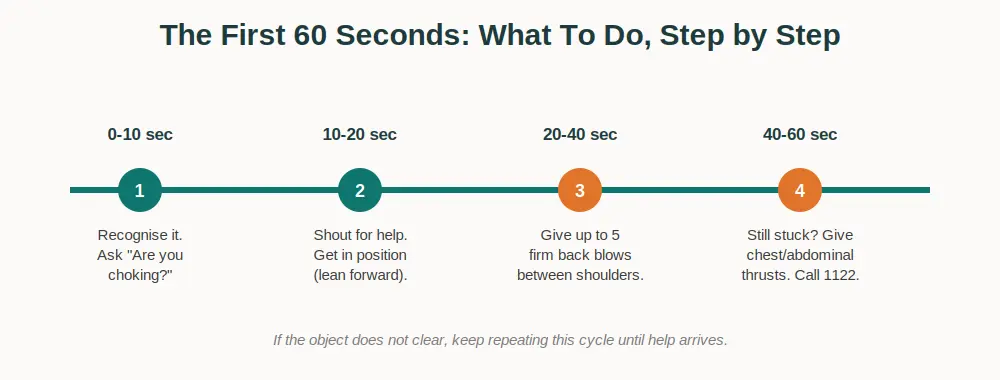
In practice, these stages overlap — you may be shouting for a family member to call 1122 while you are already leaning the child forward for back blows. The goal is not to follow a rigid stopwatch but to move through the sequence without hesitating.
Choking First Aid for Infants Under 1 Year
Babies have delicate, narrow airways, so infant choking first aid uses gentler, more controlled movements than the technique used for older children.
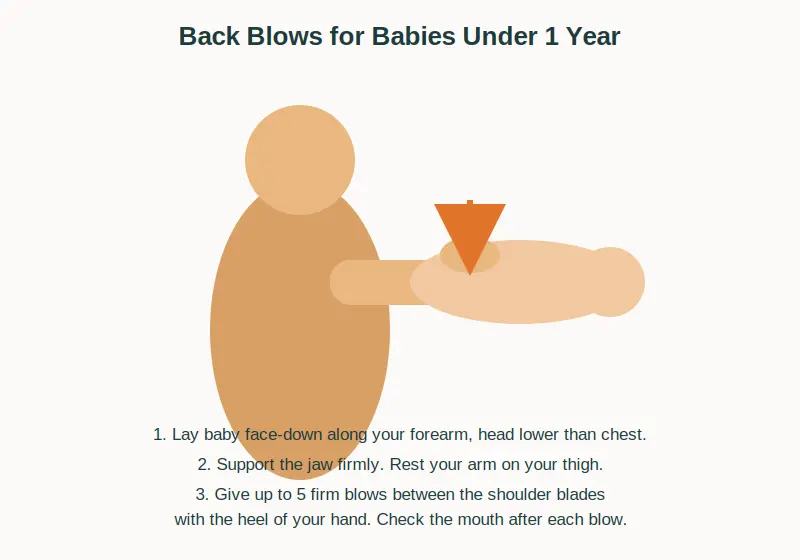
Step-by-Step: Back Blows
- Sit down and lay the baby face-down along your forearm or thigh, with the head lower than the chest.
- Support the jaw and head firmly with your hand — do not squeeze the throat.
- Using the heel of your other hand, give up to 5 firm, sharp blows between the shoulder blades.
- Check the mouth after each blow. If you can see the object clearly, remove it — never sweep blindly.
Step-by-Step: Chest Thrusts
- If back blows do not work, turn the baby face-up along your thigh, with the head lower than the body.
- Place two fingers in the centre of the chest, just below the nipple line.
- Give up to 5 sharp, downward chest thrusts.
- Alternate 5 back blows and 5 chest thrusts, checking the mouth each time, until the object clears or the baby becomes unresponsive.
Choking First Aid for Toddlers and Children Over 1 Year
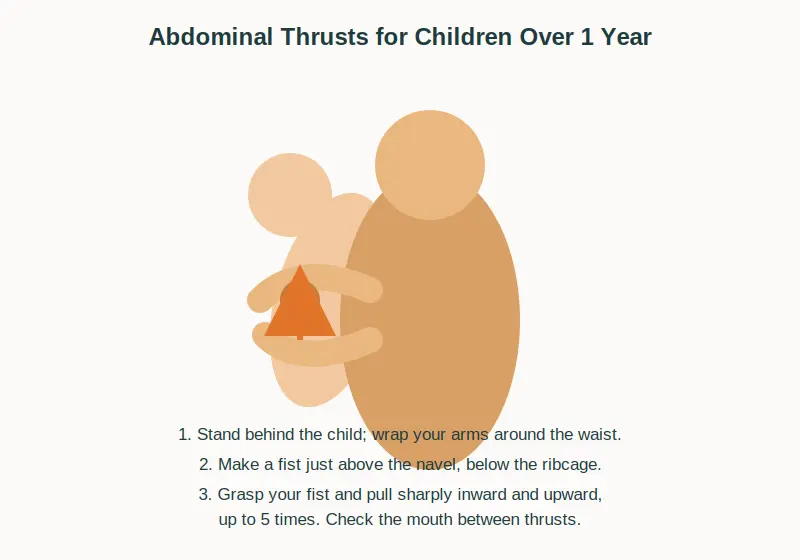
Once a child can stand and walk, the technique shifts to abdominal thrusts, also known as the Heimlich manoeuvre — one of the most searched terms for how to help a choking child.
Step-by-Step: Back Blows
- Help the child lean forward, supporting their chest with one hand.
- With the heel of your other hand, give up to 5 firm blows between the shoulder blades.
- Check the mouth after each blow.
Step-by-Step: Abdominal Thrusts
- Stand or kneel behind the child and wrap your arms around their waist.
- Make a fist and place it just above the navel, well below the ribcage.
- Grasp your fist with your other hand and pull sharply inward and upward, up to 5 times.
- Alternate between 5 back blows and 5 abdominal thrusts until the object comes out or the child stops responding.
Quick Comparison by Age
| Age Group | Back Blows | Second Technique |
| Infants (under 1 year) | Up to 5 blows between shoulder blades, baby face-down along your forearm, head lower than chest | Chest thrusts — 2 fingers, centre of chest, just below the nipple line |
| Toddlers & children (1 year+) | Up to 5 back blows between shoulder blades, child leaning forward | Abdominal thrusts (Heimlich) — fist above navel, pull inward and upward |
| Any age, unresponsive | Stop back blows/thrusts. | Start CPR immediately and call 1122. |
What NOT to Do During a Choking Emergency
| Avoid These Common Mistakes• Do not sweep the mouth blindly with your finger — this can push the object deeper.• Do not give water, food, or a spoonful of desi remedies during an active choking episode.• Do not shake the child upside down or slap the face — this is a myth, not a treatment.• Do not attempt abdominal thrusts on an infant under 1 year — use chest thrusts instead.• Do not delay calling 1122 while you keep trying “just one more time” — help should already be on the way. |
When and How to Call for Emergency Help in Pakistan
Call for help the moment you recognise severe choking — do not wait to see if back blows work first. In most of Pakistan, dialling 1122 connects you to Rescue 1122, the government emergency ambulance, fire, and rescue service that operates in Punjab, Khyber Pakhtunkhwa, Sindh, Gilgit-Baltistan, and Azad Kashmir. The Edhi Foundation’s 115 ambulance service is another free, nationwide option, and in Karachi the Chhipa Foundation can be reached on 1021.
When you call, stay as calm as your voice allows and clearly state that a child is choking, the exact location, the child’s approximate age, and whether they are conscious and breathing. Mention if you have already started back blows or thrusts, and follow any instructions the operator gives you while you wait.
| Tip: Save Emergency Numbers NowRescue 1122 (nationwide government service): 1122Edhi Foundation Ambulance (free, nationwide): 115Chhipa Foundation (Karachi and Sindh): 1021Even without mobile credit, these numbers work on any working SIM with network coverage. |
For Working Parents: Building a Choking-Safe Routine
Many Pakistani mothers and fathers juggle office hours with a toddler at home, cared for by a nanny, a grandparent, or a daycare. A working parent cannot always be in the room when a choking episode happens, which makes preparation — not presence — the real safety net.
- Walk your domestic help or day-care staff through the back-blow and abdominal-thrust steps yourself; even a short five-minute demonstration helps.
- Write the choking-hazard food list (grapes, nuts, hard sweets, boiled eggs cut in halves) on a card stuck to the fridge for whoever is feeding your child that day.
- Ask your child’s daycare or school directly whether staff are trained in paediatric first aid — it is a fair and reasonable question to ask.
- Keep your own and your partner’s phone numbers, plus one backup contact, written somewhere visible for the carer, not just saved in a phone that might be on silent during a meeting.
- If you commute, know the fastest route home and the nearest hospital with a paediatric emergency room, in case you need to meet an ambulance there instead of at home.
Joint Family Homes: Turning Numbers Into Teamwork
In many Pakistani households, children are raised alongside dadi, nani, chachi, and older cousins, all under one roof. This can be a real safety advantage — more eyes on a toddler during a meal — but only if everyone in the house, not just the mother, actually knows the choking first aid steps. It is worth spending one evening walking the whole family through this guide together, including older siblings who are often the first ones nearby when something goes wrong.
Cultural pressure to “not make a fuss” or to try a home remedy first can cost precious seconds. It is completely acceptable — and expected — to interrupt a family gathering, call out loudly for help, and start first aid immediately. No one will fault you for acting fast.
Access to a nearby hospital varies widely between urban centres like Lahore or Islamabad and smaller towns or rural areas. If you live somewhere without quick hospital access, treat first-aid training as even more essential, and know in advance which government or private facility is closest and reachable by road.
What Happens After the Object Comes Out
Even once a child starts breathing, crying, or coughing normally again, the episode is not necessarily over. Watch closely for the next few hours for a lingering cough, drooling, difficulty swallowing, wheezing, or unusual sleepiness, and take the child to a doctor the same day if any of these appear.
Any child who received abdominal thrusts should be examined by a doctor, even if they seem completely fine afterward, because thrusts can occasionally cause minor internal bruising, and part of the swallowed object may remain lodged further down. This is standard, precautionary advice, not a sign that something has necessarily gone wrong.
Tips to Prevent Choking in Children
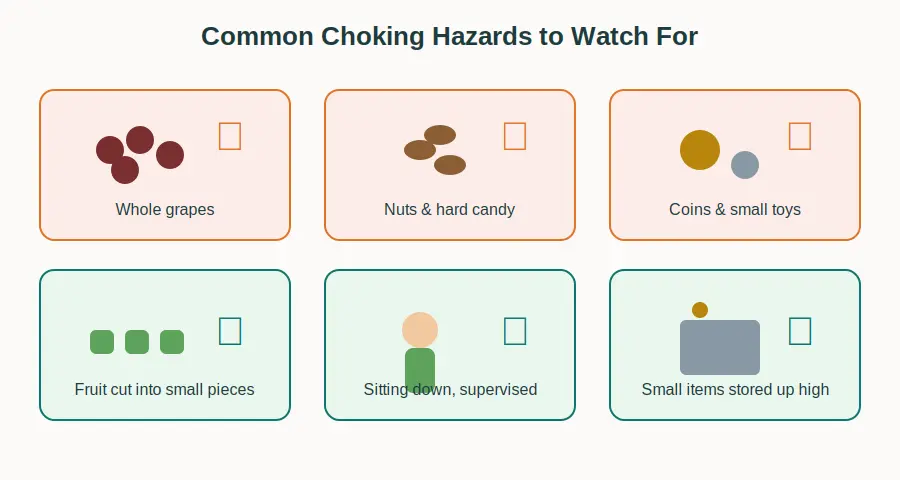
Prevention will always be safer and calmer than treatment. A few consistent habits at home dramatically lower the risk of a choking episode ever happening.
Safe Eating Habits
- Cut grapes, cherry tomatoes, and boiled eggs into quarters, not halves.
- Avoid whole nuts, popcorn, hard sweets, chewing gum, and thick spoonfuls of peanut butter for children under 4.
- Cook vegetables until soft rather than serving them raw and hard.
- Always have children sit down to eat — never while walking, playing, laughing, or in a moving rickshaw or car.
A Safer Environment
- Store coins, buttons, marbles, safety pins, and button batteries well out of reach.
- Check the floor and under sofas regularly, especially once a baby starts crawling.
- Choose age-appropriate toys — if a toy part fits through an empty toilet-paper roll, it is too small.
- Teach older siblings not to share their small toys or snacks with a younger baby or toddler.
These habits are also useful for anyone researching choking first aid for toddlers specifically, since toddlers are the age group most likely to explore food and objects by mouth.
Frequently Asked Questions
Resources and Further Reading
The guidance in this article draws on established paediatric and public-health sources. For deeper reading or to verify anything here with your own healthcare provider, these are a good starting point:
- American Academy of Paediatrics — Choking Prevention for Babies & Children — https://www.healthychildren.org/English/health-issues/injuries-emergencies/Pages/Choking-Prevention.aspx
- American Academy of Pediatrics — Prevention of Choking Among Children (Paediatrics journal) — https://publications.aap.org/pediatrics/article/125/3/601/72642/Prevention-of-Choking-Among-Children
- Persistence of Choking Injuries in Children — national US injury data, 2001–2016 — https://pubmed.ncbi.nlm.nih.gov/33819896/
- Rescue 1122 — Punjab Emergency Service, official information — https://www.rescue.gov.pk/ambulanceservice.aspx
- Rescue 1122 — overview and provincial coverage — https://en.wikipedia.org/wiki/Rescue_1122
This article was prepared with reference to publicly available first-aid guidance from paediatric health organisations; no attachments accompany this piece, but the sources above are freely accessible online for further verification.
Before You Go
A choking emergency is over in under a minute, one way or another — which is exactly why it is worth spending five minutes today walking through these steps with your spouse, your parents, or whoever else shares mealtimes with your children. If this guide helped, consider sharing it in your family or mothers’ WhatsApp group; it might be the five minutes that matters most for someone else’s Tuesday morning.
Disclaimer: This article is for informational and educational purposes only and is not intended as medical, psychological, or nutritional advice, diagnosis, or treatment. Every child, body, and pregnancy is different — please consult your paediatrician, doctor, or a qualified healthcare provider for advice specific to your situation.
Disclaimer: This article is for informational and educational purposes only and is not intended as medical, psychological, or nutritional advice, diagnosis, or treatment. Every child, body, and pregnancy is different — please consult your pediatrician, doctor, or a qualified healthcare provider for advice specific to your situation.