

Are your shoulders burning after every feeding session? Here is how to know if your posture needs help and how to pick the perfect feeding cushion.
Then reality hits on day two.
Your upper back aches. Your shoulders feel locked up in an awkward shrug. Your right arm goes completely numb ten minutes into a nursing session, but you dare not move because your baby just fell asleep.
Sound familiar?
Newborns eat constantly. Between 8 and 12 times in a single 24-hour window, to be exact. When each session lasts anywhere from twenty to forty minutes, you are essentially sitting in one spot holding a heavy weight for up to eight hours a day.
Without proper physical support, your body pays a heavy price. Many new mothers blame themselves or assume this pain is just part of the job. But it isn’t. Recognizing the early signs you need a nursing pillow can protect your spine, improve your baby’s latch, and turn painful feeds into peaceful bonding moments.
Let’s break down the five unmistakable warning signs that your current setup isn’t working—and exactly what features to look for when shopping for the right solution.
5 Unmistakable Signs You Need a Nursing Pillow
If you aren’t sure whether a dedicated breastfeeding cushion is worth the nursery space, pay close attention to how your body feels during feeds. Your body gives clear feedback when it lacks proper support.
1. Your Neck, Back, and Shoulders Ache After Every Feed
This is the most common red flag for new mothers.
When you feed your baby without structured support, your instinct is to lean forward and lower your chest to meet your baby’s mouth. Lactation consultants call this “bringing the breast to the baby.” It feels natural at first, but it ruins your spinal alignment.
Hunching over pulls on your neck muscles, strains your upper spine, and locks your shoulder blades in a tight grip. Doing this dozens of times a week leads to intense muscle spasms, tension headaches, and lingering middle-back pain.
A firm feeding cushion elevates your baby directly to chest height. It forces you to sit back against your chair, relax your shoulders down, and let the cushion hold the weight.
2. You’re Constantly Struggling to Get a Deep, Painless Latch
Latching issues aren’t always about tongue ties or milk supply. Very often, they are purely mechanical.
If your baby is resting too low on your lap, they have to stretch their neck upward to reach the nipple. This awkward angle leads to a shallow latch. When a baby latches shallowly, they pinch—causing severe nipple soreness, friction blisters, and frustration for both of you.
When you use an ergonomic nursing pillow, your baby lies flat on their side with their head, neck, and hips in a straight line. Their mouths line up naturally with your breast. They don’t have to strain, reach, or twist. A good latch gets so much easier when gravity isn’t pulling your baby away from you.
A Quick Posture Check:
Next time you start a feed, ask yourself: am I leaning down toward my baby, or is my baby resting up near my chest? If you are leaning forward more than a few degrees, your body needs structured support immediately.
3. You’re Recovering From a C-Section or Abdominal Birth
C-section recovery is no joke. Sitting upright while holding a 7-to-10-pound baby directly over a fresh surgical incision is painful, to put it mildly.
Even if you had a vaginal birth, pelvic floor soreness and perineal tearing can make standard sitting positions excruciating. You cannot afford extra weight pressing down on your abdomen or pelvic region.
A structured nursing pillow wraps around your waist or sits snugly across your thighs. It creates a protective barrier over your lower belly, distributing your baby’s weight across the pillow rather than resting directly on your healing body. For C-section moms, this simple layer of protection is a total lifesaver.
4. Your Arms, Forearms, or Wrists Go Numb Mid-Feeding
Have you ever experienced a pins-and-needles sensation spreading down your forearm while holding your baby? Or felt a sharp pain along your thumb and wrist every time you lifted them?
You aren’t alone. This wrist pain is so frequent among new mothers that clinicians call it “mother’s wrist” (De Quervain’s tenosynovitis). It happens because your tendons get inflamed from continuously supporting your baby’s heavy head with a bent wrist.
You shouldn’t have to act as a human shelf. A quality nursing cushion carries 90% of your baby’s body weight, letting your arms rest gently around them without straining your joints.
5. You Build a Wall of Sofa Pillows That Instantly Collapses
We have all done it. You grab two couch cushions, a bed pillow, and a rolled-up towel to prop under your elbow before sitting down to nurse.
It feels cozy for about three minutes.
Then your baby wiggles. The bed pillow slides out to the left. The couch cushion squishes down flat. Your baby sinks into the crevice between your knees, and suddenly you are back to hunching over, holding everything together with your knees held high.
Standard pillows are designed for soft head support, not structural baby support. They lack the density and shape required to keep an infant stable. If your current setup involves constant readjusting and pillow-stacking, it is time for a purpose-built solution.
What to Look For When Buying a Nursing Pillow
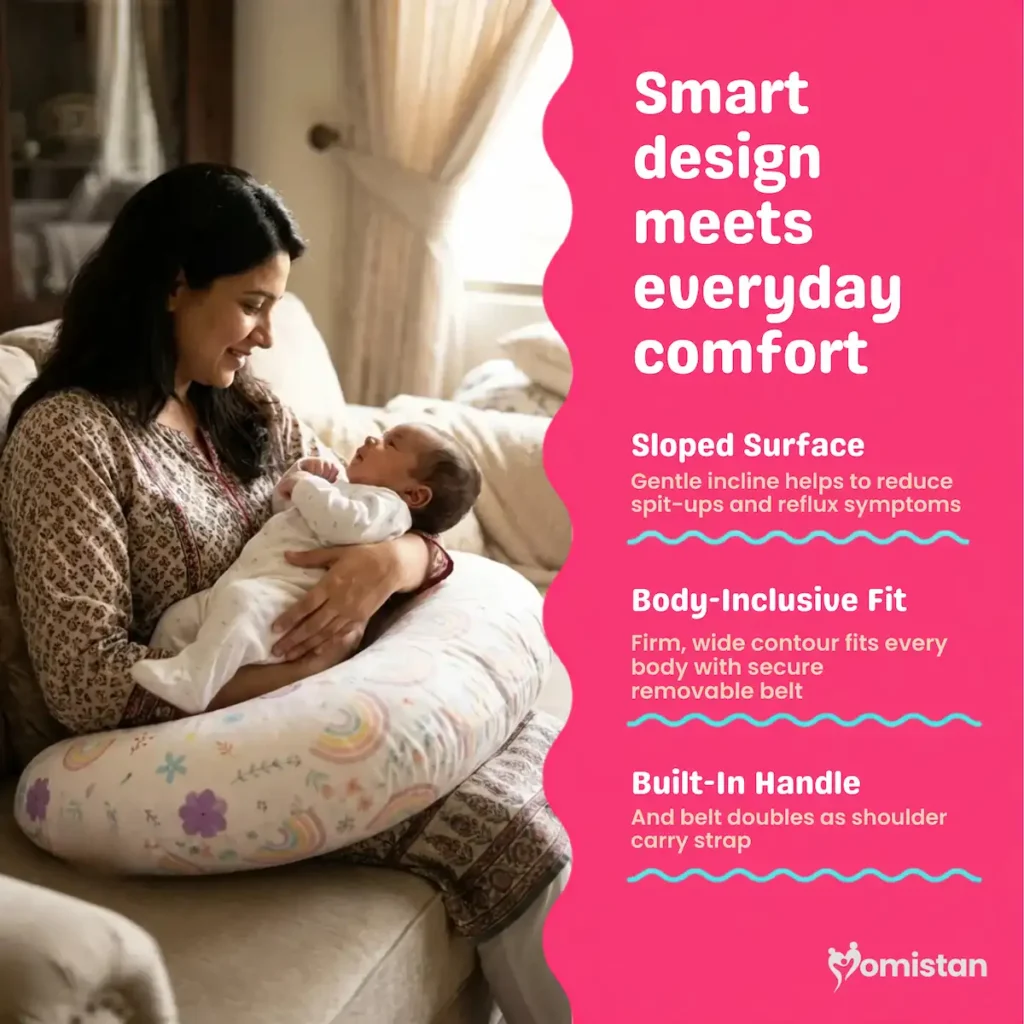
Once you realize you need one, walking into the baby aisle can feel overwhelming. Dozens of brands claim to be the best. But they aren’t all built the same.
To avoid spending money on a pillow that collects dust in the closet, look for these critical features before making your choice.
Firmness and Density Over Softness
Your instinct might tell you to buy the softest, plushiest cushion available. Resist that urge!
A pillow that feels like a soft cloud will sink straight to your lap as soon as you place your baby on it. You need firm, high-density support. Look for solid molded foam core or densely packed fiberfill that holds its shape under pressure.
Your baby should rest securely on top of the cushion without sinking into a valley.
Shape and Design Tailored to Your Body Type
Nursing pillows come in three main design styles, each suited to different needs:
- C-Shape (The Classic): Slides easily around your waist. Great for quick setups on the couch or bed. Fits most average body frames effortlessly.
- U-Shape with Back Straps: Clips around your torso with a belt. This prevents the pillow from slipping away from your waist if you move or lean back. Ideal for C-section recovery and moms who want a locked-in fit.
- Adjustable Layered Cushions: Features stacked fabric “pages” that you flip from side to side to alter height and angle. Excellent for moms with long torsos or those who switch between multiple feeding holds.
Pro Tip for Plus-Size & Petite Moms:
If you are petite, look for thinner, firmer pillows so your baby isn’t pushed too high above your breasts. If you are plus-size or have a wider waist, look for flexible C-shapes or strap designs with wide extension belts that won’t pinch your sides.
Removable, Washable Covers (and Waterproof Liners)
Spit-up happens. Milk leaks happen. Diaper blowouts happen—usually right in the middle of a peaceful 2 AM feed.
Never buy a nursing pillow that cannot be easily cleaned. Look for a durable, zippered outer cover that is 100% machine washable. Even better, check if the inner cushion has a waterproof or water-resistant protective lining so milk spills don’t soak into the core foam.
Multi-Functional Versatility
The best baby products serve more than one purpose. Look for a cushion that grows alongside your infant’s development over their first year:
- 0–3 Months: Ergonomic support for breastfeeding and bottle-feeding.
- 3–6 Months: Elevated propping after feeds to reduce reflux and gas.
- 6+ Months: Support for tummy time to strengthen neck and back muscles.
- 9+ Months: A soft protective surround when learning to sit independently.
Your Pre-Purchase Quick Checklist
Is the core firm enough to hold weight without sagging?
Does the outer cover zip off for easy machine washing?
Does it fit snugly against your waist without leaving a gap?
Is it lightweight enough to move around the house with one hand?
Does it suit your primary feeding position (cradle, football, or lying down)?
Common Mistakes Moms Make When Choosing a Feeding Cushion
Even with great options available, it is easy to pick the wrong model if you don’t know what to watch out for. Avoid these frequent traps:
1. Buying Before Testing Your Seating Area
Are you planning to feed mostly in a narrow nursery glider? Or on a wide, deep living room sectional?
Some wide wrap-around pillows are too bulky to fit comfortably inside a narrow rocking chair with armrests. Measure or picture your favorite feeding spot before buying a wide, structured model.
2. Ignoring Bottle-Feeding Needs
There is a misconception that feeding pillows are only for nursing moms. That isn’t true!
Formula-feeding mothers, dads, and grandparents experience the same arm fatigue during 30-minute bottle sessions. In fact, a good feeding cushion helps bottle-fed babies stay at a safe 45-degree incline, reducing air intake and painful gas bubbles.
3. Using the Pillow for Unsupervised Sleep
This is a critical safety rule. Nursing pillows are designed strictly for awake, supervised time.
Never leave your baby to nap on a nursing pillow or place the pillow inside a crib or bassinet. The soft contours pose a serious suffocation hazard if an infant rolls or slumps forward. Once feeding is over, always move your baby to a flat, clear sleep surface.
Frequently Asked Questions
Final Thoughts
Breastfeeding or bottle-feeding your newborn should be a sweet, comforting experience—not a physical endurance test.
If you find yourself wincing from upper back strain, nursing your baby with aching wrists, or constantly fighting to maintain a good latch, take a step back. Your body is telling you that it needs proper physical support.
Investing in a firm, well-designed nursing pillow isn’t a luxury. It is an essential ergonomic tool that protects your physical health, sets your baby up for relaxed feeds, and brings comfort back into your daily nursery routine. Give your shoulders a break—you are doing an incredible job!