You hand your baby a toy. Within two seconds, it’s in their mouth. You take it away and hand them a different toy. The same thing happens. A sock, a remote control, your finger, the corner of a board book — it all ends up exactly in the same place.
At some point, almost every parent asks the same question, usually somewhere around the fifth time they’re fishing a sock out of a baby’s mouth: Why does everything have to go in there?
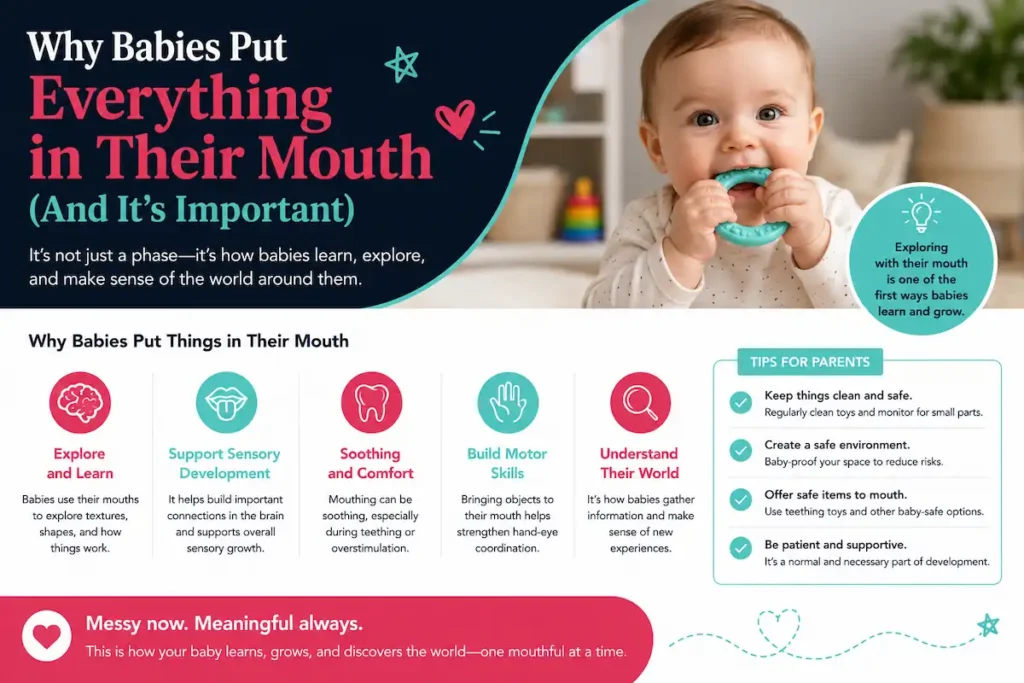
The short answer is that this isn’t random, and it’s definitely not a bad habit to correct. Mouthing — the technical term for this behaviour — is actually one of the most important things a baby does in their first year of life. It’s how they learn. It’s a real, legitimate form of exploration, not a quirk to train out of them.
This article gets into the why behind it, what’s actually going on developmentally, when it starts to taper off, and — because safety questions come up constantly — what’s genuinely fine versus what needs a closer eye.
The Mouth Is a Baby’s First Sense Organ
Here’s something that surprises a lot of new parents: a baby’s mouth is actually more sensitive than their hands in the first several months of life.
Babies are born with a strong sucking reflex and a mouth packed with nerve endings. Their hands, meanwhile, are still developing fine motor coordination — grasping, releasing, and manipulating objects with any real precision takes months to develop. So while an adult would naturally reach out and feel an object with their fingers to understand it, a baby’s most reliable, most sensitive tool for gathering information is their mouth.
This is sometimes called the “oral stage”, a term that goes back to early developmental psychology, but you don’t need any theory background to see it in action. Watch a baby with a new toy. They don’t just look at it. They turn it over, and almost immediately, it goes straight to the mouth.
It’s Not Hunger — It’s Information Gathering
A common assumption is that a baby mouthing something means they’re hungry or that it’s somehow tied to feeding senses. That’s mostly not what’s happening.
When a baby puts an object in their mouth, they’re collecting data. Is it hard or soft? Smooth or textured? What does it taste like? Does it make a sound when bitten? This sensory information helps build a mental map of the world — long before a baby has the language or fine motor skills to explore it any other way.
It’s Tied to Major Developmental Milestones
Mouthing isn’t just sensory exploration on its own — it overlaps with several other things happening in a baby’s development at the same time.
Hand-to-Mouth Coordination
Getting an object from the hand to the mouth accurately is actually a fairly complex motor skill. It requires a baby to track an object visually, coordinate their grip, and guide their hand with enough precision to land the object where they want it.
Early on, this looks clumsy—objects miss the mark, bonk against the cheek, and slide around. By around 4 to 6 months, most babies have this down with surprising accuracy. That improvement isn’t an accident. Every “failed” attempt earlier on was practice.
Teething and Mouthing Often Overlap
Around the same window that mouthing peaks — roughly 4 months through 2 years — teething is also happening. Sore, pressure-filled gums make chewing on something firm genuinely soothing, the same way pressing on a sore muscle can feel relieving.
This is why teething toys exist and why a baby who’s cutting a new tooth suddenly seems to want to chew on absolutely everything with extra intensity. The mouthing serves two purposes at once here — exploration and comfort.
Self-Soothing and Regulation
This part doesn’t get talked about enough. Sucking and mouthing have a calming effect on babies’ nervous systems. It’s part of why pacifiers work, and it’s part of why a fussy baby sometimes settles the moment something safe goes into their mouth.
Mouthing isn’t just learning. For a lot of babies, it’s also a way of managing big feelings they don’t yet have words for.
When Does Mouthing Start, and When Does It Stop?
There’s a fairly predictable arc to this, though every baby moves through it slightly differently.
| Age Range | What’s Typically Happening |
| 0–3 months | Reflexive sucking, hands and fingers explored by mouth first |
| 3–6 months | Reaching, grabbing, and mouthing objects becomes intentional |
| 6–12 months | Peak mouthing phase, often overlapping with teething |
| 12–18 months | Mouthing starts to taper as hands take over for exploration |
| 18–24 months | Mostly limited to teething discomfort or self-soothing moments |
| 2+ years | Mouthing of non-food objects should be largely gone |
That last row matters. If a child well past toddlerhood is still routinely mouthing non-food objects, it’s worth mentioning to a paediatrician — not as an emergency, just as something worth a second look, since persistent mouthing past this age can sometimes be linked to sensory processing differences.
What’s Actually Safe — and What’s Not
This is the part most parents actually came here for. Knowing the developmental reasoning is great, but the real question at 2 PM with a baby chewing on something off the floor is, ‘Do I need to stop this right now?’
Generally Fine
✓ Low Concern
Clean toys designed for babies, teething rings, soft books, silicone items, their own hands and feet, and most household objects that are too large to swallow and don’t have sharp edges, batteries, or small detachable parts.
Worth Stopping Immediately
⚠ Real Concern
Anything small enough to fit through a toilet paper roll (a rough but useful choking-hazard test), button batteries, coins, small magnets, anything with peeling paint or small detachable pieces, and anything that’s been on the floor of a public space rather than your own clean home.
Button Batteries Deserve Their Own Warning
This one is serious enough to call out separately. Button batteries — the small, coin-shaped batteries found in remote controls, key fobs, and some toys — can cause severe internal burns within hours if swallowed, because they react with saliva to generate an electric current.
If you suspect your baby has swallowed a button battery, this isn’t a “wait and see” situation. Go to an emergency room immediately. It’s one of the very few baby-related risks where speed genuinely changes the outcome.
A Real-World Example
A friend of mine spent weeks worried that her 8-month-old’s constant mouthing meant something was wrong — maybe a sensory issue, maybe just a strange habit. She mentioned it at a routine checkup, half-expecting to be told to start some kind of intervention.
The paediatrician laughed gently and asked her a simple question: “Is he reaching for things, looking at them first, then mouthing them?” The answer was yes.
That, the doctor explained, was actually the textbook pattern of healthy exploration — look, reach, grab, and put in the mouth. The concerning version looks different: mouthing without any visual interest first, or mouthing the same object in the same repetitive way for long stretches, regardless of what else is happening around them.
My friend left that appointment relieved, and honestly, a little amused at how much she’d been worrying over something completely normal.
This is a good example of how most “is this normal” parenting worries resolve — not with a dramatic fix, but with a little context that reframes the whole thing.
Practical Tips for Managing Mouthing Season
Babyproof With Mouthing in Mind, Not Just Crawling
A lot of babyproofing advice focuses on what a baby can reach once they’re mobile. But mouthing-proofing matters just as much, even before crawling starts. Get down to floor level and look around — anything within arm’s reach that’s small, sharp, or toxic needs to go.
Keep a Rotating Bin of Safe “Mouthable” Toys.
Rather than constantly saying no, keep a small basket of toys specifically chosen to be safe for mouthing — silicone teethers, soft fabric toys, wooden teething rings with no small parts. When your baby reaches for something less appropriate, swap it for one of these instead of just taking the object away with nothing offered in return.
Clean, But Don’t Panic About Germs
Wiping down toys regularly is reasonable. Sterilising everything obsessively isn’t necessary and isn’t even particularly good for a developing immune system, which benefits from some level of everyday exposure. A quick wash with soap and water is usually enough for most household toys.
Watch the pattern, not just the behaviour.
As mentioned earlier, what matters more than the mouthing itself is the pattern around it. A baby who looks, reaches, explores with their hands, and then mouths an object is doing exactly what they’re supposed to. If you notice mouthing happening without any of that surrounding curiosity – flat, repetitive, disconnected from what’s going on around them — that’s worth flagging to your paediatrician, just to be safe.
Conclusion
Mouthing isn’t a phase to rush through or a habit to correct. It’s how your baby is learning about texture, shape, taste, and cause and effect — at a stage of life before words, before fine motor precision, before any other reliable way to investigate the world.
It overlaps with teething. It overlaps with self-soothing. And by the time your child is a toddler running around with full sentences and a working set of opinions about everything, it’ll have mostly faded on its own, the way most developmental phases do.
In the meantime, the job isn’t to stop the mouthing — it’s to make sure what’s within reach is actually safe to be there.
FAQs
Disclaimer: This article is for informational and educational purposes only and is not intended as medical, psychological, or nutritional advice, diagnosis, or treatment. Every child, body, and pregnancy is different — please consult your pediatrician, doctor, or a qualified healthcare provider for advice specific to your situation.