
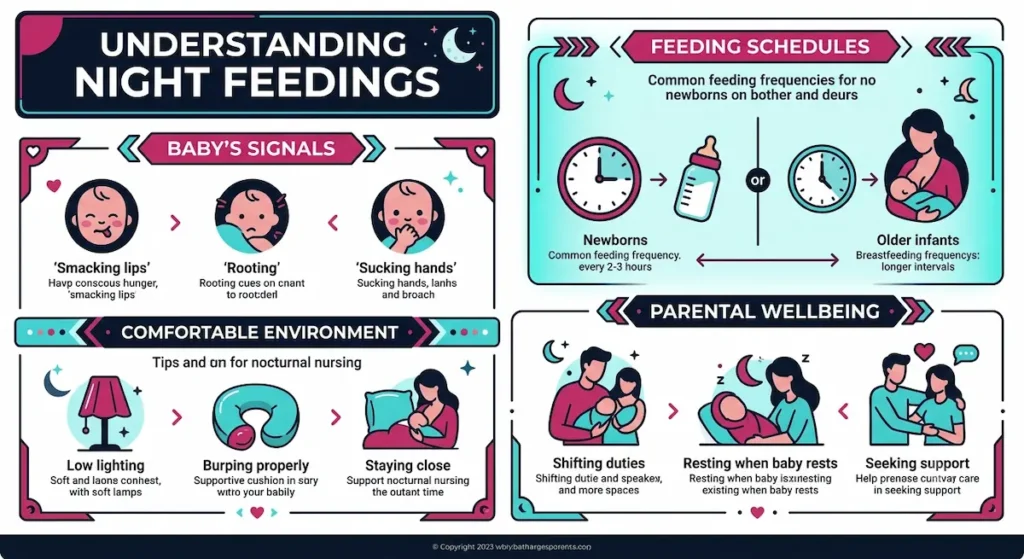
It’s 3 AM. Your baby is awake again. You’ve already fed them twice tonight, and somewhere in the back of your exhausted brain, you’re wondering, Is this normal? Should this still be happening?
The honest answer is that it depends entirely on how old your baby is. And that answer changes faster than you’d expect — sometimes month by month in the early stages.
Night feedings are one of those parenting topics where everyone has an opinion. Your mother says the baby should be sleeping through by now. A friend says her baby dropped night feeds at four months. A Facebook group says you should never wake a sleeping baby. Another says you absolutely should. Meanwhile, your baby hasn’t got any of these memos and just wants to eat.
This article cuts through all of that. It breaks down what’s genuinely normal for night feedings at every age from birth to toddlerhood, what signs to watch for, and how to tell the difference between a baby who needs to eat at night and one who’s waking out of habit.
The goal isn’t to tell you when your baby “should” sleep through the night. It’s to help you understand what’s actually happening – so you can stop second-guessing yourself at 3 AM.
Quick Reference: Night Feedings by Age
Before diving into the details, here’s a bird’s-eye view. Every baby is different — these are general expectations, not strict rules.
| Age | Expected Night Feeds | Hours Between Feeds | Sleep Through? (Generally) |
| 0–4 weeks | 3–5 per night | Every 2–3 hours | No |
| 1–2 months | 3–4 per night | Every 2–3 hours | No |
| 3–4 months | 2–3 per night | 3–4 hours | Rarely |
| 4–6 months | 1–2 per night | 4–6 hours | Some begin to |
| 6–9 months | 0–2 per night | 6–8+ hours | Many can |
| 9–12 months | 0–1 per night | Can stretch longer | Most can |
| 12+ months | Usually 0 | Full night stretch | Yes (if well-fed in the day) |
Why Babies Wake at Night to Feed
Understanding why babies need night feeds makes the whole thing feel a lot less frustrating. It’s not manipulation. It’s not poor sleep training. It’s biology.
Newborn stomachs are tiny — literally the size of a marble at birth, expanding to about the size of a walnut by day three. Breast milk and formula digest quickly, typically within 1.5 to 2 hours for breastfed babies and 2 to 3 hours for formula-fed ones. A baby who empties that tiny stomach simply cannot go eight hours without eating. Their body won’t let them, and it shouldn’t.
Night feeds also serve important purposes beyond just nutrition. For breastfeeding moms, nighttime nursing helps maintain milk supply — prolactin levels, the hormone responsible for milk production, are highest at night. Skipping night feeds too early can cause a real dip in supply, especially in the first few months.
Worth Knowing
Young babies don’t yet know the difference between night and day. Their circadian rhythm — the internal clock that governs sleep-wake cycles — doesn’t fully develop until around 3 to 4 months of age. Before that, expecting a baby to naturally consolidate sleep at night is asking something their brain literally isn’t wired to do yet.
Night Feedings by Age: What to Actually Expect
Newborn — 0 to 4 Weeks
The Most Intense Stage
| Night Feeds3–5 per night | Between FeedsEvery 2–3 hours | Breastfed3–5 times | Formula-fed2–4 times |
This is survival mode. There’s no other way to describe it. A newborn needs to feed every 2 to 3 hours around the clock — that’s 8 to 12 feeds in 24 hours, and a significant chunk of those happen at night.
Breastfed newborns typically feed more frequently than formula-fed ones because breast milk digests faster. This doesn’t mean anything is wrong with your supply—it’s just how human milk works.
One thing that trips up a lot of first-time parents: some newborns are sleepy feeders. They drift off before finishing a feed, which means they’re hungry again sooner. Keeping them awake during feeds – tickling the feet, switching positions – can help them take a fuller feed and potentially stretch the gap slightly.
Important
In the first month, never let a newborn go more than 4 hours without feeding, even if they’re asleep. They don’t yet have adequate fat stores to go longer, and low blood sugar is a real risk. Always check with your paediatrician if you’re unsure.
1 to 3 Months
The First Signs of a Pattern
| Night Feeds2–4 per night | Between Feeds3–4 hours | What ChangesFeeds begin to space out slightly |
By around 6 to 8 weeks, most babies start stretching one longer sleep stretch — typically 3 to 4 hours — usually at the beginning of the night. This is often the first real break parents get, and it feels enormous.
By 2 to 3 months, some babies can manage one 4 to 5-hour stretch, though many are still waking every 2 to 3 hours. Both are completely within normal range.
Don’t be discouraged if your 2-month-old is still waking 3 times a night. That’s exactly what a 2-month-old is supposed to do. The babies who “sleep through” at this age are the exception, not the standard — and many of those babies make up for it by waking more often in other ways.
3 to 6 Months
Getting More Predictable — But With a Catch
| Night Feeds1–2 per night | Between Feeds4–6 hours | Notable4-month sleep regression |
This stage often feels like the light at the end of the tunnel — until around 4 months, when the light seems to turn off for a while.
The “4-month sleep regression” is real, and it’s frustrating precisely because it tends to happen right when parents think they’re finally getting a handle on things. It’s caused by a genuine neurological shift in sleep architecture — babies start cycling through sleep stages more like adults do, which means they wake more briefly between cycles. If they haven’t learned to resettle themselves, they call for you.
By 5 to 6 months, many babies genuinely only need 1 to 2 night feeds. At this point, a baby who’s waking 4 or 5 times might be feeding out of comfort or habit rather than hunger. The key distinction: a hungry baby will feed actively and seem satisfied afterwards. A baby who’s waking for comfort often feeds for just a minute or two and falls back asleep without really eating.
Helpful Sign
If your baby is taking in only a small amount and falling back asleep within 2–3 minutes, that wake is likely about comfort rather than genuine hunger. This doesn’t mean the need is invalid — it just helps you understand what’s actually going on.
6 to 9 Months
Many babies can drop night feeds here — but don’t have to.
| Night Feeds0–2 per night | Between Feeds6–8+ hours | SolidsBeing introduced around 6 months ago |
By 6 months, most full-term, healthy babies who are growing well are physically capable of going through the night without a feed. Capable — not required, and not guaranteed.
The introduction of solid foods around this time doesn’t automatically lead to longer sleep stretches. A lot of parents expect solids to solve night waking, and it rarely works that way. Solid supplements nutrition — they don’t replace the calories from milk. A 6-month-old still gets most of their nutrition from breast milk or formula.
If your baby is still feeding once or twice at night at this age and it’s manageable for your family, there’s no medical reason to rush night weaning. But if night waking is affecting everyone’s functioning, this is also the age at which gentle night weaning becomes a reasonable option — and many babies respond well to it.
9 to 12 Months
Night Feeds Should Be Winding Down
| Night Feeds0–1 per night | What to WatchEarly morning feed (3–5 AM) may persist |
By 9 months, most babies genuinely don’t need to eat at night from a nutritional standpoint — assuming they’re eating well during the day. If night waking is still frequent at this age, it’s worth looking at sleep associations rather than hunger as the primary cause.
That said, one very early morning feed, somewhere between 3 and 5 AM, can persist well into the first year for many babies, especially breastfed ones. This is considered normal and not necessarily a problem to solve unless it’s causing significant disruption.
12 Months and Beyond
Night feedings are usually a habit, not a need
| Night FeedsUsually 0 | ExceptionIllness, developmental leaps, and teething |
A toddler who is eating three meals a day plus snacks and drinking well during the day does not need to eat at night. If they’re still waking and feeding, it’s almost always about comfort, habit, or sleep associations — not nutrition.
This doesn’t make those wake-ups any less real or the toddler any less in need of reassurance. But it does shift the conversation from “Is my baby hungry?” to “How do we help them resettle independently?”
⚠ Note for Breastfeeding Moms
If you’re still breastfeeding and want to continue night nursing into toddlerhood, that’s completely your choice. The World Health Organization recommends breastfeeding for two years and beyond if desired. Nursing at night is not harmful — it only becomes a problem if it’s a problem for you.
Is My Baby Hungry or Just Waking From Habit?
This is the question that keeps parents up almost as much as the waking itself. Here’s how to tell the difference.
Signs Your Baby Is Genuinely Hungry at Night
- Feeds actively and vigorously for a substantial stretch (10 minutes or more for breastfed babies and a full portion for bottle-fed babies)
- Seems genuinely unsettled until feeding starts, not just fussy
- Settles completely and contentedly after the feed
- Day feeds are spaced out well — they’re not making up calories at night that they should be getting in the day
- Still at an age where night feeds are genuinely expected (under 6 months, or younger if premature)
- Signs It Might Be Habit or Comfort
- Feeds for only 2 to 3 minutes and falls back asleep immediately
- Wakes at very predictable times every single night — same hour, every night like clockwork
- Settles equally well with rocking or patting as with feeding
- Is over 6 months, and eating well during the day
- Seems to want the breast or bottle, but isn’t actively swallowing much
Neither of these situations is “bad”. They just call for different responses.
When Is the Right Time to Drop Night Feeds?
There’s no universal answer here, and any article that tells you there is should be read with healthy scepticism.
The general markers that suggest a baby may be ready to drop night feeds include:
- They’re over 6 months and growing well on their growth chart
- They’re eating solid foods and taking in good daytime milk feeds
- Night feeds are short and don’t seem to fully satisfy them anyway
- They can settle back to sleep sometimes without feeding
When night weaning makes sense, a gradual approach tends to work better than going cold turkey — especially for breastfed babies and their mothers, since dropping feeds abruptly can cause engorgement and, in some cases, mastitis. Reducing the duration of feeds slowly over a couple of weeks is gentler all around.
Practical Tips for Surviving (and Improving) Night Feeds
Maximise day feeds to reduce night demand.
Babies who are distracted during the day – by noise, siblings, or activity – sometimes don’t feed well and then make up calories at night. Making sure daytime feeds are calm and focused can genuinely reduce how much a baby needs at night.
Set Up for Efficiency
Keep night feeds as dark, quiet, and low-stimulation as possible. No lights, no talking, minimal eye contact. You want your baby to know this is not playtime. The feed, a quick change if needed, and back to sleep. The less stimulating the experience, the faster everyone gets back to bed.
Try a dream feed.
A dream feed is when you pick up and feed a sleeping baby — usually around 10 or 11 PM, before you go to bed — in the hopes of extending the first stretch of the night’s sleep. It doesn’t work for every baby, but for many it shifts the longest sleep window to overlap with the parent’s own sleep. Worth trying for a week to see if it helps.
One Parent at a Time
If you have a co-parent and you’re formula feeding, splitting night shifts is one of the most practical things you can do. One person takes the first half of the night; the other takes the second. Neither gets a full night, but both get a meaningful chunk of uninterrupted sleep.
Don’t Skip Daytime Naps to “Make Them Tired”
This one keeps coming up as advice, and it consistently backfires. An overtired baby sleeps worse at night, not better. Sleep builds sleep. A well-rested baby who naps adequately during the day is more likely to consolidate their night sleep than an exhausted one who misses naps.
A Final Note to Every Exhausted Parent Reading This at 2 AM
If you got here because you’re in the middle of a feed and wondering if this is normal, it probably is. The range of “normal” for night feedings is wider than most parenting content lets on.
A 6-week-old waking three times a night? Normal. A 5-month-old waking twice? Normal. A 9-month-old still having one early morning feed? Normal. These things don’t mean you’re doing something wrong. They mean you have a baby.
What actually matters is the trend over time – that night feeds gradually reduce as your baby grows, as their stomach capacity increases, and as their neurological development allows longer sleep. That progression happens for almost every baby. The timeline just varies, and it doesn’t follow any strict schedule.
Your baby is not broken. You are not failing. This is just the season you’re in — and like all seasons, it passes.
More Practical Parenting Guides on Momistan
From newborn sleep to toddler nutrition, we write honest, practical content for real Pakistani parents. No judgement, no fluff.
Frequently Asked Questions
Disclaimer: This article is for informational purposes only and does not constitute medical advice. Night feeding needs vary from baby to baby. If you have concerns about your child’s feeding, growth, or sleep, please consult your paediatrician or a certified lactation consultant.
Disclaimer: This article is for informational and educational purposes only and is not intended as medical, psychological, or nutritional advice, diagnosis, or treatment. Every child, body, and pregnancy is different — please consult your pediatrician, doctor, or a qualified healthcare provider for advice specific to your situation.