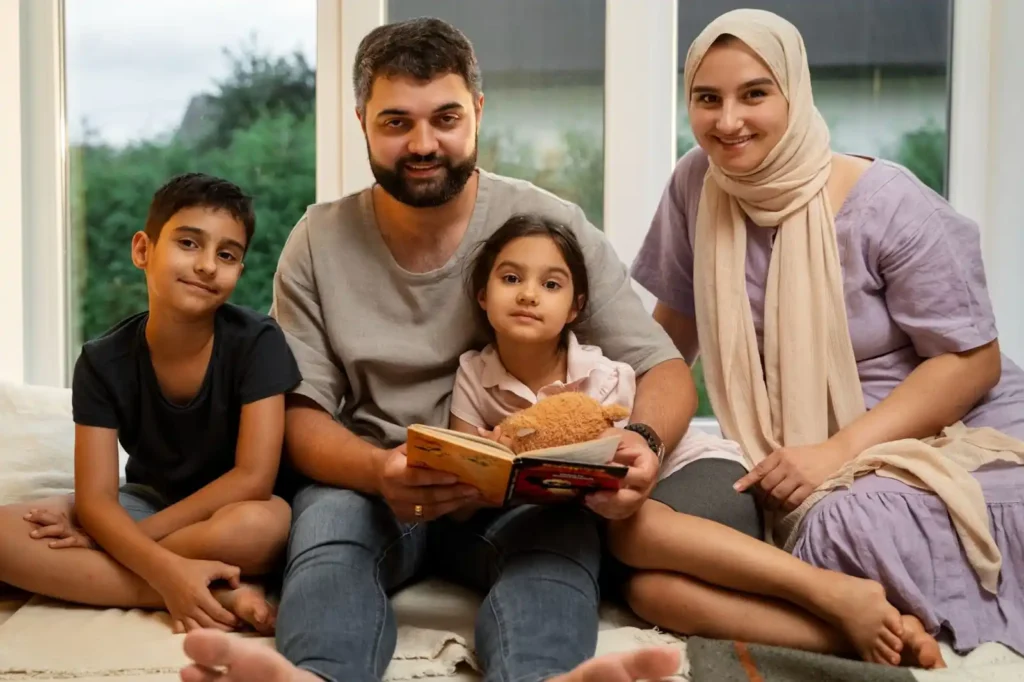
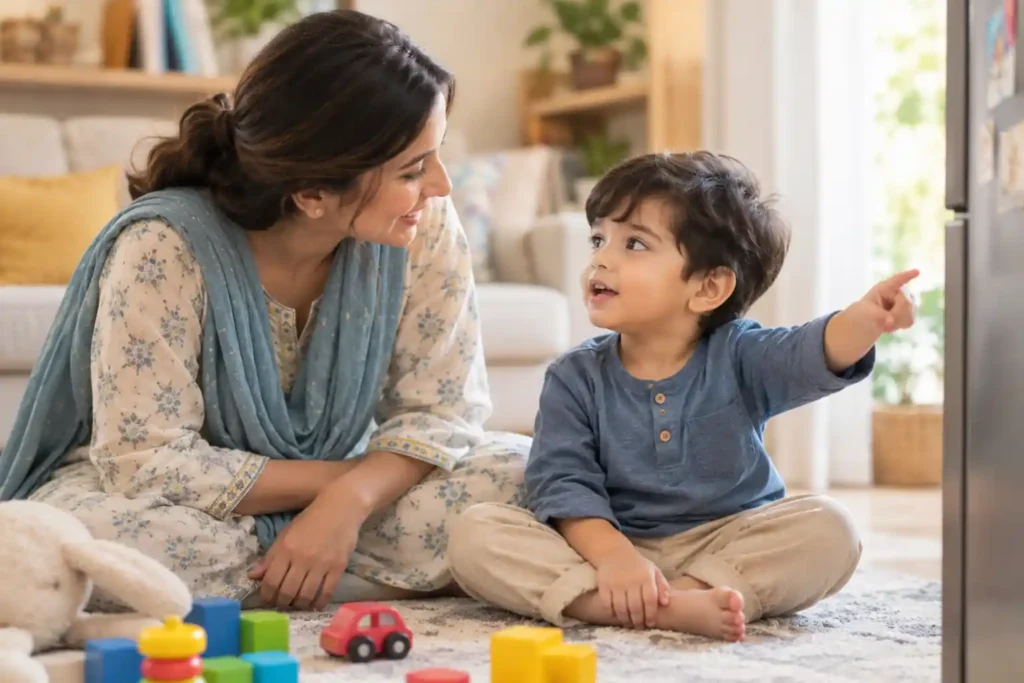
Your two-year-old points at the fridge and says, “Mama, mujhe water chahiye.” Nani smiles. Your sister-in-law frowns and says, “Bas English bolo, warna school mein dikkat hogi.” Someone else insists it should be Urdu only.
Sound familiar? Many Pakistani homes run on two languages (sometimes three or four) before a child can even tie their shoes. And when a toddler is slow to talk, the first suspect is usually “too many languages.”
This guide covers bilingual toddler language development in plain terms: what’s typical, what mixing Urdu and English really means, and how to tell a normal bilingual pattern from a genuine delay. That last part is where most articles go quiet, so we’ll spend real time on it.
Quick takeaways
- Learning two languages doesn’t cause a speech or language delay.
- Mixing Urdu and English in one sentence is a normal part of the process.
- A real language delay shows up in both languages, not just one.
- Always count words across both languages, never just English or just Urdu.
- If you’re worried, ask for an evaluation. Don’t drop a language first.
What bilingual toddler language development actually looks like
Let’s start with the big worry. Does a second language slow a child down? According to the American Speech-Language-Hearing Association (ASHA), no. Children all over the world learn more than one language without developing speech or language problems, and they pick up language skills much like other children do.
The milestones run on the same clock
ASHA’s parent guidance says most bilingual children say their first words by around their first birthday, and by age two most can put two words together, like “my ball” or “no juice.” In a Pakistani home, that could sound like “meri gend” or “nahi juice.” Same milestone. Different words.
Count words from both languages together
Here’s where many parents (and some professionals) trip up. A toddler might know “paani” and “water,” “billi” and “cat,” “gari” and “car.” Those are three concepts, not six separate words. If you only count the English ones, your child can look behind. If you count everything, the picture usually changes.
Researchers reviewing bilingual development note that when a young bilingual child is measured in each language separately, their vocabulary and grammar can look smaller than a monolingual child’s, because their learning is split between two languages. That’s an expected effect of how the child is being measured, not a sign that something’s wrong.
One language is often stronger
Many bilingual toddlers lean toward one language. Usually it’s the one they hear most. Reviews of the research explain that children’s language skills reflect the quantity and quality of the language they hear, and that’s equally true for bilingual children. If your toddler spends all day with Urdu-speaking grandparents and only a few hours with English cartoons, expect Urdu to be ahead.
Mixing Urdu and English: confusion or normal?
“Mujhe apple do.” “Papa, look, ye kya hai?” Parents hear this and worry the child can’t separate the two languages.
The ASHA guidance says children may mix grammar rules or use words from both languages in the same sentence, and that this is a normal part of bilingual language development. Nothing in that points to a disorder.
So when your toddler grabs whichever word comes to mind first, that’s efficient, not confused. Plenty of adults mix Urdu and English in phone calls, offices and WhatsApp messages. Your child is simply doing what they hear.
Urdu–English bilingual delays: how to tell the difference
This is the part parents search for at 2 a.m. “My child is nearly three and barely talks. Is it the languages, or is something else going on?”
The honest answer is that bilingualism itself isn’t the cause of a language delay. Bilingual children are as likely as monolingual children to have a speech or language disorder, no more and no less. When a delay exists, it comes from something else, and it would have shown up even if your child heard only one language.
The two-language test
Several NHS speech and language services give the same practical rule. A bilingual child with a speech or language disorder will have difficulty in all the languages they speak. If your child is struggling only in English but chatting happily in Urdu, they most likely need more exposure to English, not an evaluation for a disorder. The reverse is also true.
For Pakistani families, “both languages” might really mean the home language (Punjabi, Sindhi, Pashto, Saraiki, Balochi or another) plus Urdu plus English. The principle is the same. Look at the child’s communication across everything they hear.
Typical bilingual pattern vs. worth checking
| Usually a normal bilingual pattern | Worth raising with a professional |
|---|---|
| Mixes Urdu and English words in one sentence | Very few words or gestures in any language |
| Stronger in the language they hear most | Struggles to communicate in both languages, not just one |
| Smaller vocabulary in each language, but a good total across both | Total vocabulary across both languages stays very small |
| Quieter in a newly introduced language, but communicating well in the first | Stops talking or loses words they used to say |
| Understands more than they can say | Doesn’t seem to understand simple everyday instructions in either language |
Use this as a conversation starter, not a diagnosis. Only a qualified professional can tell you what’s going on with your particular child.
Situations common in Pakistani homes
Some patterns are worth recognising, because they can look like a delay when they aren’t:
- A mother tongue at home, Urdu outside. A child who hears Punjabi from grandparents and Urdu from the neighbours may sound slower in Urdu. That’s about exposure.
- A sudden shift to English at nursery. A child who has only heard Urdu at home may go quiet when school starts in English. Check how they talk at home before worrying.
- Different languages from different caregivers. Mum speaks Urdu, Dad speaks English, a nanny speaks Pashto. The child is hearing three languages in small portions. Their skills will often reflect that mix.
Why one-language testing can mislead
An assessment done only in English, for a child who mostly hears Urdu, can make a perfectly typical bilingual toddler look delayed. A 2023 review in the Journal of Speech, Language, and Hearing Research discusses how monolingual assumptions can lead to bilingual children being over-identified for services. The reverse can also happen: a real difficulty gets explained away as “just bilingual.”
So if you do seek an evaluation, ask these questions directly:
- Will you assess my child in both languages, or at least take my child’s home language into account?
- Will you count total vocabulary across languages?
- Do you have experience with bilingual children?
One honest limit: we couldn’t verify how widely Urdu-language assessment tools or Urdu-speaking therapists are available across Pakistan. Availability likely varies by city. That’s exactly why those questions matter. Ask the clinician how they’ll account for both languages.
When to see a professional
Don’t wait it out if you notice any of these:
- Your child has stopped talking, or has lost words they used to say.
- They aren’t using words or gestures to communicate in either language.
- They don’t seem to understand simple everyday requests in any language.
- They don’t respond when you call their name or speak, which may point to a hearing concern.
- Your gut says something is off and the worry isn’t going away.
A paediatrician is a sensible first stop. They can check hearing and general development, and refer you to a speech-language therapist if needed. Don’t let anyone talk you into dropping a language as the “first fix.” The research summarised by speech-language professionals does not support that advice.
Practical ways to support both languages at home
You don’t need flashcards or an expensive programme. Children learn language through everyday back-and-forth. Here’s what that can look like in a Pakistani household.
Keep talking in your strongest language
NHS parent guidance tells families to keep using the home language. It helps children speak with the wider family, and it supports their growth as bilingual adults. You’ll naturally give richer, warmer conversation in the language you feel most at ease with.
Narrate daily routines
Talk while you cook, bathe, dress and shop. “Ab hum roti banayenge. Look, the dough is soft.” Name the things your toddler sees: the rickshaw, the crow on the wall, the fruit seller. Short, simple sentences are easier for a toddler to catch.
Let every caregiver use their own language
Grandparents, aunts, fathers, older siblings. Each of them can talk in the language that comes naturally. There’s no single “right” system, and no need to police every sentence. What matters is that your child hears plenty of real conversation.
Read, sing and play in both languages
Picture books, nursery rhymes, lullabies and clapping games all count. Urdu rhymes and English ones both build the sounds and rhythms of speech. Sit on the floor and do it together, so your child can hear, watch and answer you.
Repeat back, don’t correct
If your toddler says “Mujhe more milk do,” don’t say “Wrong!” Just reply naturally: “Aur doodh chahiye? Okay, here’s more milk.” They hear a model without feeling criticised.
Get everyone involved
Language development isn’t only a mother’s job. Fathers, uncles and older cousins can read, play and chat too. A child who hears several voices gets more input.
Two everyday examples
These are illustrative scenarios, not real case studies or research findings.
Illustration 1: Probably an exposure story
Hamza is 26 months old. At home he hears Urdu and some Punjabi from his grandmother. He’s just started a play group where the teacher speaks English. He says “paani,” “bus,” “mama aao” and “ball” and uses two-word phrases at home. At play group he’s quiet.
He’s communicating well at home and is probably adjusting to a new language. A paediatrician visit isn’t urgent, though keeping an eye on progress is always fine.
Illustration 2: Worth checking
Zara is nearly three. In Urdu and in English she uses very few words, rarely points, and doesn’t seem to follow simple instructions like “jootay lao” or “bring your shoes.” Her parents have been told it’s “just the two languages.”
Because the difficulty shows up in both languages, that explanation doesn’t fit. A hearing check and a developmental review are sensible next steps.
Common mistakes to avoid
- Dropping a language to “make it easier.” It rarely helps, and it can weaken the child’s link with family and culture.
- Comparing your child with a cousin. Children vary, and a cousin hearing one language isn’t a fair yardstick.
- Counting only English words. You’ll miss most of what your child actually knows.
- Waiting for a child to “grow out of it” when red flags are present. Seek advice early.
- Treating mixing as a problem. It’s part of how bilingual speakers talk.
Your next step
Here’s the short version. Two languages don’t cause a delay, mixing them is normal, and a genuine delay shows up in all of a child’s languages.
This week, try a simple exercise: jot down every word your toddler uses in any language, and note which ones come with gestures. That list is far more useful than a vague “she doesn’t talk much.” If it’s short, or if any of the warning signs above sound familiar, book a chat with your paediatrician and bring the list.
And if everything looks fine? Keep talking, singing and playing, in whichever languages feel like home. You can find more parenting guidance at Momistan.
Frequently asked questions
Will speaking Urdu and English confuse my toddler?
No. ASHA says children all over the world learn more than one language without developing speech or language problems. Mixing words between languages is a normal stage, not a sign of confusion.
My toddler is a late talker. Should I stop using one language?
No, and a professional shouldn’t tell you to do that as a first step. Bilingualism doesn’t cause language delay, so removing a language won’t fix one. Keep the home language and ask a paediatrician or speech-language therapist to look at your child’s overall communication.
How do I know if it’s a bilingual pattern or a real delay?
Look at both languages together. If your child communicates reasonably well in one language but is slower in the other, exposure is the likely reason. If they struggle in all the languages they hear, or have lost skills, get a professional opinion.
My child understands everything but says very little. Should I worry?
Research has found that bilingual children often show a gap between understanding and speaking. On its own, that can be typical. But if your child also seems to understand very little, or isn’t using gestures or sounds to communicate, mention it to your paediatrician.
Is it too much to add Punjabi, Sindhi or Pashto on top of Urdu and English?
The sources we reviewed mostly discuss two languages, so we can’t offer firm, tailored advice for three or more. ASHA’s guidance refers to children learning more than one language, and the same practical rules apply: count everything, keep conversations rich, and seek advice if your child struggles across all their languages.
Which language should my child be evaluated in?
Ideally, a clinician should consider all your child’s languages and count total vocabulary. Ask whether they have experience with bilingual children. Where Urdu-language tools aren’t available, a clinician can use your description of how your child communicates at home.
Do bilingual children catch up with monolingual children?
Bilingual children reach the same early milestones on a similar timeline. Their vocabulary in each single language may look smaller at first because their learning is shared across two languages. Total ability across both is the fairer measure. For questions about your own child, ask a professional.
Disclaimer: This article is for informational purposes only and does not constitute medical advice. Always consult your paediatrician or healthcare provider regarding your child’s speech and language development, hearing, evaluation, or any medical concerns specific to your child.
Sources and references
- Learning Two Languages, ASHA parent guidance (reprinted by Reading Rockets): milestones, mixing languages, and no link to speech problems.
- Bilingual first language development in children under 5 (peer-reviewed review, PubMed Central): effects of language input and single-language measurement.
- Exploring Assumptions of the Bilingual Delay in Children With and Without Developmental Language Disorder, Peña, Bedore and Granados Vargas, Journal of Speech, Language, and Hearing Research (2023).
- A large receptive–expressive gap in bilingual children (PubMed Central).
- Bilingualism, Shropshire Community Health NHS Trust speech and language therapy.
- Children and young people’s therapy service, Somerset NHS Foundation Trust: bilingual disorders appear in all languages.
- Bilingualism information sheet for parents, NHS (keeping the home language).
- Dispelling the Myths of Second-Language Learning, The ASHA Leader (2011).
© Momistan. momistan.com
Disclaimer: This article is for informational and educational purposes only and is not intended as medical, psychological, or nutritional advice, diagnosis, or treatment. Every child, body, and pregnancy is different — please consult your pediatrician, doctor, or a qualified healthcare provider for advice specific to your situation.