

You place your baby on their tummy.
Within a seconds your baby starts crying and you see frustration in their tiny faces with their arms flailing all over the place.
You start wondering if tummy time is really necessary for your baby.
You think to yourself “My baby hates time. What should I do?”
The truth is, tummy time is essential for your baby but it does not have to be a stressful experience for you or your baby.
Many babies resist time at first because it is hard work for them as they are building muscles they have never used before.
The good news is that with the tummy time positions you can reduce your baby’s tears and make tummy time an enjoyable experience.
Let us break it down in a practical way.
Why is tummy time important for your baby?
Before we talk about positions let us understand why tummy time matters much for your baby.
Tummy time helps strengthen your baby’s neck muscles, builds shoulder and arm strength, develops stability, prevents flat head syndrome and prepares your baby for rolling, crawling and sitting.
The American Academy of Pediatrics recommends starting tummy time early even from the first weeks for short sessions.
Tummy time makes your baby’s muscles strong which is the foundation for crawling.
When should you start time with your baby?
You can begin time as early as the first week after birth once you are home and your baby is medically stable.
Start with one to two minutes two to three times a day. Gradually increase the time as your baby tolerates it.
By three months aim for forty-five to sixty minutes total per day broken into small sessions.
Why do some babies hate time?
If your baby cries immediately you are not alone.
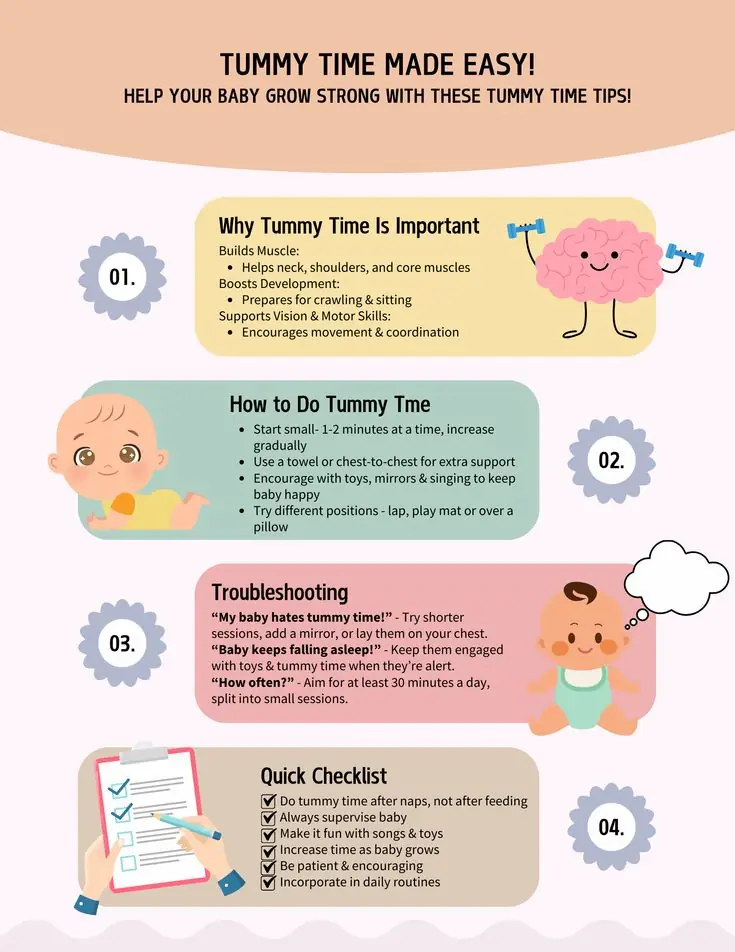
There are reasons why babies hate tummy time such as weak neck muscles, not being able to see you easily, gas discomfort, overtiredness and being placed flat on the floor too soon.
Most babies do not hate time; they just dislike the way it is introduced.
Let us fix that.
Time without tears. There are positions that actually work.
Here are some realistic parent-approved tummy time positions that reduce crying.
1. Tummy time on your chest is the position for newborns.
This is the most comforting way to start tummy time.
Lie down slightly reclined and place your baby on your chest, tummy down.
Talk, smile and make eye contact with your baby.
This position works because your baby feels safe and can see your face and gravity is gentler than floor time.
This is perfect for babies who hate time on the floor.
2. Lap tummy time is ideal for babies who resist surfaces.
Sit down comfortably. Place your baby across your lap on their tummy.
Gently rub their back to help relieve gas and make them feel secure.
This position reduces crying. It is very effective.
3. A rolled towel or small pillow support is another position.
Sometimes babies cry because lifting their head is too hard.
Roll a towel and place it under your baby’s chest with their arms forward.
Ensure their face is clear. Their airway is open.
This makes lifting easier. Build confidence in your baby.
4. A side-lying position is a beginner- position.
Not all tummy time has to be fully flat.
Lay your baby on their side. Support their back with a rolled towel.
Encourage your baby to reach for toys to build neck strength, core rotation and visual tracking.
This is a transitional position.
5. Tummy time across your forearm also known as the “tiger in the tree” hold is especially helpful for babies.
Lay your baby tummy-down across your forearm. Support their head and neck.
Gently. Walk to soothe gas and make your baby feel calm.
This position strengthens your baby’s neck. It is very calming.
6. Tummy time with a mirror is another idea.
Babies love faces, their own.
Place a baby mirror in front of your baby.
This encourages head lifting, extends session time and builds curiosity in your baby.
7. Tummy time on an exercise ball is a position that requires supervision.
For babies, place your baby tummy-down on a stability ball and hold them securely at the hips.
Gently roll forward. Back to engage and strengthen multiple muscle groups.
Always hold your baby firmly. Never leave them unsupported.
How long should tummy time last?
Do not focus on one session.

Instead do mini sessions, two to five minutes at a time and increase gradually.
If your baby cries, pause and try again later.
Consistency matters more than duration.
Here are some practical tummy time tips that actually help.
* Choose the timing, such as after a diaper change after a nap or before feeding.
* Avoid time immediately after feeding as it can cause reflux.
* Get down at your baby’s level. Lie on the floor face-to-face.
* Talk, sing and make sounds to engage your baby.
* Use high-contrast toys for newborns as they are stimulating for young babies.
* Make tummy time part of your routine, such as after every diaper change or during morning and evening routines.
* Do not panic at fussing as a little struggle builds strength.
* However if your baby is in distress stop and comfort them.
Common tummy time mistakes to avoid include waiting long to start, forcing long sessions only doing floor tummy time and comparing your baby to others.
Every baby builds strength at their pace.
Signs that tummy time is working include head lifting pushing up on forearms rolling attempts and less crying over time.
By four months babies often push up strongly, lift their chest off the floor and enjoy play.
When to talk to a pediatrician?
Consult your doctor if your baby strongly dislikes time after consistent effort, has very stiff or very floppy muscles, is not lifting their head at all by three to four months or always tilts their head to one side.
Early support makes a difference.
Emotional reassurance for parents. If tummy time feels like a battle you are not failing.
Muscle development is work and your baby is not being difficult. They are learning.
Every baby develops at their speed and patience is the most important thing.
Tummy time checklist. Start early, keep sessions short, use supportive positions, engage face-to-face, try different surfaces and stay consistent.
Finally tummy time does not have to mean tears.
With the tummy time positions, smart timing and gentle encouragement it can become a bonding experience instead of a struggle.
Your baby is building strength, coordination and confidence. You are building trust. One small session, at a time.
FAQs: Tummy Time Without Tears – Positions That Actually Work
Disclaimer: This article is for informational and educational purposes only and is not intended as medical, psychological, or nutritional advice, diagnosis, or treatment. Every child, body, and pregnancy is different — please consult your pediatrician, doctor, or a qualified healthcare provider for advice specific to your situation.