
If your toddler is biting or hitting, you’re not alone—and it doesn’t mean you’re doing anything wrong. Many parents notice this behavior between ages 1 and 3, often without understanding why it starts or how to respond effectively.
Toddler biting and hitting usually happen because young children are still learning how to express emotions like frustration, anger, or excitement. Since they don’t yet have the words to communicate their needs, they may act out physically instead.
In this guide, you’ll learn the most common causes of toddler biting and hitting, whether this behavior is normal, and practical, gentle strategies to manage it without punishment or stress. By understanding what’s behind the behavior, you can respond calmly and help your child develop better emotional and communication skills.
Why Toddlers Hit or Bite?
Toddlers would be hitting or biting because their emotions and language are still growing and they do not have mature means of communicating what they are feeling yet. The sections of the brain that control impulse, emotional regulation and decision making are not yet fully developed at this age. This leads to physical reactions in heat of the moment in toddlers. When they experience large feelings of anger, frustration, jealousy, excitement, or fear, they react with their bodies purely because they can not stop, reflect or articulate themselves. It has also been found that toddlers apply physical behaviors where words cannot be used, particularly where the toddler wants attention, is threatened, or needs to guard a toy or their personal space.
There is always a tendency of children biting to see the cause and effect. Others strike due to lack of knowledge of social rules and being at a crossroad. The scholars regard these behaviors as a usual developmental process rather than aggression and misbehavior. Making upfront hits and bites, toddlers learn how to cope with emotions, communicate, share a space, and how their actions influence other people.
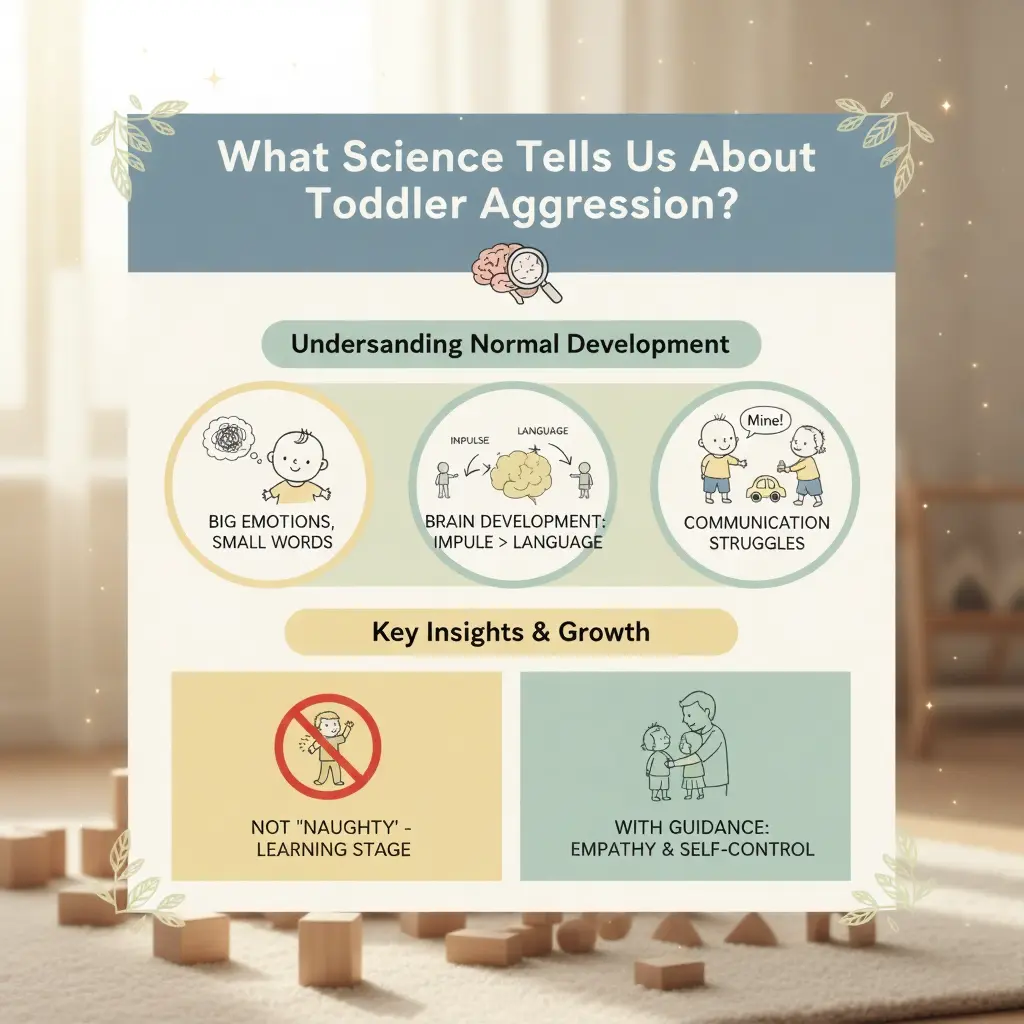
What Science Tells Us About Toddler Aggression?
The child development professionals concur that toddler aggression is a normal and anticipated phase of child development. It does not indicate that a child is naughty or being deliberately mischievous. One thing at this age is that toddlers do not have brain skills yet to express emotions, control the impulses, or communicate using language, hence bodily responses often occur prior to thought.
The Reason Why Toddlers React Without Thinking
Toddlers essentially speak through the power of their bodies since their emotions and language are yet to be developed. To the extent that they are not able to utter words like “I am angry” or “please stop”, they may push, hit, or bite. They have a rather weak command of their emotions, they simply cannot relax as adults do, when they are frustrated or overwhelmed.
Tantrums are the norm, and generally they reach their highest point when children reach the age of two to three years old curiosity, independence and big feelings are all soaring simultaneously. After they have acquired sound language, master rules and learn more to check impulse, the hitting and biting disappear. Essentially, toddler violence is learning, rather than a personality flaw. It is not because your kid is being mischievous that you are getting him into trouble; they are simply learning how to deal with the feelings and how to process the world.
At What Age Does Hitting or Biting Occur?
This normally occurs when children have an age of approximately 1 to 3 years old when their feelings are more rapidly increasing than their language and restraint. Most children attempt to hit or bite between the ages of 12-18 months, when they are teething, exploring or when they are frustrated the first time. It is easier to notice these actions when they are approximately 2 years old as the people can have a lot to say but cannot express everything by words. As they cannot completely speak or restrain impulses, hitting or biting occur naturally more often.
To the majority of children, this stage is most difficult when they are 2 to 3 years old. They desire to be freer, yet they are not able to restrain their feelings. At the age of 3 or 4, children can talk more, they know and comprehend simple rules about sharing and understand that hitting or biting can cause pain to others. This education will enable them to cease to be aggressive.
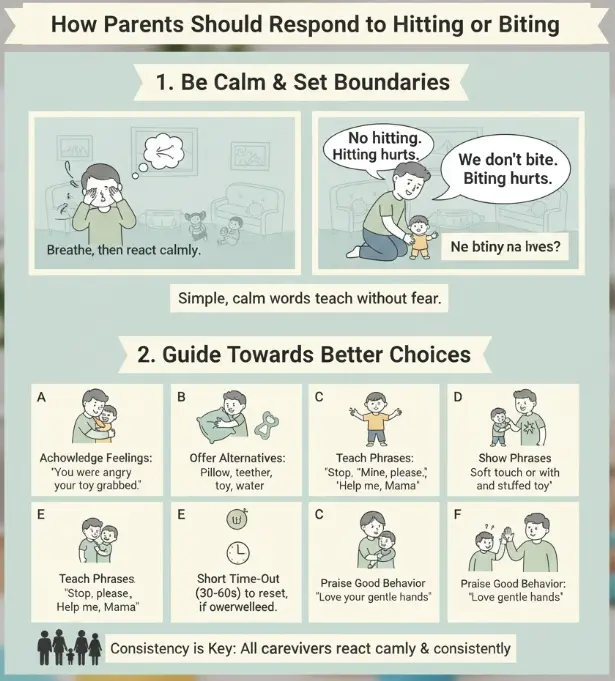
How Parents Should Respond to Hitting or Biting?
Once a toddler hits or bites, it might be stressful, surprising or even embarrassing, however, this is an opportunity to help them, through kind guidance, towards improved behavior. Toddlers watch us closely. They pick up on how we speak, how we carry ourselves and how we are handling their giant heartaches. Calming and consistent answer does a lot more teaching than punishment could ever teach.
Be Cool and Establish a Limiting Wall
Breath then react so that you can react in a steady manner.
Use brief and simple sentences your toddler could comprehend, like:
“No hitting. Hitting hurts.”
“We don’t bite. Biting hurts.”
Soothing, straight-forward words make them learn without being frightened or embarrassed.
Show the way to Improved Decisions.
Be aware of the feelings of your toddler:
“and you said you were furious that your toy should be grabbed like that.”
“You were angry when Mama said no.”
Move them to a less active position or provide something that they can use to release their frustrations such as a pillow, teether, a calming toy, or a drink of water.
Ask them to memorize a few simple phrases that they can use in the future, e.g.
“Stop.”
“Mine, please.”
“Help me, Mama.”
Demonstrate to them what gentle hands are like either by touching them softly or a demonstration with a stuffed toy.
In case they are overly overwhelmed, have a very short time-out (30-60 seconds) to allow them to re-set.
Complete praise good behavior immediately:
“Good job using your words!”
“I love how gentle you were.”
Ensure that all the caregivers, Mama, Baba, Dadi, Nani or a nanny, all react similarly and in a calm and consistent manner.
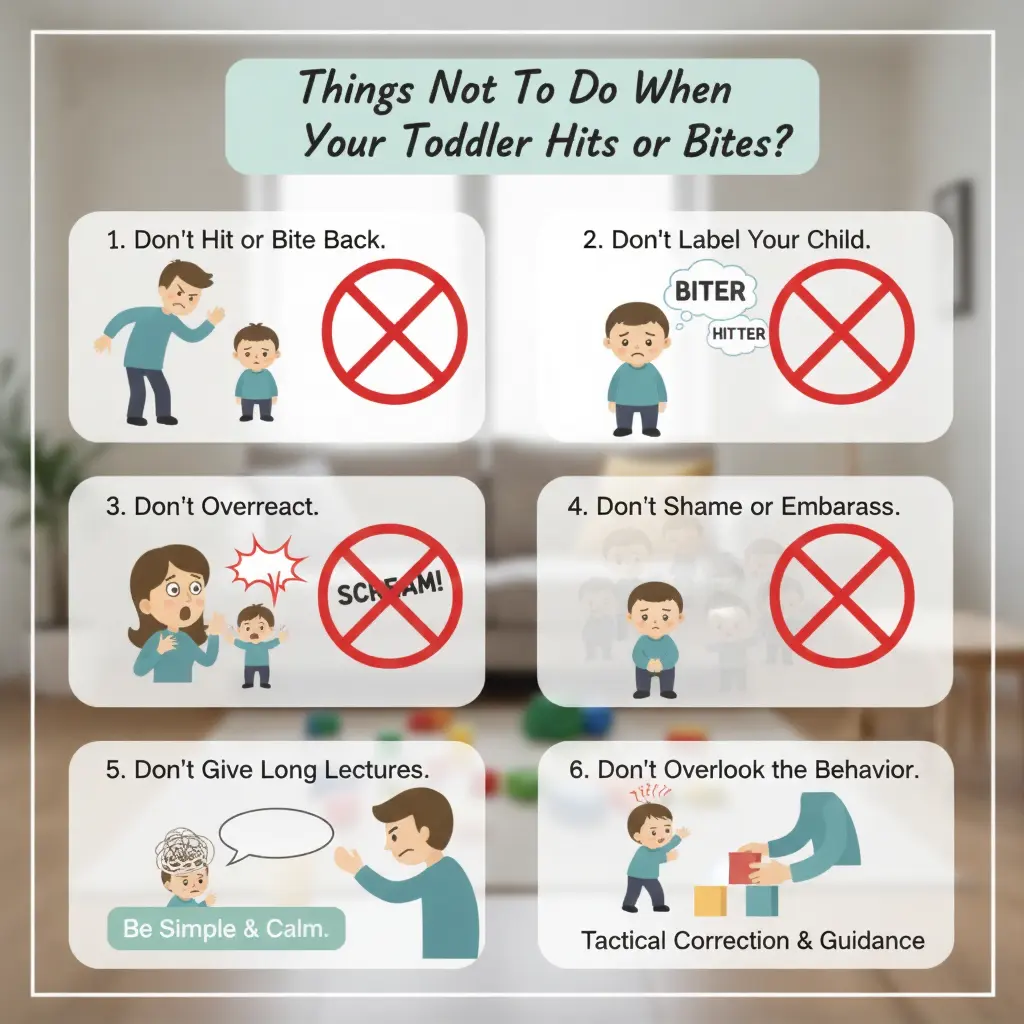
Things Not To Do When Your Toddler Hits or Bites?
Don’t hit or bite back.
This is sending the wrong kind of message and perplexes your toddler even in case you want to make them experience how it feels.
Don’t label your child.
Do not refer to them as a “biter” or “hitter.” Such labels are permanent and toddlers begin thinking that is what they are.
Don’t overreact.
They can make it more thrilling or noticeable by loud gasps, screaming or dramatic reactions.
Do not get ashamed or embarrassed of your toddler.
Punitive language or humiliation beside others can scare them or make them feel misunderstood and normally this will result in increased acting out.
Do not read monotonous sentences.
A child cannot comprehend large explanations when they are emotional. Be simple, calm in your words.
Do not overlook the behavior altogether.
It is very important to remain calm, however, your toddler still requires tactical correction and guidance.
When Toddler Hitting or Biting Is Normal?
In the majority of cases, hitting or biting is merely the way how toddlers develop and learn. Their feelings are large, their vocabulary is small and they are yet to figure out how to express themselves. It is generally stated to be normal when:
It occurs at times and also has a definite trigger.
To illustrate, it occurs whenever they are sleepy, hungry, angry with a toy, or they are overwhelmed.
Afterwards, your toddler appears to be worried or lost.
They can cry, attach to you or attempt to console the other child by lightly patting it. This indicates that they were not trying to harm anybody, they were simply responding.
The behavior gradually gets better with time.
Perhaps two weeks ago they bit someone, and they have not done it since, or they used to bite much but now they are beginning to talk. Minor changes are seen to improve.
They do not oppose kind instructions.
As you establish calm boundaries and your child slowly applies more acceptable means to communicate, that is quite a natural phenomenon in the development of the toddler.
Scholars are in agreement that nearly all toddlers strike or bite somewhere along the way. This is not to say that your child is a bad kid and neither does it imply that you are a bad parent. It is just an indication that your toddler is yet to master emotions regulation, expression of needs, and social regulations. This stage would tend to self-heal with time and perseverance.
When Toddler Hitting or Biting becomes a Real Issue?
Hitting and biting are normal effects of early development, though it sometimes happens that this behavior is stronger, more common, and takes longer than it should. When this occurs, you should listen more so as to know what your child may be grappling with. Ask someone to help you when you observe any of the following:
The tendency is highly common or abnormally violent.
When your child strikes or bites multiple times per day, or inflicts significant bodily damage upon others that leaves a mark, it can be considered more than normal toddler investigation or frustration.
It does not get any better in a couple of months.
Nothing appears to change even with relaxed leadership, consistency and instruction. The behavior remains unchanged or becomes worse which is an indication that one needs to dig deeper.
Your child is above 3/4 years of age and is still hitting or biting frequently.
By preschool age, most children have got over this stage. In case the behavior persists after that, it might indicate that your child requires additional help in the field of emotion and social guidelines.
It has language or developmental delays.
Children with problems talking, with sensory sensitivities, or with signs of autism or stress can use physical reactions more frequently, as they do not yet know other methods of making their discomfort or stress known to them. It does not imply that something is wrong, it only means that they might require a bit of assistance.
Tantrums are high levels of aggression or extreme.
When your child strikes himself or other people during tantrums, or is unable to calm down without assistance, it might be an indication of something more emotional or sensory.
Provided that the behavior is impacting the friendships as well as the learning or daily routine of your child, it will be a good move to talk to a pediatrician or a specialist in child matters. A little advice at the beginning can be so important and give you a sense of what your child requires. It also aids you in assisting them to be in healthier and more productive ways.
How to Minimize Hitting or Biting in Daily Life.
- Make routines consistent, have frequent meals, naps, and bedtime to ensure that your toddler remains calm.
- Be sensitive to some triggers such as hunger, fatigue, loud noise or overstimulation and provide rest or snacks when necessary.
- Simple emotion words include sad, angry, upset, or help, which should be taught to develop their skills in the expression of feelings.
- Provide safe methods of releasing frustration such as a teether, playdough, a pillow to hit or water play.
- You can soften them, before you take them out, by reminding them, such as, No biting. If you feel upset, come to Mama.”
- Example behavior, toddlers use the examples of how you handle stressful situations.
A kind of suggestion to all parents.
Hitting or biting by the toddler may be pressure on your part, and that does not imply that your child is bad. They just need to learn how to fit big feelings in small words. In crowded Pakistani families, a small one can easily get outnumbered.
With calm guidance and patience, this phase will pass. Celebrate small improvements and be kind to yourself. At Momistan, we believe good parents don’t have to be perfect — they just need to be present. You are doing better than you think.
FAQs About Toddler Biting & Hitting
Disclaimer: This article is for informational and educational purposes only and is not intended as medical, psychological, or nutritional advice, diagnosis, or treatment. Every child, body, and pregnancy is different — please consult your pediatrician, doctor, or a qualified healthcare provider for advice specific to your situation.